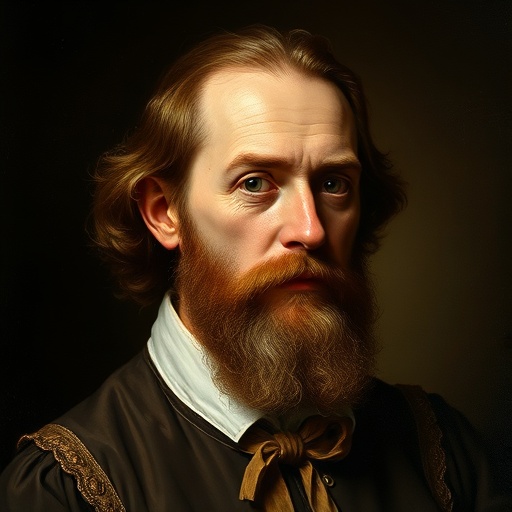
William Harvey — "The pulse is nothing more than the impulsion of the blood into the arteries."
The pulse is nothing more than the impulsion of the blood into the arteries.
The pulse is nothing more than the impulsion of the blood into the arteries.
Click any product to generate a realistic preview. Up to 3 at a time.
* Initial load can take up to 90 seconds — revising the preview in another color is nearly instant.
"The heart is the sun of the microcosm."
"What remains to be said is of so novel and unheard of a character that I not only fear injury to myself from the envy of a few, but I tremble lest I have mankind at large for my enemies, so much to wo…"
"I have seen the testicles of a hanged man twitch for a full hour after death, as if they still longed for life."
"The heart itself is the first to live and the last to die."
"The motion of the blood is constant and circular."
English physician whose On the Motion of the Heart and Blood in Animals (1628) demonstrated blood circulation, overturning 1,400 years of Galenic medicine. Closely associated with Francis Bacon (his contemporary in the new English empiricism). For an intellectual contrast, see Galenic medicine, the 2nd-century Greek medical tradition (humors, blood-as-consumed-fuel) — Harvey calculated that the heart pumps more blood per hour than the body could possibly produce as fuel — a single quantitative observation that demolished the entire Galenic-Aristotelian medical worldview. The cleanest example in medical history of arithmetic disproving 14 centuries of authority.
Found in 1 providers: grok
1 source checked
The pulse felt at the wrist or neck is simply the physical sensation of blood being pushed into the arteries by the heart's contraction. It is not a mystical vital sign but a mechanical event — pressure transmitted through vessels each time the heart beats, detectable as a rhythmic throb wherever arteries run close to the skin.
Harvey spent decades dissecting animals and observing beating hearts to prove blood circulates continuously rather than being consumed. This quote embodies his core method: stripping away Galenic mysticism and replacing it with mechanical cause-and-effect. His 1628 work De Motu Cordis reframed the pulse as hydraulic physics, not humoral spirit.
In early-modern Europe, medicine still largely followed Galen's 1,400-year-old framework, treating the pulse as a window into vital spirits and humoral balance. Harvey worked amid the Scientific Revolution, when figures like Galileo were quantifying natural phenomena. Reducing the pulse to simple hydraulics was radical, directly challenging Church-sanctioned ancient authority and inviting fierce professional backlash.
AI-generated insights based on extensive research and information for context. Factual errors? Email [email protected].
Your cart is empty