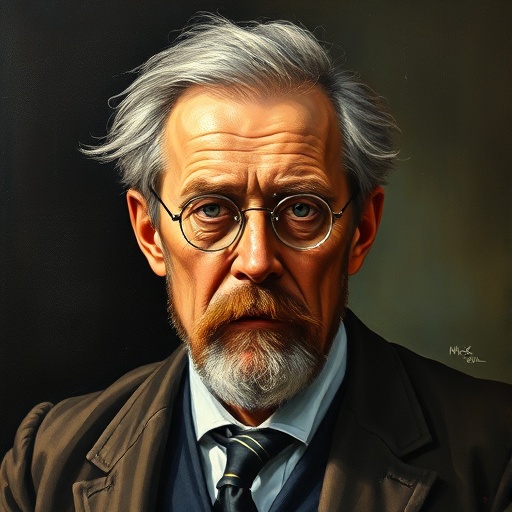
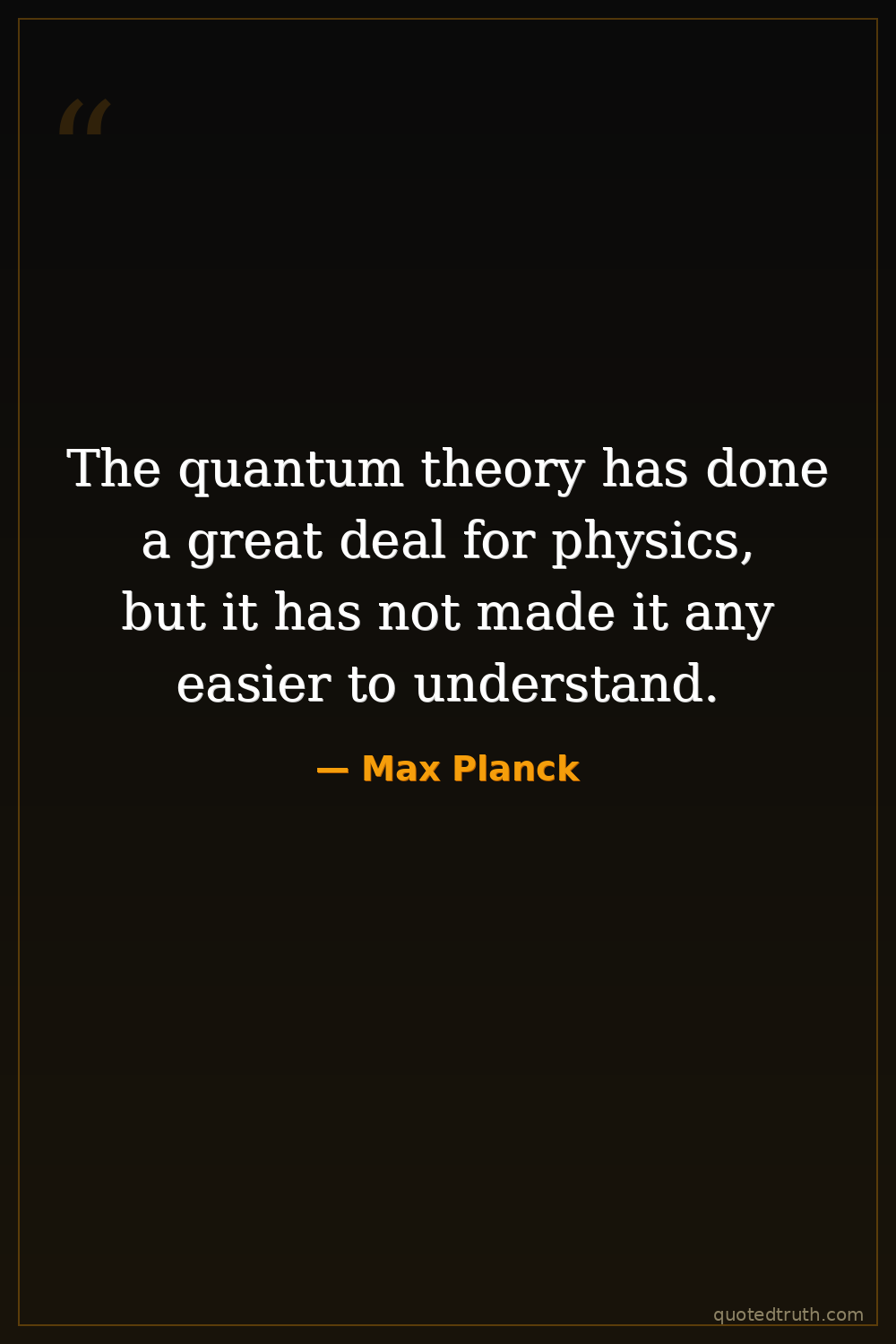
Max Planck — "The quantum theory has done a great deal for physics, but it has not made it any…"
The quantum theory has done a great deal for physics, but it has not made it any easier to understand.
The quantum theory has done a great deal for physics, but it has not made it any easier to understand.
Click any product to generate a realistic preview. Up to 3 at a time.
* Initial load can take up to 90 seconds — revising the preview in another color is nearly instant.
"We cannot rest content with an explanation of natural phenomena which does not connect them ultimately with the spiritual."
"A scientist must be a man of faith, not in the sense of a believer in dogma, but in the sense of a man who believes in the possibility of discovering new truths."
"The future of humanity depends on our ability to understand and harness the power of science."
"Anybody who has been seriously engaged in scientific work of any kind realizes that over the entrance to the gates of the temple of science are written the words: 'Ye shall have faith.' It is a qualit…"
"I learned more from my professors in one year than I have from all the books I've read."
Found in 1 providers: grok
1 source checked
Quantum theory gave physics powerful new tools and unlocked accurate predictions about atoms, light, and energy, but it did not make the underlying reality more intuitive. The math works, yet the picture it paints—particles that behave like waves, outcomes that are only probabilities, measurements that change what is measured—resists common sense. In short, the theory is enormously useful while remaining deeply strange, and mastering its equations is not the same as truly grasping what they mean.
Planck launched quantum theory in 1900 when he introduced energy quanta to solve blackbody radiation, winning the 1918 Nobel Prize. Yet he was a classically trained, deeply philosophical physicist who spent decades uneasy with where his own discovery led, especially after Bohr, Heisenberg, and Born pushed it toward probability and indeterminacy. This remark captures his honest ambivalence: proud of quantum theory's triumphs, but never convinced that its equations delivered the intuitive, causal picture of nature he had always sought.
Planck lived through physics' most turbulent revolution. Between 1900 and the 1930s, relativity and quantum mechanics overturned the Newtonian worldview, sparking the Bohr–Einstein debates and Heisenberg's 1927 uncertainty principle. Germany was simultaneously convulsed by world wars, Weimar collapse, and Nazi persecution of Jewish scientists—Planck personally lobbied Hitler to spare colleagues and lost his son to a 1944 execution. Against that backdrop, physicists were asking not only what nature is, but whether human intuition could ever fully comprehend it.
AI-generated insights based on extensive research and information for context. Factual errors? Email [email protected].
Your cart is empty