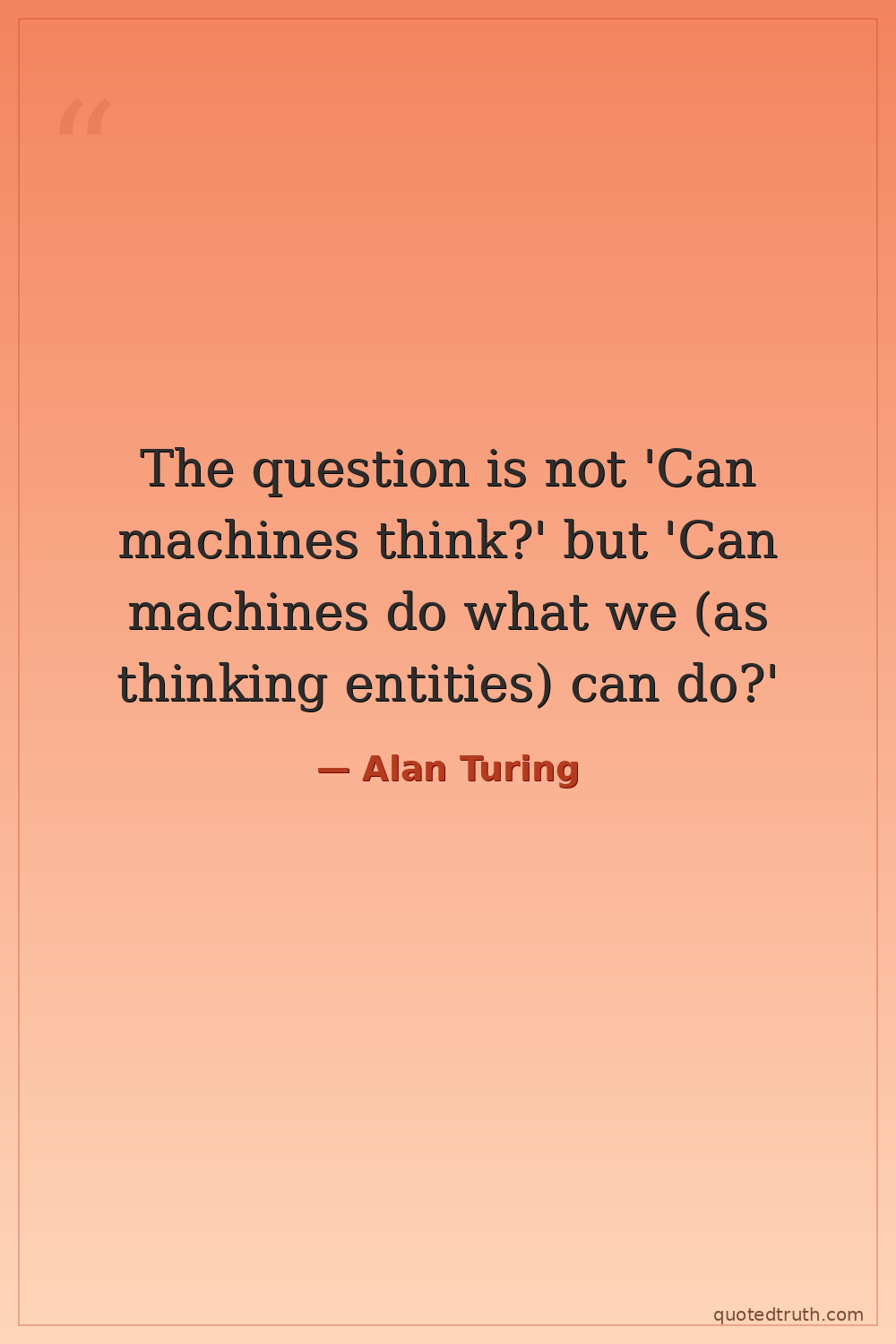
Alan Turing — "The question is not 'Can machines think?' but 'Can machines do what we (as think…"
The question is not 'Can machines think?' but 'Can machines do what we (as thinking entities) can do?'
The question is not 'Can machines think?' but 'Can machines do what we (as thinking entities) can do?'
Click any product to generate a realistic preview. Up to 3 at a time.
* Initial load can take up to 90 seconds — revising the preview in another color is nearly instant.
"The development of artificial intelligence will have a profound impact on society."
"The human mind is a very powerful computer."
"The human mind is a probabilistic machine."
"The human brain is a machine, and it can be simulated by another machine."
"I believe that at the end of the century the use of words and general educated opinion will have altered so much that one will be able to speak of machines thinking without expecting to be contradicte…"
Interpretation of his work, not a direct quote but often attributed as his underlying sentiment.
Date: N/A
GeneralFound in 1 providers: grok
1 source checked
The quote shifts debate from abstract philosophy to practical behavior. Instead of wrestling with whether machines possess genuine thought — a question tangled in consciousness and semantics — Turing argues we should ask whether machines can perform every task a thinking human can. If behavior is indistinguishable, the internal mechanism becomes irrelevant. It's a pragmatist's redirection: define intelligence by outputs and capabilities, not by unknowable internal experience.
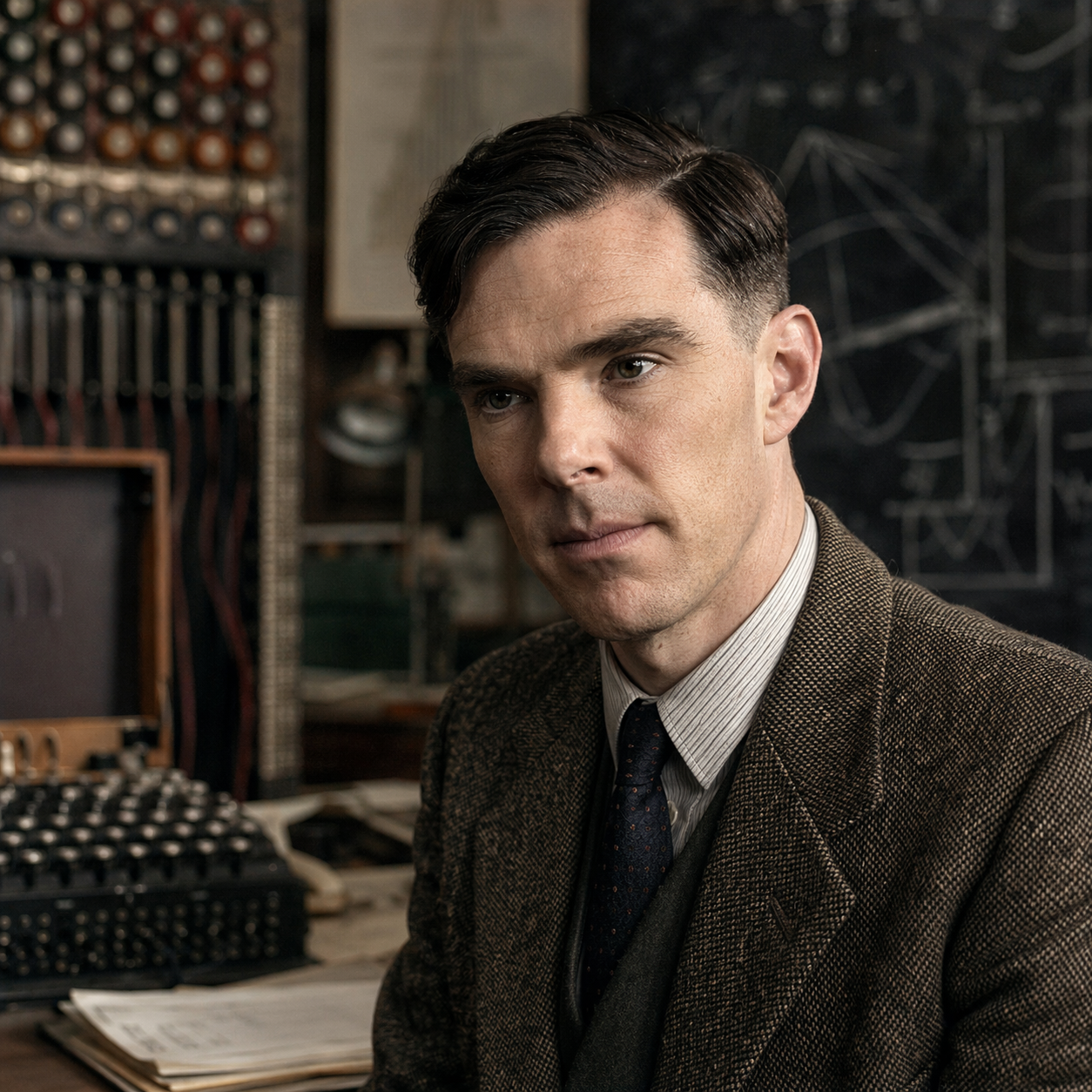
Turing published this idea in his landmark 1950 paper 'Computing Machinery and Intelligence,' proposing the Imitation Game — now called the Turing Test. Having cracked Nazi Enigma ciphers at Bletchley Park using mechanical reasoning, he knew machines could execute complex logical tasks. As a gay man prosecuted by his own government for who he was internally, he understood firsthand how unjust it is to judge inner life from the outside. Functional equivalence was personal conviction.
In 1950, the first electronic computers were barely five years old. World War II had demonstrated machines could perform feats of computation humans couldn't — breaking codes at superhuman speed. The Cold War was accelerating investment in computing. Yet philosophers and theologians fiercely resisted the idea that machines could rival human minds. Turing's reframing arrived precisely when society needed it: a clear, testable standard replacing an unanswerable metaphysical argument about consciousness.
AI-generated insights based on extensive research and information for context. Factual errors? Email [email protected].
Your cart is empty