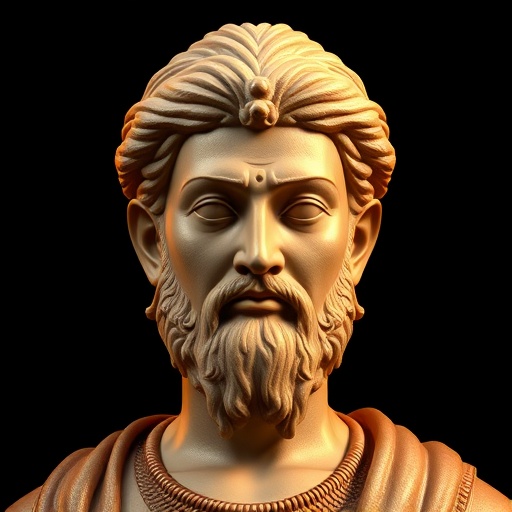
Mahavira — "The real self is beyond all forms of karma."
The real self is beyond all forms of karma.
The real self is beyond all forms of karma.
Click any product to generate a realistic preview. Up to 3 at a time.
* Initial load can take up to 90 seconds — revising the preview in another color is nearly instant.
"He who neglects the present moment, loses both future and past."
"The soul is permanent and eternal, while the body is temporary and perishable."
"Do not indulge in unnecessary talk."
"The soul is entangled in the web of karma."
"A man who is averse from harming even the wind knows the sorrow of all things living."
24th and last Tirthankara of Jainism, whose teachings of strict ahimsa (non-violence), aparigraha (non-attachment), and karma reshaped ancient Indian religion. Closely associated with The Buddha (near-contemporary moral revolutionary, also reacting against Vedic ritualism). For an intellectual contrast, see Vedic Brahmanical ritual sacrifice, the animal-sacrifice-centered Vedic religion of his era — Mahavira's ahimsa demanded total non-violence, including not eating root vegetables that kill the plant — a maximum-distance ethical move from the Vedic priestly tradition that ritually sacrificed cattle and horses. The two cleanest poles of ancient Indian religious ethics.
Found in 1 providers: grok
1 source checked
The soul — your deepest, truest self — exists in a state of pure, unconditioned awareness independent of karma. Karma is not who you are but what temporarily binds you. Your authentic nature cannot be defined or limited by past actions or their consequences. Strip away karma through right conduct, knowledge, and non-attachment, and what remains is the self in its original, liberated state.
Mahavira renounced his royal household at 30 and spent 12 years in extreme asceticism to shed karmic bonds, achieving omniscience called Kevala Jnana. His core teaching positioned the jīva, the soul, as inherently pure but trapped by karma accruing through passion and violence. His life physically enacted this belief: total non-attachment, nakedness, silence, fasting, and non-violence — all designed to stop karmic accumulation and reveal the unbounded self beneath.
Mahavira lived in 6th-century BCE northeast India during the Axial Age, when Brahmanical orthodoxy tied spiritual fate to ritual sacrifice and caste birth. Karma in Vedic thought meant ritual action with cosmic consequences. Mahavira, contemporaneous with the Buddha, radicalized the concept: karma became subtle matter clinging to the soul through desire and violence. Declaring the real self beyond karma challenged priestly authority and caste hierarchy, implying any person could achieve liberation through inner discipline.
AI-generated insights based on extensive research and information for context. Factual errors? Email [email protected].
Your cart is empty