Laozi — "The sage governs by emptying senses and filling bellies."
The sage governs by emptying senses and filling bellies.
The sage governs by emptying senses and filling bellies.
Click any product to generate a realistic preview. Up to 3 at a time.
* Initial load can take up to 90 seconds — revising the preview in another color is nearly instant.
"Governing a large country is like frying a small fish."
"When there is no desire, all things are at peace."
"Keep your mouth shut, guard your senses, and you will be free from trouble. Open your mouth, always be busy, and you will be beyond hope."
"The sage puts his person last, and it comes first. He treats his person as an outsider, and it is preserved."
"The superior man, when he hears of the Tao, endeavors to observe it."
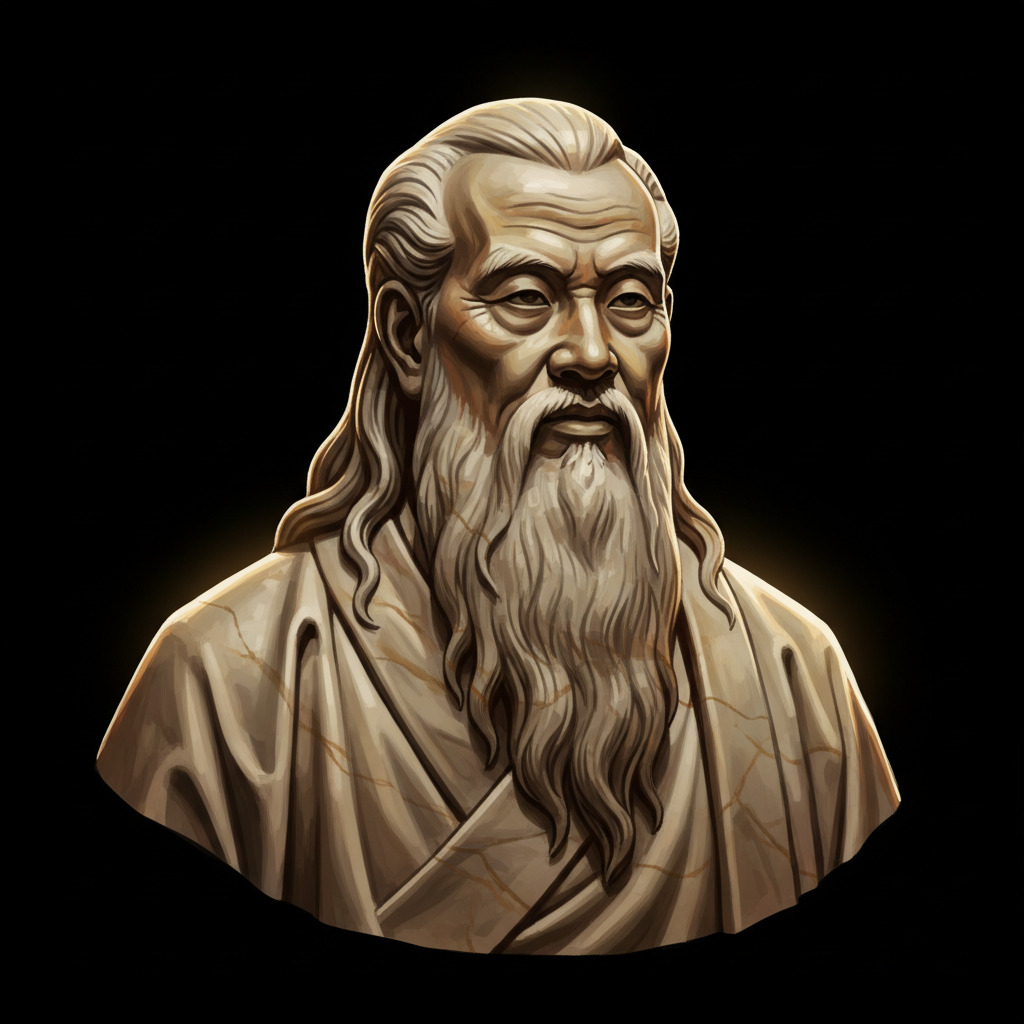
Reputed founder of Taoism and author of the Tao Te Ching, whose wu wei (effortless action) shaped East Asian philosophy. Closely associated with Zhuangzi (later Taoist who extended Laozi's framework). For an intellectual contrast, see Confucius, near-contemporary Chinese sage of social ritual and duty — Confucius systematized social order through ritual and hierarchy; Laozi argued that all such systems were the disease, not the cure — the two founding poles of Chinese moral philosophy.
Found in 1 providers: gemini
1 source checked
A wise ruler focuses on meeting people's basic physical needs rather than stimulating their desires, ambitions, or endless wants. By quieting cravings and ensuring everyone is fed, society stays peaceful and content. Overstimulation through luxury, status competition, or intellectual agitation creates restless populations that are hard to govern. True leadership means calming the noise of desire and securing the simple fundamentals that let ordinary life proceed without strain.
Laozi, the legendary founder of Taoism and author of the Tao Te Ching, championed wu wei (non-action) and simplicity over striving. Tradition holds he served as a keeper of royal archives in the Zhou court before withdrawing from public life, disillusioned with political ambition. This saying reflects his conviction that rulers who cultivate quiet contentment, rather than stoke cleverness and appetite, align with the Tao and produce naturally harmonious societies.
Laozi lived during the late Zhou dynasty, a period of collapsing central authority leading toward the Warring States era. Feudal lords competed ruthlessly, populations suffered from war, taxation, and famine, and rival philosophical schools debated how to restore order. Against Confucian emphasis on ritual and learning, Laozi's advice to fill bellies and quiet senses spoke to exhausted peasants and offered rulers an alternative: minimal interference, basic provision, and restraint over ambition-driven statecraft.
AI-generated insights based on extensive research and information for context. Factual errors? Email [email protected].
Your cart is empty