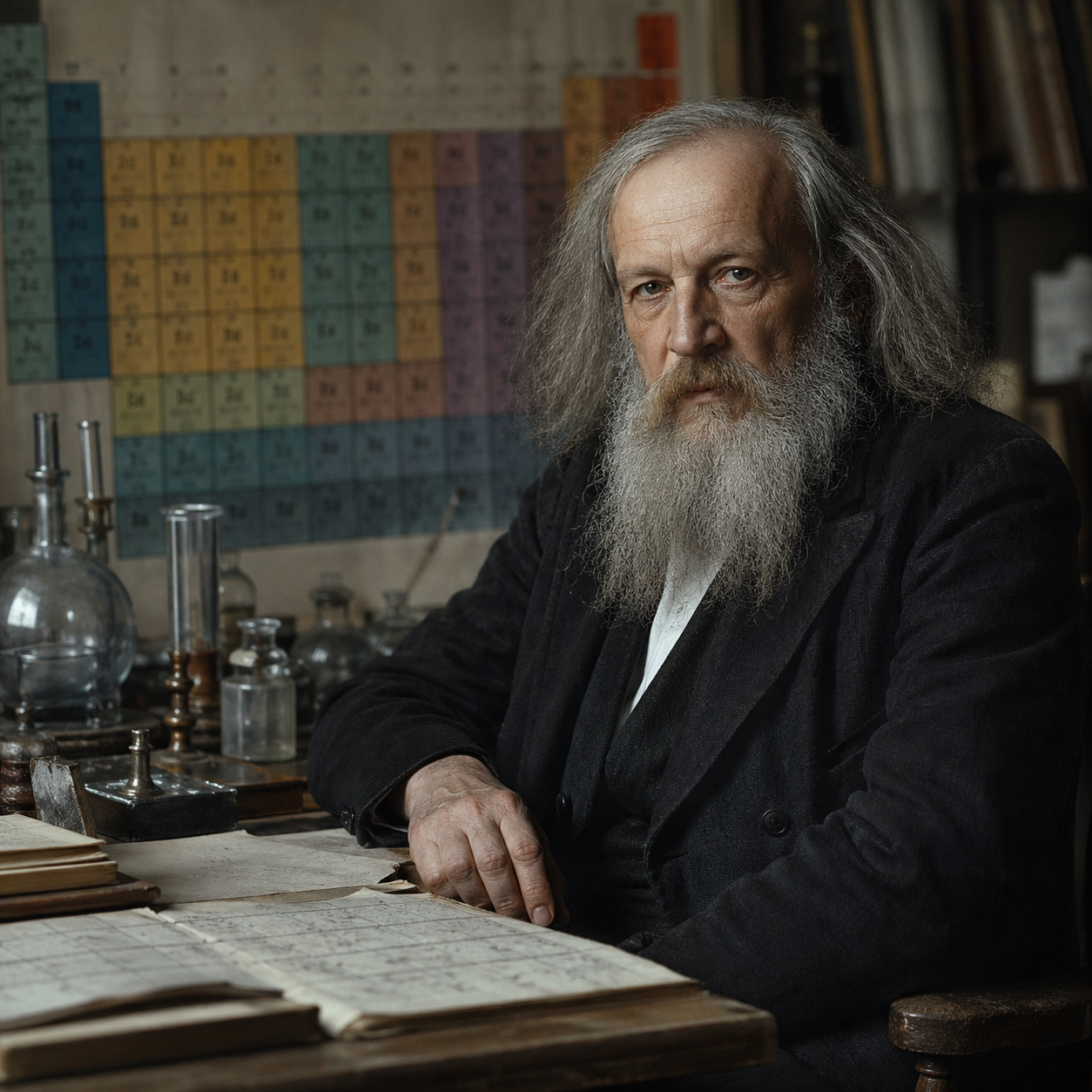
Dmitri Mendeleev — "The spirit of scientific inquiry must be cultivated in all children."
The spirit of scientific inquiry must be cultivated in all children.
The spirit of scientific inquiry must be cultivated in all children.
Click any product to generate a realistic preview. Up to 3 at a time.
* Initial load can take up to 90 seconds — revising the preview in another color is nearly instant.
"There is nothing in this world that I fear to say."
"It is easier to make a scientific discovery than to explain it to the common man."
"The time has evidently come for the development of the internal structure of atoms."
"My main interest is to help my country, Russia, develop its industrial capacity."
"To conceive, understand, and grasp the whole symmetry of the scientific edifice, including its unfinished portions, is equivalent to tasting that enjoyment only conveyed by the highest forms of beauty…"
Found in 1 providers: grok
1 source checked
Every child should be taught to ask questions, test ideas, and seek evidence rather than simply memorize facts. Curiosity and methodical investigation are not talents reserved for a gifted few; they are habits of mind that can and should be deliberately nurtured from an early age. Education succeeds when it produces people who wonder how things work and know how to find out.
Mendeleev built the periodic table by patiently organizing messy chemical data until hidden patterns emerged, then boldly predicting undiscovered elements. That achievement required exactly the disciplined curiosity he urges here. He also spent decades as a professor in St. Petersburg, writing textbooks and reforming Russian education, because he believed national progress depended on raising generations trained to reason scientifically, not merely to recite.
Nineteenth-century Russia lagged Western Europe industrially, and most schooling emphasized rote learning, religious instruction, and classical languages. Meanwhile chemistry, physics, and evolutionary biology were transforming Europe, and reformers like Mendeleev pushed the Tsarist state to expand universities, technical institutes, and public literacy. His call to cultivate inquiry in children reflected a broader struggle to modernize a largely peasant society and close the scientific gap with Germany, Britain, and France.
AI-generated insights based on extensive research and information for context. Factual errors? Email [email protected].
Your cart is empty