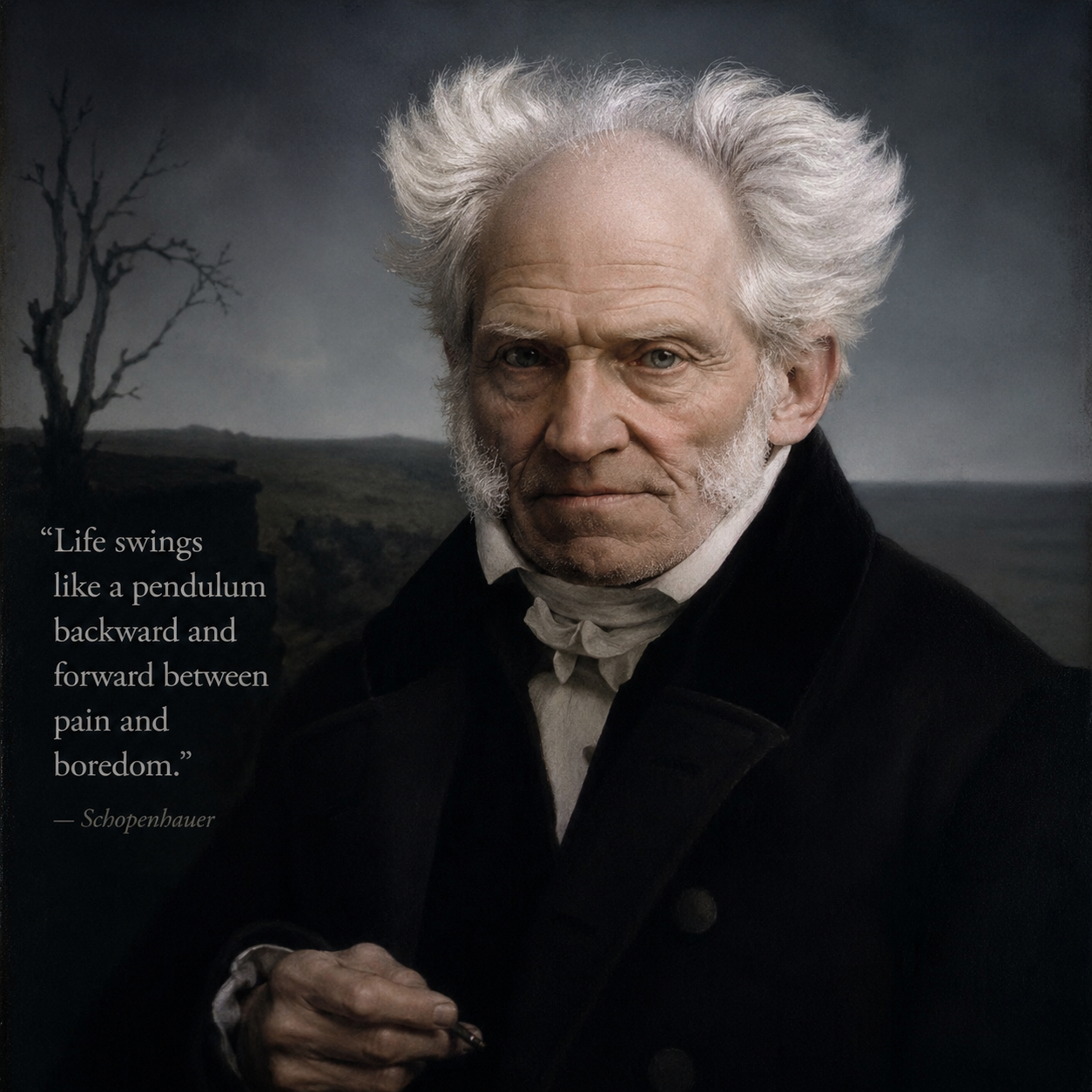
Arthur Schopenhauer — "The state is merely a large-scale institution for the prevention of crime, and a…"
The state is merely a large-scale institution for the prevention of crime, and as such is a necessary evil.
The state is merely a large-scale institution for the prevention of crime, and as such is a necessary evil.
Click any product to generate a realistic preview. Up to 3 at a time.
* Initial load can take up to 90 seconds — revising the preview in another color is nearly instant.
"The price of glory is the loss of leisure."
"Style is the physiognomy of the mind. It is a more infallible index to character than the face."
"The assumption that animals are without rights and the illusion that our treatment of them has no moral significance is a positively outrageous example of Western crudity and barbarity. Universal comp…"
"Marrying means, to grasp blindfolded into a sack hoping to find out an eel out of an assembly of snakes."
"We forfeit three-fourths of ourselves in order to be like other people."
German philosopher of pessimism whose The World as Will and Representation (1819) defined the suffering-and-renunciation tradition. Closely associated with Immanuel Kant (the system Schopenhauer built on and revised). For an intellectual contrast, see G.W.F. Hegel, German Idealist of the rational unfolding of Spirit — Schopenhauer scheduled his Berlin lectures opposite Hegel's and spent decades attacking Hegel's optimistic system as deliberately mystifying nonsense — the foundational rivalry of 19th-century German philosophy.
The standard scholarly entry points to Arthur Schopenhauer's work: Bryan Magee (Oxford, populariser-philosopher) — The Philosophy of Schopenhauer (1983); Christopher Janaway (Southampton, Schopenhauer specialist) — Self and World in Schopenhauer's Philosophy (1989); David E. Cartwright (Wisconsin–Whitewater) — Schopenhauer: A Biography (2010). These are the works graduate seminars cite when teaching Arthur Schopenhauer.
Your cart is empty