Carl Linnaeus — "The stone grows, the plant grows and lives, the animal grows, lives and feels."
The stone grows, the plant grows and lives, the animal grows, lives and feels.
The stone grows, the plant grows and lives, the animal grows, lives and feels.
Click any product to generate a realistic preview. Up to 3 at a time.
* Initial load can take up to 90 seconds — revising the preview in another color is nearly instant.
"The knowledge of plants is a science, but the knowledge of their names is a pleasure."
"My mind reels when, on this height, I look down on the long ages that have flowed by like waves in the sound and have left traces of the ancient world, traces so nearly obscured that they can only whi…"
"The earth is a paradise, but men make it a hell."
"The study of nature is the study of God."
"There are as many species as the infinite being created diverse forms in the beginning, which, following the laws of generation, produced many others, but always similar to them: therefore there are a…"
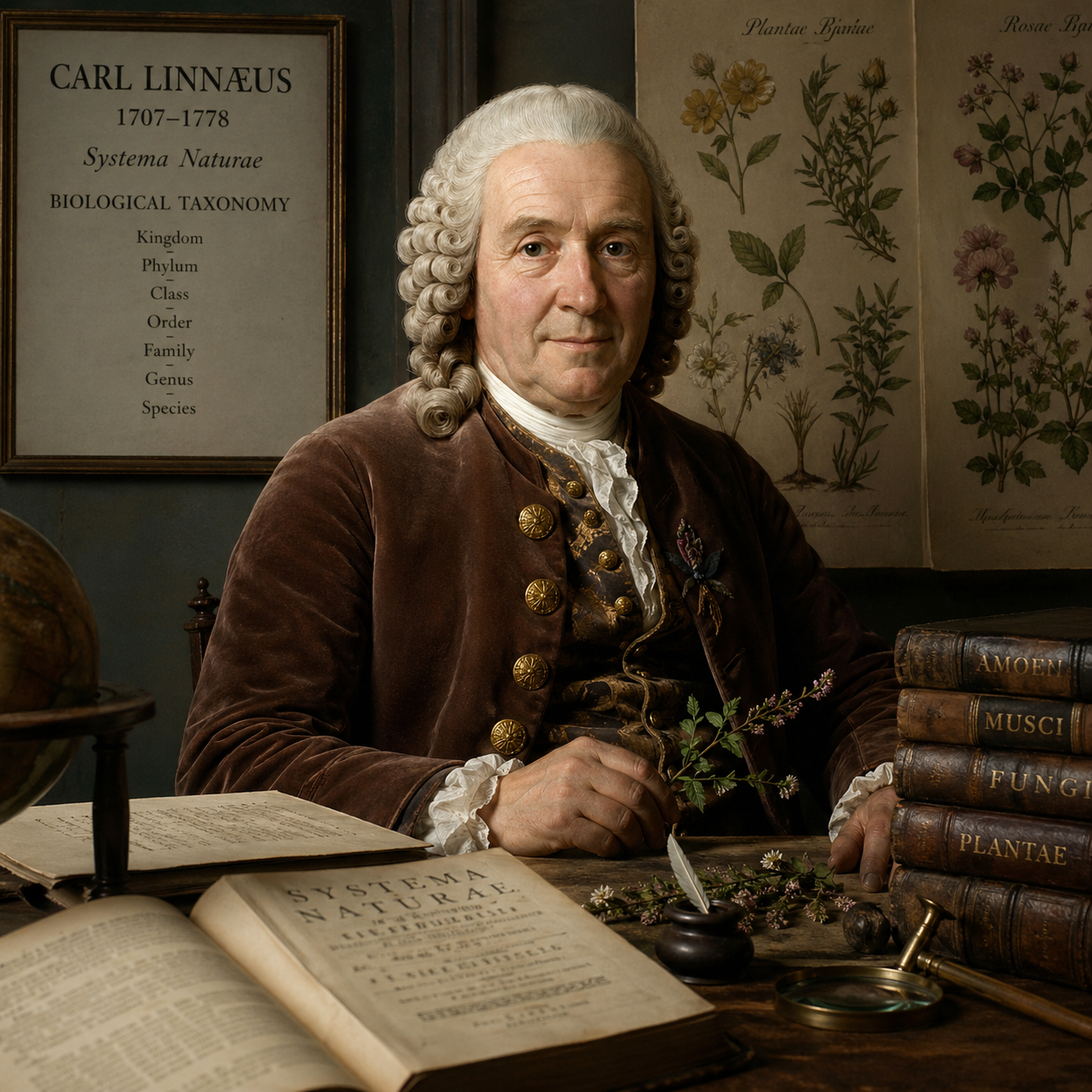
Swedish botanist and the father of modern taxonomy whose Systema Naturae (1735) introduced binomial nomenclature for naming all species. Closely associated with Joseph Banks (British naturalist who carried Linnaean classification on Cook's voyages). For an intellectual contrast, see Comte de Buffon, French naturalist and Histoire Naturelle author (1749-1788) — Buffon explicitly attacked Linnaean fixed-categories taxonomy as artificial and rejected the binomial system; his gradualist, environment-shaped natural history was the explicit alternative. Anticipates the fixed-species-vs-evolution debate Darwin would later resolve.
A succinct and hierarchical definition of the three kingdoms of nature, reflecting his observational approach.
Date: c. 1735
Nature & WorldFound in 1 providers: gemini
1 source checked
This saying lays out a simple hierarchy of the natural world. Stones merely get bigger through accumulation. Plants do that too, but they are also alive, drawing nourishment and reproducing. Animals do everything plants do and add sensation, awareness of their surroundings. It is a tidy ladder that sorts every object in nature by what it can do, moving from inert matter up through vegetative life to sentient creatures.
Linnaeus built his career on sorting living things into neat, nested groups, and this line is that instinct in miniature. Before Systema Naturae organized species by genus and family, he first divided everything into three kingdoms: mineral, vegetable, and animal. The quote is essentially his opening move as a classifier, defining each kingdom by the capacity that sets it apart. It reflects a mind that trusted order, observable traits, and clear boundaries between categories.
In the early 1700s, European naturalists were flooded with specimens from colonial voyages and desperately needed a system to catalog them. Aristotle's old scala naturae still shaped thinking, but no standard naming convention existed. Linnaeus worked in this gap, and his binomial system became the backbone of biology. The era also balanced Enlightenment rationalism with lingering belief in a divinely ordered creation, so ranking stones, plants, and animals felt both scientifically useful and theologically comfortable.
AI-generated insights based on extensive research and information for context. Factual errors? Email [email protected].
Your cart is empty