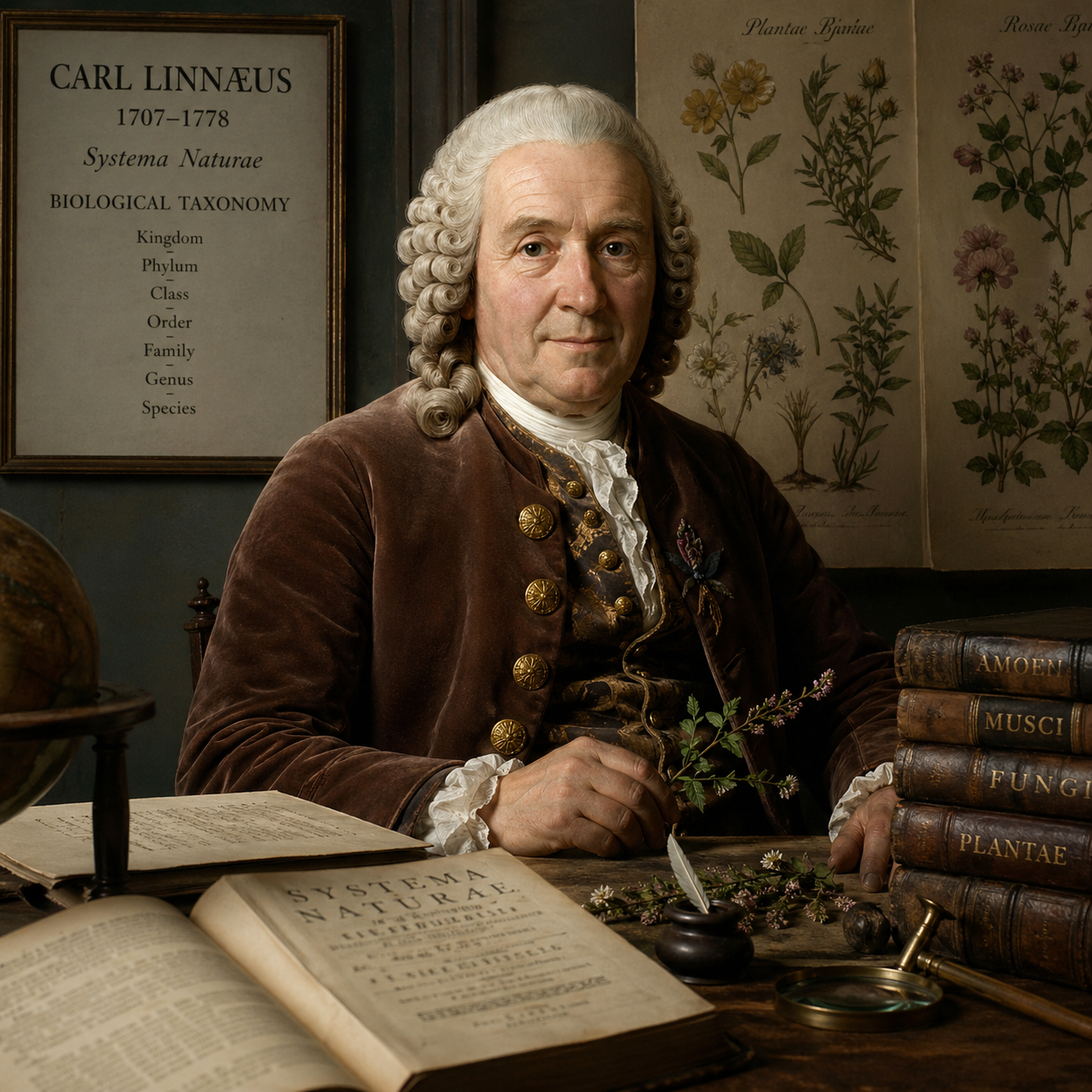
Carl Linnaeus — "The study of nature will reveal the divine order of creation."
The study of nature will reveal the divine order of creation.
The study of nature will reveal the divine order of creation.
Click any product to generate a realistic preview. Up to 3 at a time.
* Initial load can take up to 90 seconds — revising the preview in another color is nearly instant.
"To live by medicine is to live horribly."
"The whole of natural history depends on the accurate knowledge of species."
"Nature has always been my school, and my teachers have been the trees, the flowers, and the stones."
"When all the thoughts are concerning one thing and the person loses interest in other things, the melancholy begins."
"In natural science the principles of truth ought to be confirmed by observation."
Swedish botanist and the father of modern taxonomy whose Systema Naturae (1735) introduced binomial nomenclature for naming all species. Closely associated with Joseph Banks (British naturalist who carried Linnaean classification on Cook's voyages). For an intellectual contrast, see Comte de Buffon, French naturalist and Histoire Naturelle author (1749-1788) — Buffon explicitly attacked Linnaean fixed-categories taxonomy as artificial and rejected the binomial system; his gradualist, environment-shaped natural history was the explicit alternative. Anticipates the fixed-species-vs-evolution debate Darwin would later resolve.
Found in 1 providers: deepseek
1 source checked
Examining the natural world closely reveals an underlying divine logic and structure to all living things. Nature is not chaotic but organized according to discernible principles. By cataloging and understanding organisms, patterns emerge that point toward purposeful design rather than randomness — knowledge of creation becomes a form of knowledge about the creator behind it.
Linnaeus spent his life naming and classifying every organism he encountered, producing Systema Naturae and Species Plantarum. His taxonomic hierarchy — kingdom, class, order, genus, species — was explicitly rooted in his Lutheran faith. He believed God had designed nature with rational order, and that his binomial nomenclature was literally uncovering the Creator's blueprint for life on Earth.
The 18th-century Enlightenment saw natural philosophy and theology intertwined, not opposed. Natural theology held that studying creation was a devotional act — evidence of God's handiwork. Linnaeus worked alongside contemporaries like Ray and Buffon in an era when biology, botany, and religious conviction coexisted comfortably, before Darwin's evolutionary framework would later challenge static, divinely-ordered views of species.
AI-generated insights based on extensive research and information for context. Factual errors? Email [email protected].
Your cart is empty