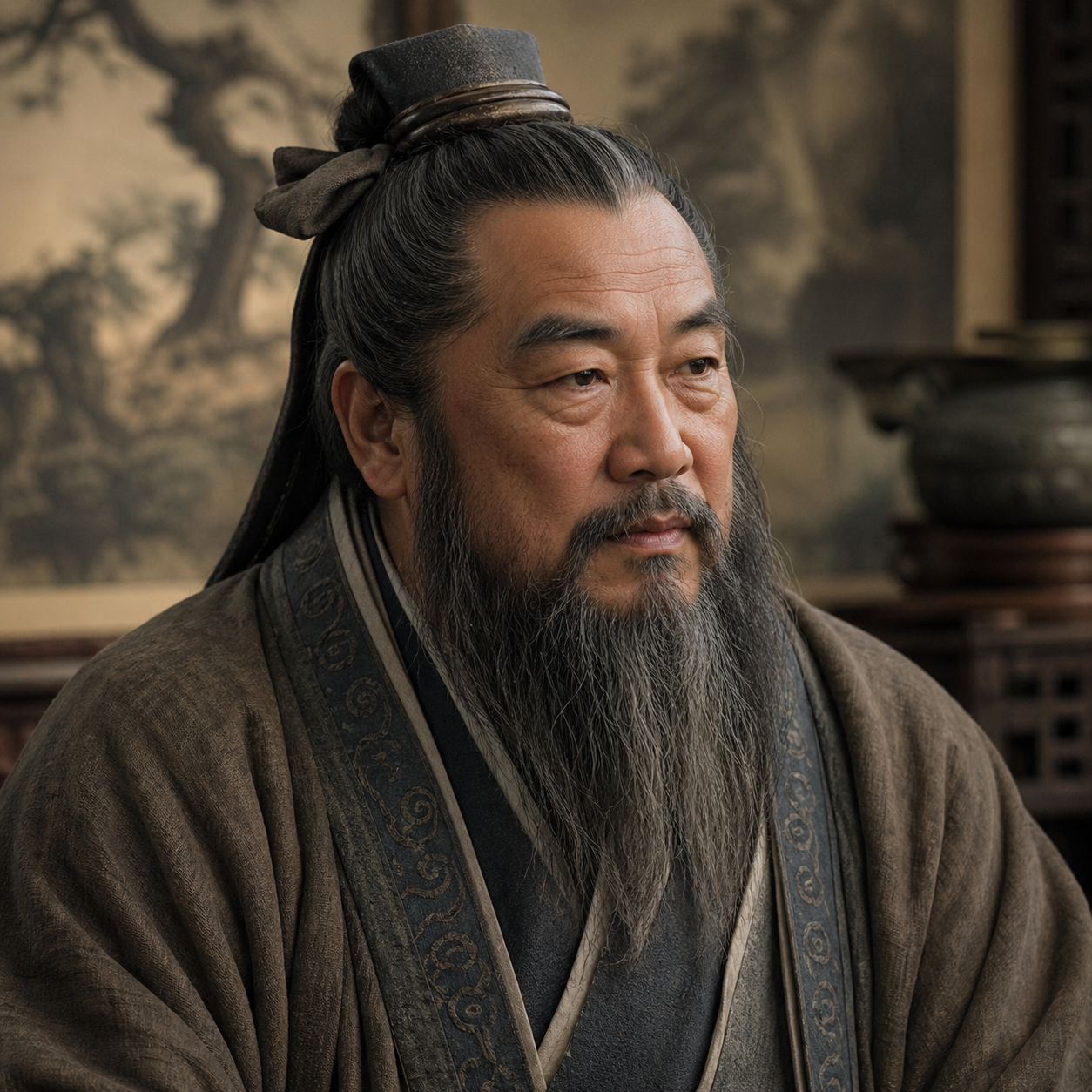
Confucius — "The superior man is catholic and not partisan. The mean man is partisan and not …"
The superior man is catholic and not partisan. The mean man is partisan and not catholic.
The superior man is catholic and not partisan. The mean man is partisan and not catholic.
Click any product to generate a realistic preview. Up to 3 at a time.
* Initial load can take up to 90 seconds — revising the preview in another color is nearly instant.
"Hold faithfulness and sincerity as first principles."
"A youth is to be regarded with respect. How do we know that his future will not be equal to our present?"
"The Master said, 'The superior man is not an implement.'"
"When the self is cultivated, the family will be in harmony. When the family is in harmony, the state will be well-governed. When the state is well-governed, the world will know peace."
"A journey of a thousand miles begins with a single step."
Chinese philosopher and teacher whose teachings (compiled by his students in the Analects) became the foundational ethical framework of East Asian civilization for 2,500 years. Closely associated with Mencius (his most-influential follower a century later). For an intellectual contrast, see Laozi, near-contemporary Chinese sage and Tao Te Ching author — Confucius systematized social order through ritual and family hierarchy; Laozi's Taoist effortless-action philosophy argued such systems were the disease, not the cure. The two founding poles of Chinese moral philosophy — every East Asian moral tradition since has positioned itself between them.
The standard scholarly entry points to Confucius's work: Philip J. Ivanhoe (Georgetown, Chinese philosophy) — Confucian Moral Self Cultivation (2000); Edward Slingerland (UBC, Asian Studies) — Effortless Action: Wu-wei as Conceptual Metaphor (2003); Tu Weiming (Harvard, Confucian scholar) — Confucian Thought: Selfhood as Creative Transformation (1985). These are the works graduate seminars cite when teaching Confucius.
Found in 1 providers: grok
1 source checked
A person of genuine character embraces everyone with fairness and open-mindedness, judging situations on their merits rather than loyalty to a faction. A small-minded person does the opposite: sticking rigidly with their clique, playing favorites, and dismissing outsiders. Real integrity means rising above tribal allegiances and treating people impartially, while pettiness shows itself in cliquish behavior that puts group loyalty ahead of truth or fairness.
Confucius spent his life teaching that junzi, the superior person, cultivates ren, universal benevolence, over narrow self-interest. As a traveling advisor rejected by many feudal courts, he watched officials hoard power through factions and nepotism. His school welcomed students regardless of class, famously accepting anyone who brought dried meat as tuition, embodying the inclusive ethic this saying demands of moral leadership.
Confucius lived during the Spring and Autumn period around 551-479 BCE, when the Zhou dynasty was fracturing and rival states engaged in shifting alliances, court intrigue, and bloody factional purges. Ministers routinely betrayed lords for clan gain, and advisors rose or fell by clique rather than competence. Against this partisan chaos, Confucius promoted impartial virtue and ritual propriety as the only foundation for restoring social order and legitimate governance.
AI-generated insights based on extensive research and information for context. Factual errors? Email [email protected].
Your cart is empty