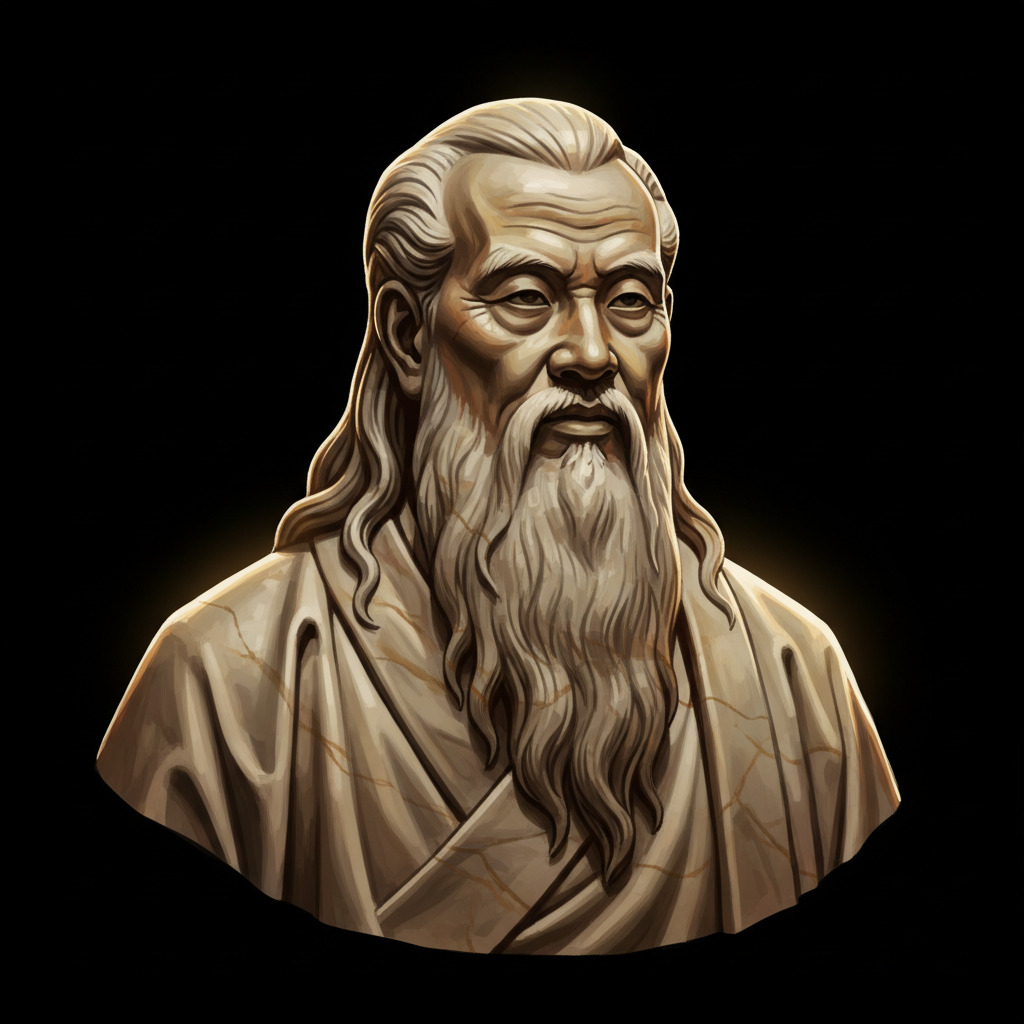
Laozi — "The superior man, when he hears of the Tao, endeavors to observe it."
The superior man, when he hears of the Tao, endeavors to observe it.
The superior man, when he hears of the Tao, endeavors to observe it.
Click any product to generate a realistic preview. Up to 3 at a time.
* Initial load can take up to 90 seconds — revising the preview in another color is nearly instant.
"The best rulers are those whose existence is barely known by the people."
"The sage does not act and therefore does not fail, does not seize and therefore does not lose."
"Do that which consists in taking no action; Pursue that which is not meddlesome; Savor that which has no flavor."
"Governing a large country is like frying a small fish."
"Therefore even the sage treats some things as difficult. That is why in the end no difficulties can get the better of him."
Reputed founder of Taoism and author of the Tao Te Ching, whose wu wei (effortless action) shaped East Asian philosophy. Closely associated with Zhuangzi (later Taoist who extended Laozi's framework). For an intellectual contrast, see Confucius, near-contemporary Chinese sage of social ritual and duty — Confucius systematized social order through ritual and hierarchy; Laozi argued that all such systems were the disease, not the cure — the two founding poles of Chinese moral philosophy.
Found in 1 providers: grok
1 source checked
A person of genuine character, upon learning about the Tao (the natural way of the universe), actively tries to live by it rather than just discussing it. Understanding a truth means nothing without the discipline to embody it daily. Wisdom is measured by practice, not by how much someone talks about ideas. Hearing inspires the serious student to begin walking the path immediately.
Laozi, traditionally a court archivist in the Zhou dynasty, reportedly grew disillusioned with performative scholarship and empty ritual. His legendary departure westward, during which he is said to have composed the Tao Te Ching, embodies this line: he did not merely theorize about the Tao, he left society to live it. The quote reflects his conviction that true followers act quietly rather than debate endlessly.
Laozi lived during the late Zhou period (roughly 6th century BCE), an age of political fragmentation preceding the Warring States era. Competing philosophical schools, Confucians, Mohists, and early Legalists, argued loudly over statecraft and morality. Many intellectuals chased government posts, offering theories to rival lords. Against this noisy marketplace of ideas, Laozi's emphasis on quiet practice over public doctrine was a pointed rebuke to scholars who discussed virtue without actually cultivating it.
AI-generated insights based on extensive research and information for context. Factual errors? Email [email protected].
Your cart is empty