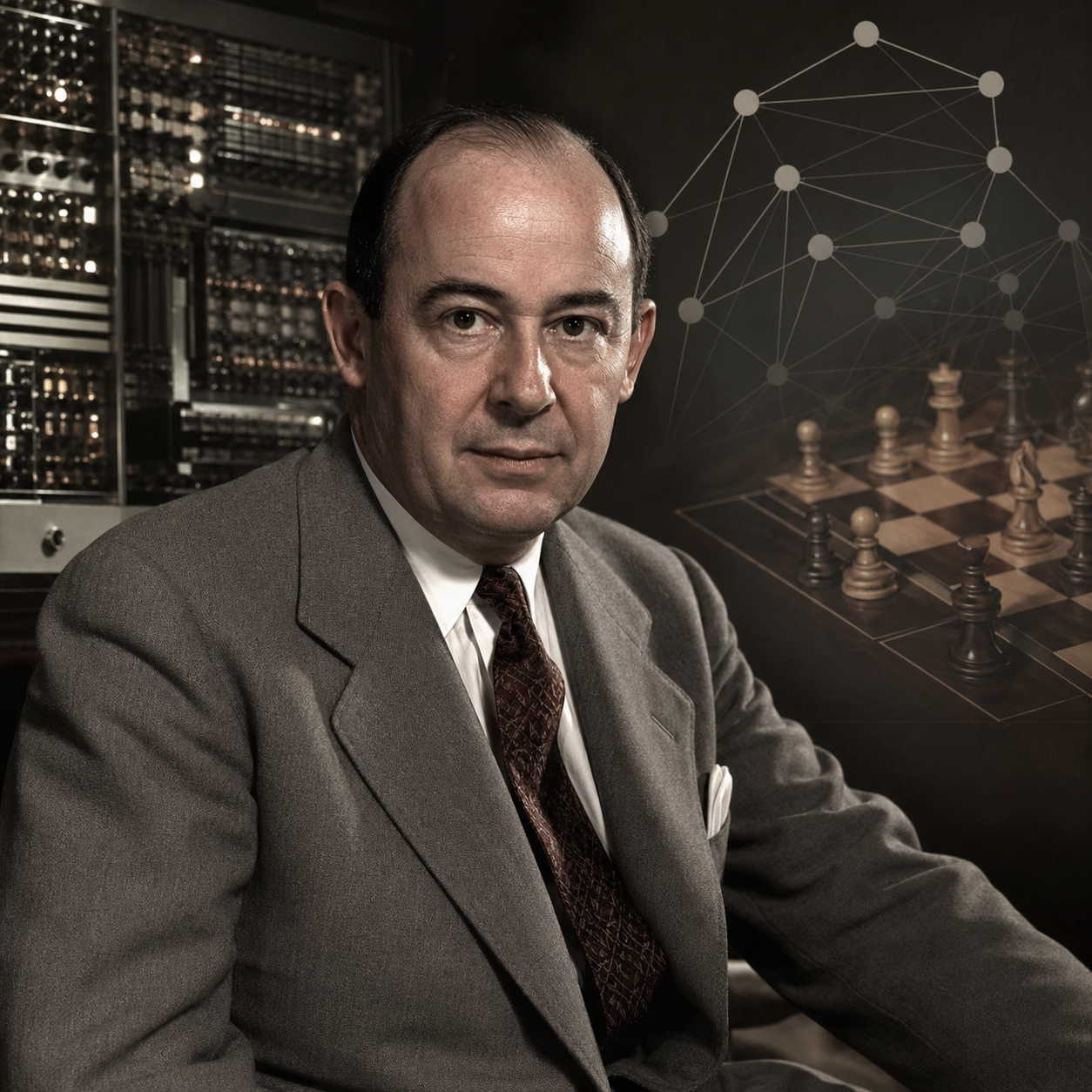
John von Neumann — "Truth is much too complicated to allow anything but approximations."
Truth is much too complicated to allow anything but approximations.
Truth is much too complicated to allow anything but approximations.
Click any product to generate a realistic preview. Up to 3 at a time.
* Initial load can take up to 90 seconds — revising the preview in another color is nearly instant.
"Mathematics is a game played according to certain simple rules with meaningless marks on paper."
"It is not a question of whether we will be able to build a computer that can think. It is a question of whether we will be able to build a computer that can think as fast as we do."
"It would appear that we have reached the limits of what it is possible to achieve with computer technology, although one should be careful with such statements, as they tend to sound pretty silly in 5…"
"The more precisely the position is determined, the less precisely the momentum is known in this instant, and vice versa."
"The world is governed by statistics, not by laws."
A philosophical outlook on the nature of truth, suggesting that complete understanding is often beyond reach.
Date: Mid-20th century
ShockingFound in 1 providers: gemini
1 source checked
Reality is too intricate for any formula, theory, or system to capture perfectly. The best we can do — in science, math, economics, or daily reasoning — is build models that are useful approximations of the truth. Exact answers are often impossible; the goal is getting close enough to act on. Accepting approximation isn't intellectual failure — it's honest recognition of the limits of any formal system or human mind.
Von Neumann spent his career building models of reality that were explicitly incomplete: game theory approximates human strategic behavior; his computer architecture encodes continuous phenomena in finite bits; his Manhattan Project calculations used numerical methods knowing they introduced error. He helped formalize quantum mechanics, where fundamental uncertainty is irreducible. A man who simultaneously built hydrogen bomb simulations and economic equilibrium models, he knew better than anyone that every map leaves out the territory.
Von Neumann lived 1903–1957, an era when classical certainty collapsed on multiple fronts. Heisenberg's uncertainty principle showed exact measurement was physically impossible. Gödel's incompleteness theorems proved no formal system could capture all mathematical truth. WWII's Manhattan Project required massive numerical approximations to simulate nuclear reactions. Then the Cold War birthed game theory — modeling geopolitical conflict through simplified rational-actor assumptions. The age forced even the sharpest minds to embrace productive imprecision as the only honest path forward.
AI-generated insights based on extensive research and information for context. Factual errors? Email [email protected].
Your cart is empty