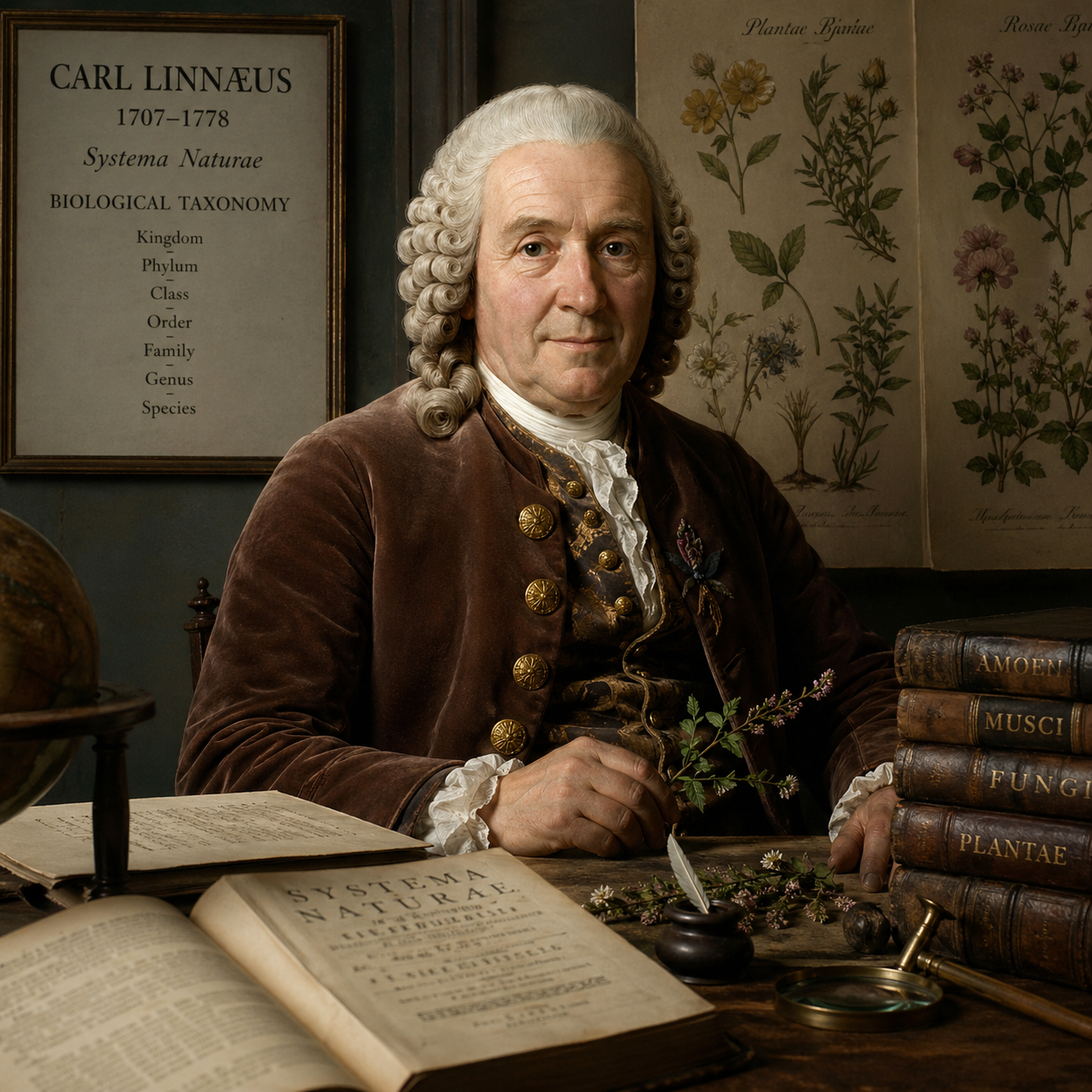
Carl Linnaeus — "The system of nature is a mirror of God's wisdom."
The system of nature is a mirror of God's wisdom.
The system of nature is a mirror of God's wisdom.
Click any product to generate a realistic preview. Up to 3 at a time.
* Initial load can take up to 90 seconds — revising the preview in another color is nearly instant.
"I have created order out of chaos."
"¿Qué tiene de extraño que yo no vea a Dios si no puedo ver siquiera al Yo que vive en mí?"
"Every genus is natural, created as such in the beginning, hence not to be rashly split up or stuck together by whim or according to anyone's theory."
"The stony rocks are not primeval, but daughters of Time."
"The classes are for the genera, the genera for the species, the species for the individuals."
Swedish botanist and the father of modern taxonomy whose Systema Naturae (1735) introduced binomial nomenclature for naming all species. Closely associated with Joseph Banks (British naturalist who carried Linnaean classification on Cook's voyages). For an intellectual contrast, see Comte de Buffon, French naturalist and Histoire Naturelle author (1749-1788) — Buffon explicitly attacked Linnaean fixed-categories taxonomy as artificial and rejected the binomial system; his gradualist, environment-shaped natural history was the explicit alternative. Anticipates the fixed-species-vs-evolution debate Darwin would later resolve.
Found in 1 providers: grok
1 source checked
Nature operates through an intricate, organized system — and that system, Linnaeus argues, is no accident. It reflects deliberate, divine intelligence. To understand nature's order is to understand something of God's mind. The quote fuses science and theology: careful observation of living things reveals not just facts but meaning. Every species, every structure, every pattern points back to a designing wisdom greater than human invention.
Linnaeus was a devout Lutheran who considered taxonomy a sacred duty — naming every species as Adam had in Genesis. His landmark work Systema Naturae (1735) explicitly framed classification as cataloguing God's creation. He called himself a second Adam. For Linnaeus, binomial nomenclature wasn't merely practical convenience; it was reading a divine blueprint. His religious conviction that nature possessed inherent, God-given order directly drove his lifelong mission to classify all living things.
In the 18th-century Enlightenment, natural theology dominated educated thought — studying nature to prove God's existence and wisdom was mainstream, not controversial. Darwin was a century away, so no tension existed between science and Scripture. European explorers were cataloguing newly discovered species from the Americas, Africa, and Asia, and the world urgently needed an organizing system. Taxonomy served both imperial ambition and theological conviction simultaneously, making Linnaeus's synthesis perfectly timed.
AI-generated insights based on extensive research and information for context. Factual errors? Email [email protected].
Your cart is empty