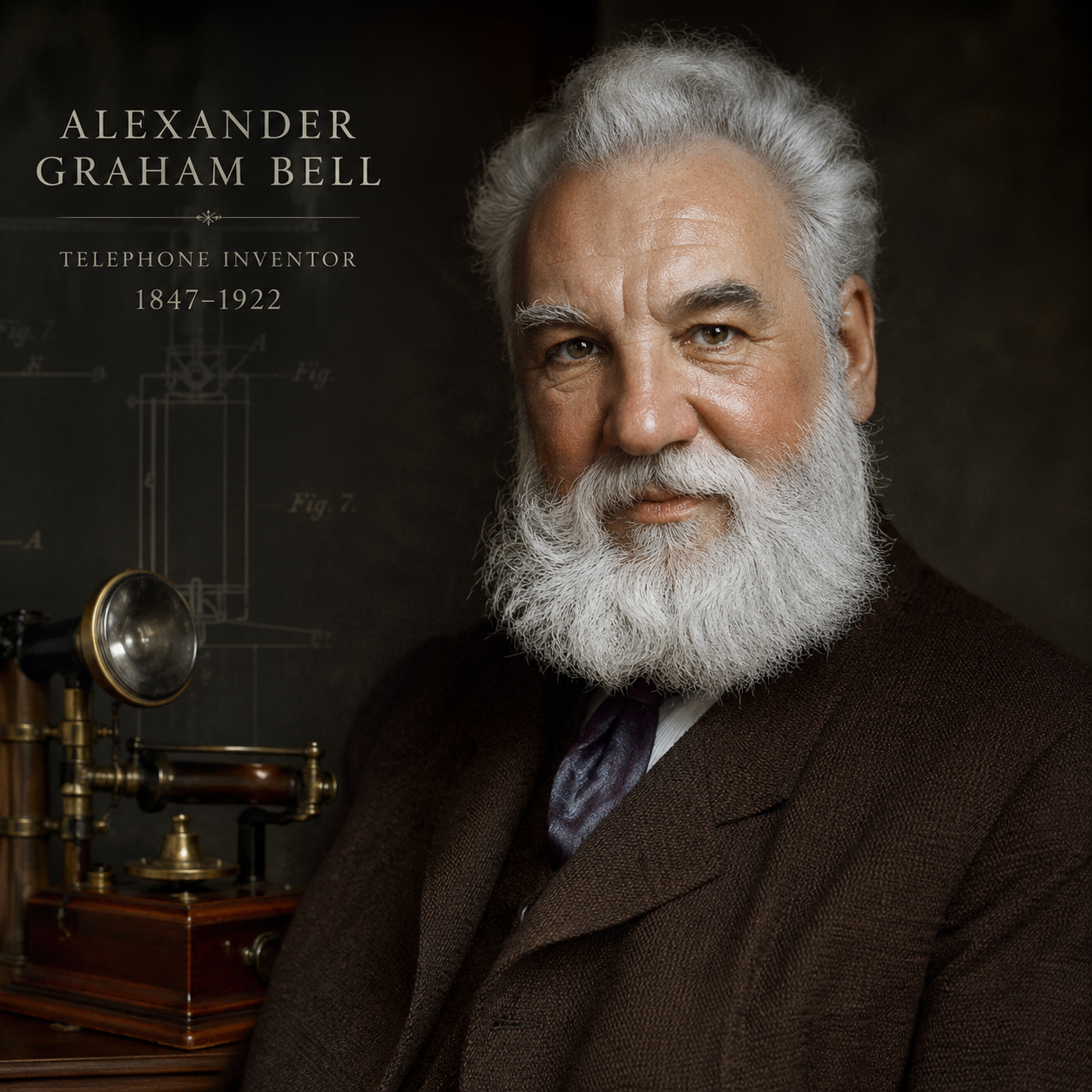
Alexander Graham Bell — "The telephone is an electrical toy."
The telephone is an electrical toy.
The telephone is an electrical toy.
Click any product to generate a realistic preview. Up to 3 at a time.
* Initial load can take up to 90 seconds — revising the preview in another color is nearly instant.
"The true inventor is not the one who first conceives an idea, but the one who brings it to fruition."
"What this power is I cannot say; all I know is that it exists and it becomes available only when a man is in that state of mind in which he knows exactly what he wants and is fully determined not to g…"
"The day will come when the man at the telephone will be able to see the distant person to whom he is speaking."
"Environment counts for a great deal. A man's particular idea may have no chance for growth or encouragement in his community. Real success is denied that man, until he finds a proper environment."
"If it is not necessary, it is obviously not advisable, that deaf children should acquire, and use, as their ordinary and habitual means of communication — their vernacular in fact — a language that is…"
Often attributed as an early dismissive remark, but likely apocryphal or taken out of context. He was very aware of its potential.
Date: c. 1876
GeneralFound in 1 providers: grok
1 source checked
The quote dismisses the telephone as a mere novelty or plaything rather than a serious communication tool. It captures the skepticism surrounding emerging technologies in the industrial age — that something genuinely transformative could be written off as entertainment rather than practical utility. The irony is profound: what critics called a toy became one of civilization's most transformative inventions, reshaping commerce, relationships, and daily life across the entire world.
Bell patented the telephone in 1876 after years of research into acoustic telegraphy. Western Union famously dismissed his invention as an electrical toy when he offered to sell the patent for $100,000 — a rejection they deeply regretted. Bell's career was built on proving skeptics wrong, advancing deaf education, and pursuing relentless experimentation. This phrase captures the very dismissal Bell had to overcome to commercialize and prove the telephone's extraordinary, civilization-altering value.
In the 1870s and 1880s, the Industrial Revolution was producing rapid technological upheaval. The telegraph was established infrastructure, but transmitting a human voice over wire seemed implausible to many investors and industrialists. Western Union's internal memo dismissing Bell's telephone patent exemplified institutional resistance to disruption. The era normalized pragmatic skepticism toward radical invention, yet simultaneously produced Edison, Bell, and Tesla — figures who proved that today's toy could become tomorrow's essential infrastructure.
AI-generated insights based on extensive research and information for context. Factual errors? Email [email protected].
Your cart is empty