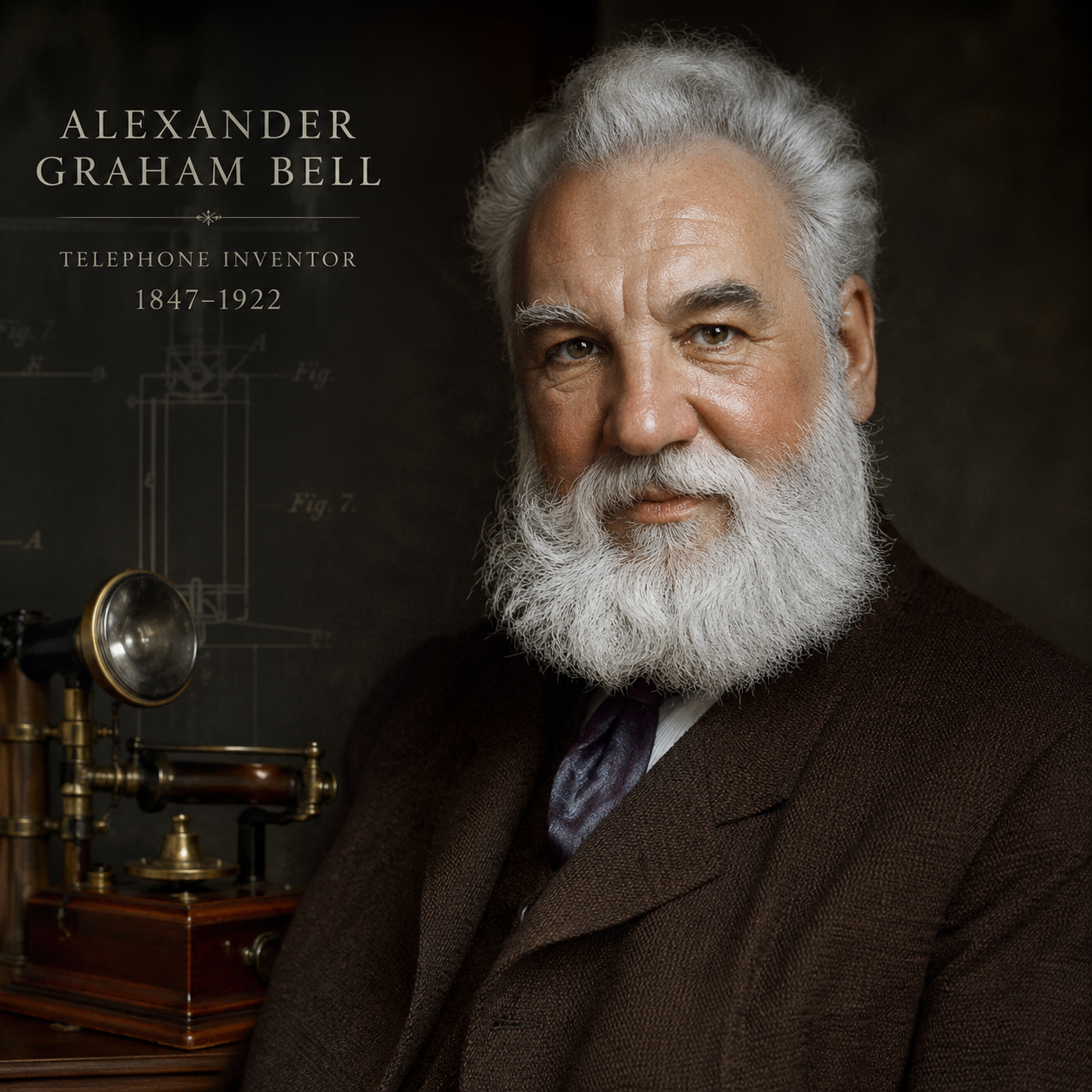
Alexander Graham Bell — "The telephone will be a great convenience to business men, but it will never be …"
The telephone will be a great convenience to business men, but it will never be used by the general public.
The telephone will be a great convenience to business men, but it will never be used by the general public.
Click any product to generate a realistic preview. Up to 3 at a time.
* Initial load can take up to 90 seconds — revising the preview in another color is nearly instant.
"The day will come when the man in the street will be able to send his voice to any part of the world, and hear the reply."
"It is a bad plan that admits of no modification."
"The deaf are not a race apart. They are a part of humanity."
"The inventor looks at the world and is not contented with things as they are. He wants to improve them, he wants to change things, he is inspired by the desire to invent."
"The only difference between a successful person and others is not a lack of strength, not a lack of knowledge, but rather a lack of will."
Often attributed to him, but likely apocryphal or a misattribution, or a sentiment expressed by others about his invention.
Date: c. 1876-1880
Food & DrinkFound in 1 providers: grok
1 source checked
This quote assumes telephone adoption would stay confined to commercial and professional users, never reaching ordinary households. It reflects the common failure to anticipate mass-market technology — assuming cost, complexity, and novelty will permanently keep innovations in the hands of businesses rather than becoming everyday tools for everyone. The telephone, of course, became one of history's most universal communication devices, with over a million U.S. subscribers by 1900.
Bell patented the telephone in 1876 after years of experiments in acoustic telegraphy. He initially targeted businesses and telegraph companies, offering Western Union the invention's rights — they declined. Bell's lifelong work with deaf students, including his wife Mabel, drove his belief in accessible communication. Yet even he may have underestimated how quickly telephone exchanges would reach ordinary homes, making the quote's skepticism historically ironic given his own invention's trajectory.
In the 1870s, the telegraph was the gold standard for long-distance communication, operated exclusively by trained professionals. Electricity was a rarity in homes, and consumer technology barely existed as a concept. New inventions were viewed as industrial tools for commerce and industry. The notion of a working-class household owning a personal communication device seemed financially and practically absurd — factories, banks, and newspapers were the obvious and natural early customers for any wired technology.
AI-generated insights based on extensive research and information for context. Factual errors? Email [email protected].
Your cart is empty