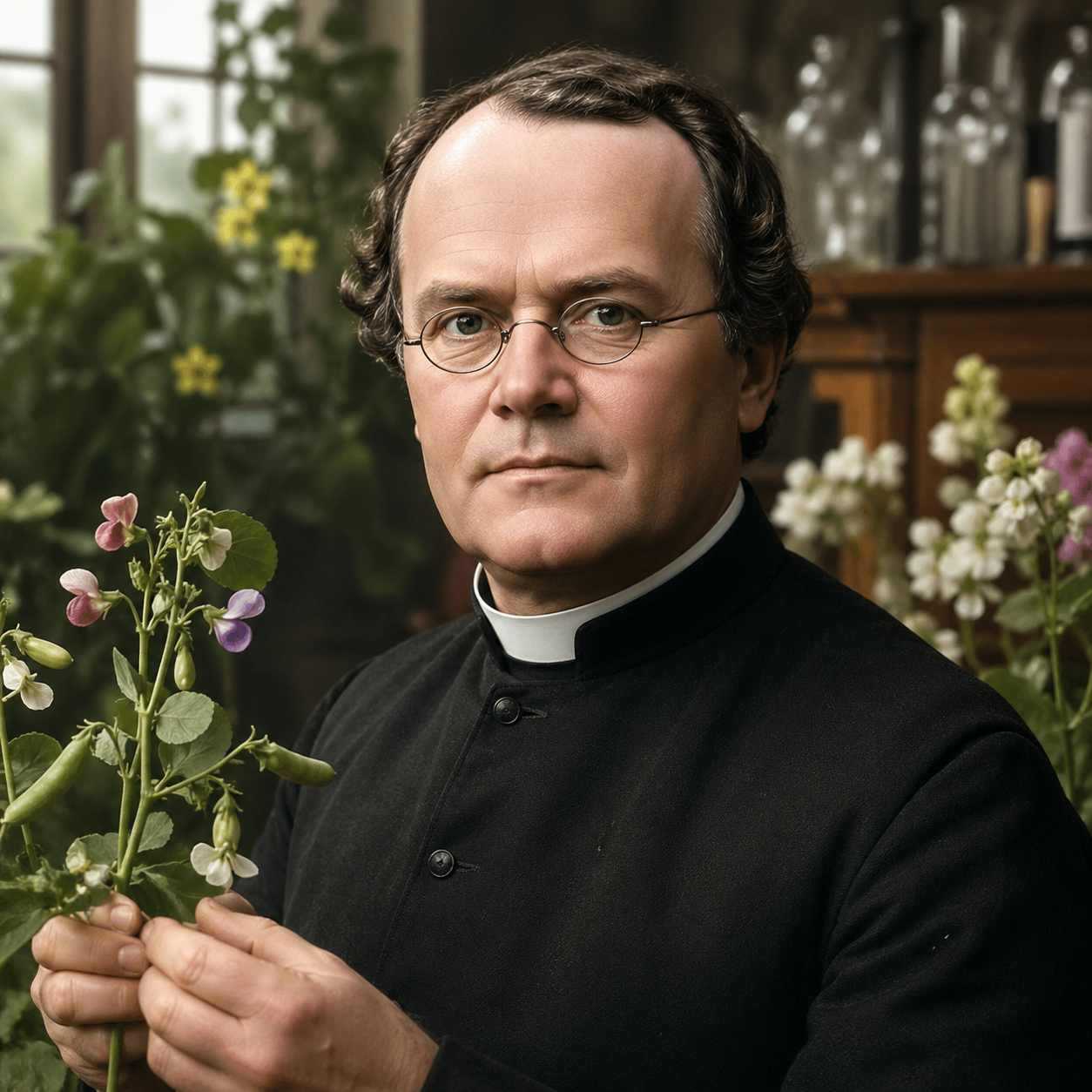
Gregor Mendel — "The traits of parents do not blend in their offspring but remain distinct."
The traits of parents do not blend in their offspring but remain distinct.
The traits of parents do not blend in their offspring but remain distinct.
Click any product to generate a realistic preview. Up to 3 at a time.
* Initial load can take up to 90 seconds — revising the preview in another color is nearly instant.
"Those traits that pass into hybrid association entirely or almost entirely unchanged, thus themselves representing the traits of the hybrid, are termed dominating and those that become latent in the a…"
"I measure, I count, I compare—this is the way of science."
"You should regard the numerical expressions as being only empirical, because they can not be proved rational."
"I have experienced many a bitter hour in my life. Nevertheless, I admit gratefully that the beautiful, good hours far outnumbered the others."
"The inheritance of traits is not a matter of chance but of law."
Found in 1 providers: deepseek
1 source checked
When two parents reproduce, their inherited characteristics don't merge into a middle-ground result. A child of a tall parent and short parent doesn't simply become medium-height by default. Instead, discrete hereditary units — what we now call genes — pass down intact, expressing themselves according to predictable rules. Traits can appear, disappear, or resurface across generations because they remain separate and unchanged, not blended away.
Mendel spent eight years crossbreeding pea plants in his Brno monastery garden, meticulously tracking thousands of offspring across seven traits. His precise, quantitative approach — unusual for biology at the time — revealed that hereditary factors segregate cleanly during reproduction. As an Augustinian friar turned scientist, he worked in careful isolation, publishing his findings in 1866 to near-total indifference. This quote is essentially his central law: factors, or alleles, don't dilute; they separate and recombine.
When Mendel published in 1866, Darwin's On the Origin of Species was just seven years old, and biologists lacked any mechanism explaining how traits passed between generations. Blending inheritance — the assumption that parental characteristics mixed like pigments — was consensus. Ironically, blending theory fatally undermined Darwin's evolution by diluting favorable mutations each generation. Mendel's particulate inheritance solved that problem, but the mathematical literacy to recognize its importance wouldn't reach mainstream biology until 1900.
AI-generated insights based on extensive research and information for context. Factual errors? Email [email protected].
Your cart is empty