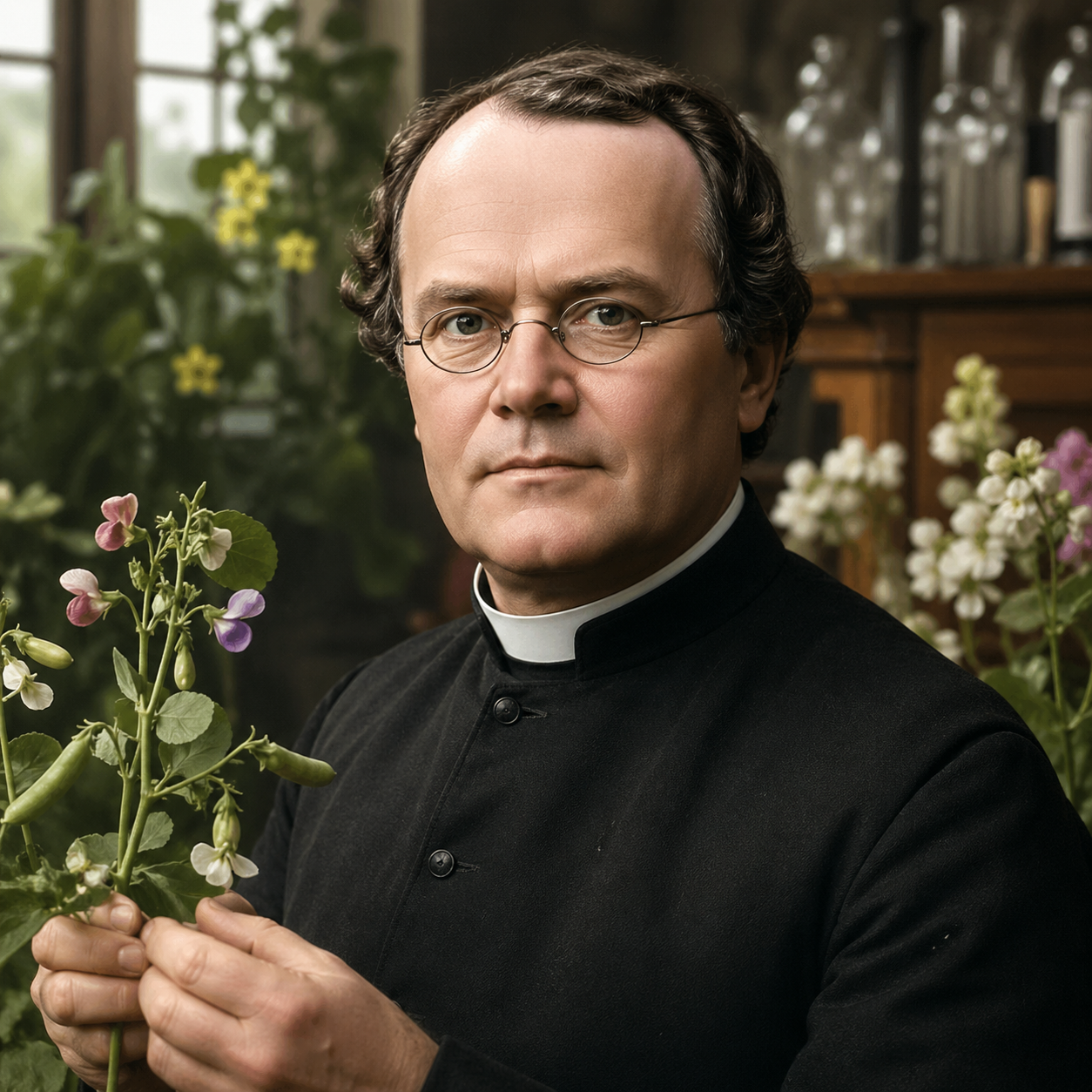
Gregor Mendel — "I measure, I count, I compare—this is the way of science."
I measure, I count, I compare—this is the way of science.
I measure, I count, I compare—this is the way of science.
Click any product to generate a realistic preview. Up to 3 at a time.
* Initial load can take up to 90 seconds — revising the preview in another color is nearly instant.
"The value and utility of any experiment are determined by the fitness of the material to the purpose for which it is used, and thus in the case before us it cannot be immaterial what plants are subjec…"
"Man must contribute his minimum work of toil, and God gives the growth. Truly, the seed, the talent, the grace of God is there, and man has simply to work, take the seeds to bring them to the bankers."
"The numerical ratios I have observed cannot be dismissed as mere coincidence."
"My experiments with single traits all lead to the same result: that from the seeds of hybrids, plants are obtained half of which in turn carry the hybrid trait (Aa), the other half, however, receive t…"
"Whether they will retain the characteristics of the hybrid, or whether they will show variations, will be determined by next year's observations."
Found in 1 providers: deepseek
1 source checked
Scientific knowledge comes from disciplined, systematic observation rather than intuition or speculation. Science advances by quantifying what we see, tallying results across many trials, and contrasting outcomes to find patterns. Only through this rigorous, repeatable process can real patterns emerge from noise and facts be separated from assumptions. It endorses the empirical method—reality reveals itself not through grand theorizing alone, but through patient, methodical data collection and honest comparison.
Mendel spent eight years tracking nearly 29,000 pea plants in his monastery garden, recording exact trait ratios—3:1, then 1:2:1—across generations. He was trained in physics and mathematics before taking religious vows, bringing statistical rigor unprecedented in biology. His experimental notebooks were dense with tallies, not narrative prose. His entire breakthrough depended on counting enough offspring to reveal underlying probability laws—the quote isn't metaphor; it is a literal description of how he worked every day.
In the 1860s, Darwin's evolution theory had transformed biology but offered no mechanism for inheritance. The prevailing assumption was 'blending' inheritance—traits simply mixed like paint. Statistics had no foothold in biological research; qualitative description was the norm. Mendel published his pea-plant findings in 1866, but the field wasn't ready for probabilistic thinking, and his work was ignored for 35 years. His counting-based method only became foundational when rediscovered independently in 1900 by three European botanists.
AI-generated insights based on extensive research and information for context. Factual errors? Email [email protected].
Your cart is empty