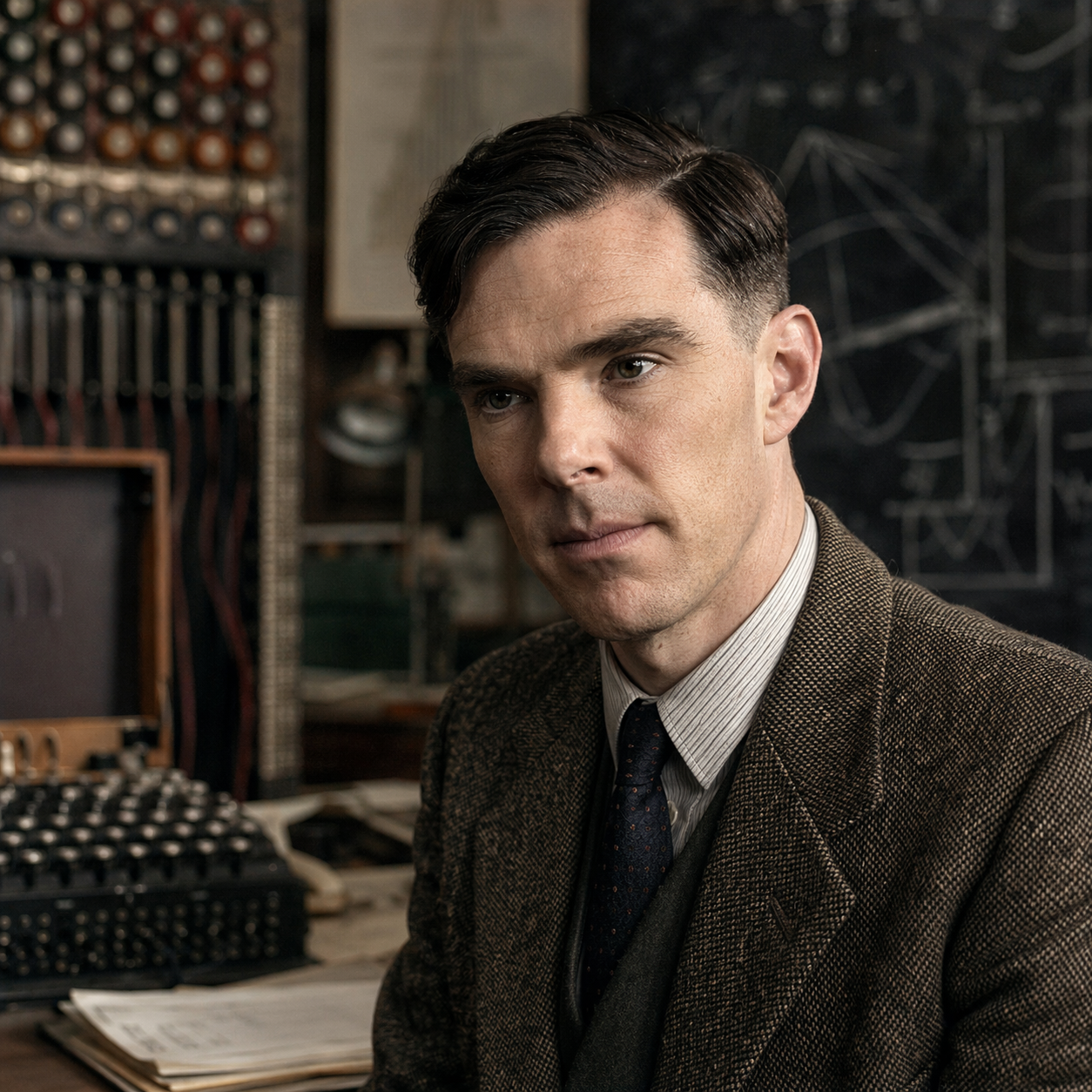
Alan Turing — "The true sign of intelligence is not knowledge but imagination."
The true sign of intelligence is not knowledge but imagination.
The true sign of intelligence is not knowledge but imagination.
Click any product to generate a realistic preview. Up to 3 at a time.
* Initial load can take up to 90 seconds — revising the preview in another color is nearly instant.
"The extent to which we regard mind as distinct from matter, is a matter of convention."
"It is possible for a machine to have a memory in the sense that a human being has a memory."
"Possibly a machine might be made to enjoy this delicious dish, but any attempt to make one do so would be idiotic."
"The true nature of intelligence is not to be found in the ability to solve problems, but in the ability to ask the right questions."
"The problem of creating intelligent machines is one of the most challenging and exciting problems in all of science."
Found in 1 providers: grok
1 source checked
Raw facts and accumulated knowledge aren't the highest form of intelligence. What truly distinguishes a sharp mind is the capacity to envision what doesn't yet exist — to form new ideas, hypothesize beyond current evidence, and conceive possibilities no one has mapped. Knowing things is relatively easy; imagining something entirely new, or a new framework for understanding, requires a different and rarer kind of mental power.
Turing didn't just know mathematics — he imagined new classes of machines that didn't yet exist. The Turing Machine was a pure thought experiment conceived before computers were built. His 1950 paper 'Computing Machinery and Intelligence' asked whether machines could think, a question no one had formally posed. At Bletchley Park, breaking Enigma required creative leaps beyond established cryptanalysis. His greatest contributions were imaginative first, mathematical second.
Turing worked during World War II and the early digital age, when intelligence was widely equated with calculation — fast, accurate, knowledge-based processing. Computers were being built to replicate known arithmetic, not to imagine. Turing's era saw the first stored-program machines emerge while the question of machine thought remained radical. In post-war Britain, where scientific rationalism dominated, suggesting imagination — not knowledge — defined intelligence was a genuinely provocative intellectual stance.
AI-generated insights based on extensive research and information for context. Factual errors? Email [email protected].
Your cart is empty