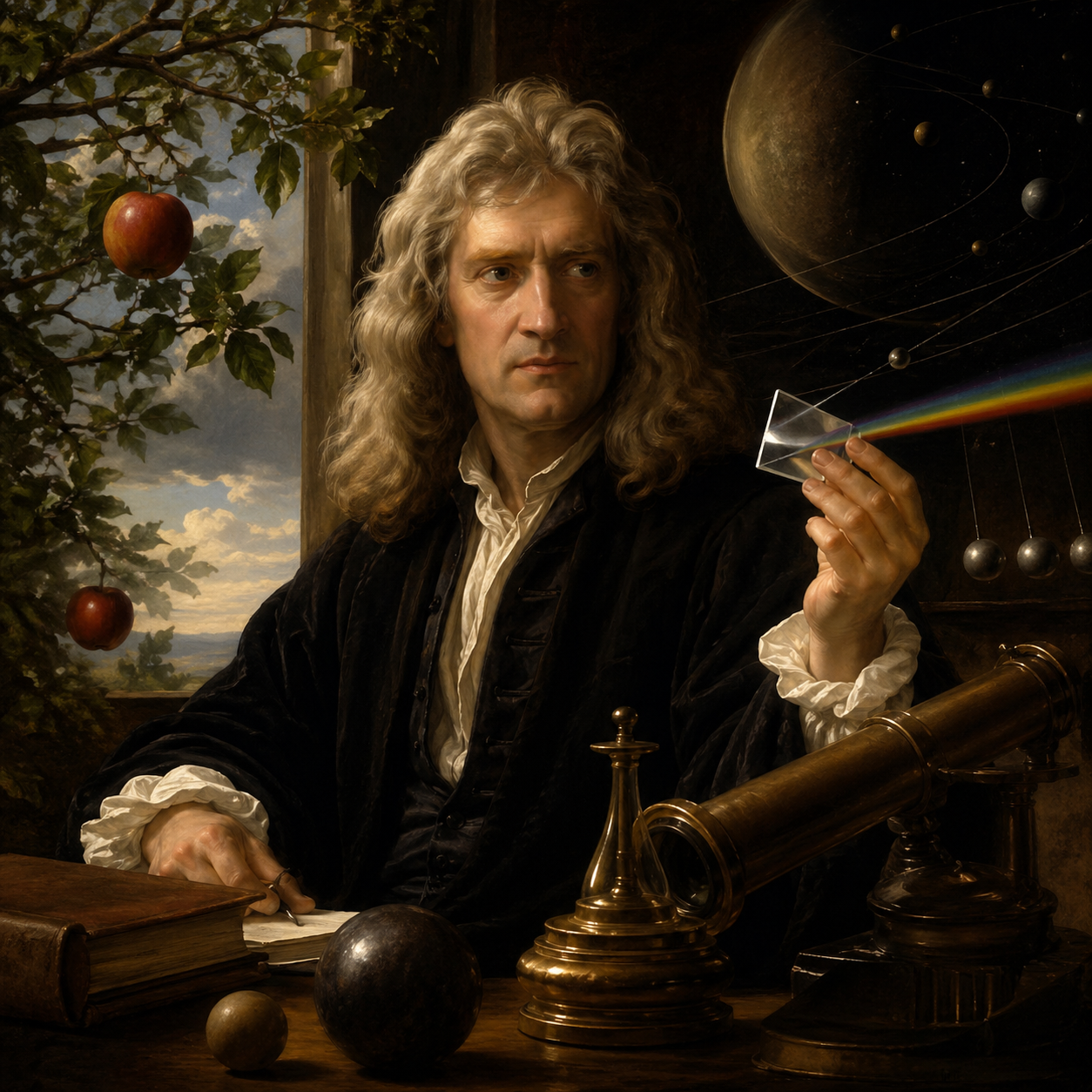
Isaac Newton — "My powers are ordinary. Only my application brings me success."
My powers are ordinary. Only my application brings me success.
My powers are ordinary. Only my application brings me success.
Click any product to generate a realistic preview. Up to 3 at a time.
* Initial load can take up to 90 seconds — revising the preview in another color is nearly instant.
"I built my first telescope with my own hands."
"Plato is my friend, Aristotle is my friend, but truth is more my friend."
"He who thinks half-heartedly will not believe in God; but he who thinks seriously will believe in God."
"The most beautiful order of the planets and comets could not have arisen without the design and dominion of an intelligent and powerful Being."
"The true way of considering a thing is by its causes."
Found in 1 providers: grok
1 source checked
Success flows from relentless, disciplined effort rather than exceptional innate talent. The quote argues that ordinary abilities, consistently and purposefully applied to a problem, outperform raw genius left undirected. In modern terms: sustained focus is the real differentiator. It rejects the idea that achievement requires special gifts—anyone who applies themselves with rigor and persistence can accomplish what looks, from the outside, like extraordinary results.
Newton, widely regarded as history's greatest scientist, deflected praise toward method over gift. During the plague years of 1665–1666 he worked in near-total isolation at Woolsthorpe, producing foundational work in calculus, optics, and gravity through grinding continuous thought, not sudden inspiration. He described his approach as 'thinking on things continuously.' His decades-long labor on Principia Mathematica reflects exactly this ethos—extraordinary output driven by relentless application rather than any talent he acknowledged possessing.
Newton worked during the Scientific Revolution, when Europe was overthrowing Aristotelian authority with empirical method. The Royal Society, founded 1660, championed collective, methodical inquiry over individual inspiration. Protestant culture simultaneously valorized diligent labor as morally virtuous. Yet society still romanticized innate genius as divine endowment. Newton's insistence that application—not natural power—drives success aligned with the era's emerging Enlightenment conviction that systematic, patient effort, not birthright or divine favor, unlocks nature's truths.
AI-generated insights based on extensive research and information for context. Factual errors? Email [email protected].
Your cart is empty