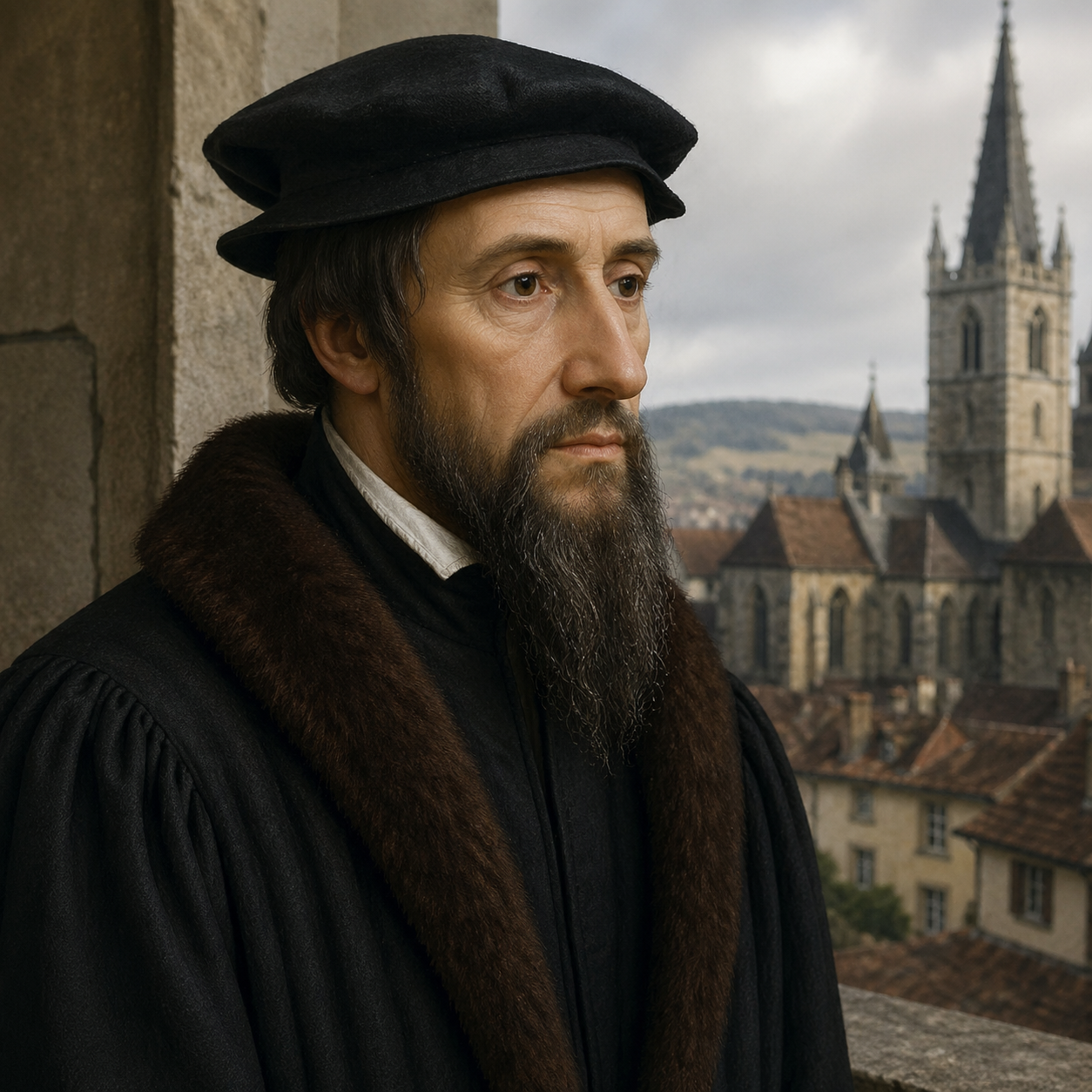
John Calvin — "The true wisdom of man consists in the knowledge of God and of himself."
The true wisdom of man consists in the knowledge of God and of himself.
The true wisdom of man consists in the knowledge of God and of himself.
Click any product to generate a realistic preview. Up to 3 at a time.
* Initial load can take up to 90 seconds — revising the preview in another color is nearly instant.
"The whole sum of Christian philosophy is contained in these two points: the knowledge of God and of ourselves."
"It is not in our power to believe, but it is the gift of God."
"God's foreknowledge and predestination are not the same; for foreknowledge is simple knowledge, but predestination is a decree."
"Prayer is the chief exercise of faith."
"I am unwilling to pledge my word for his safety, for if he shall come [to Geneva], I shall never permit him to depart alive, provided my authority be of any avail."
French theologian whose Institutes of the Christian Religion (1536) systematized Protestant Reformed doctrine, including predestination. Closely associated with Martin Luther (Reformation founder, Calvin's predecessor). For an intellectual contrast, see Jacobus Arminius, Dutch Reformed theologian (1560-1609) — Arminius's rejection of strict double-predestination founded Arminianism — the theological tradition modern Methodism, most evangelicalism, and Pentecostalism descend from. The Calvinist-Arminian debate has divided Protestantism for 400 years.
Found in 1 providers: grok
1 source checked
Genuine wisdom isn't found in worldly learning, philosophy, or material success — it comes from two intertwined sources: understanding who God is and understanding who you are. Knowing God reveals the standard of perfection; knowing yourself reveals your sinfulness and limitations. These two forms of knowledge are inseparable — you cannot truly grasp one without the other. Real wisdom is theological and self-reflective, not merely intellectual achievement.
Calvin opens his Institutes of the Christian Religion with nearly this exact formulation, making it foundational to his entire theology. As a lawyer-turned-theologian who governed Geneva's Reformed church, Calvin believed rigorous self-examination under God's sovereign authority was essential to right living. His doctrine of total depravity demanded believers confront their own corruption honestly — only against God's perfect holiness could humans accurately measure their fallen condition.
The Reformation shattered medieval Catholicism's monopoly on spiritual authority, forcing ordinary Europeans to engage scripture personally. Renaissance humanism — Erasmus, Pico della Mirandola — had recentered intellectual life on the human being. Calvin's formulation pushed back: self-knowledge alone distorts without God as the reference point. In an era of religious wars, fractured ecclesiastical authority, and competing epistemologies, anchoring wisdom in theology rather than Renaissance individualism was a deliberate counter-statement.
AI-generated insights based on extensive research and information for context. Factual errors? Email [email protected].
Your cart is empty