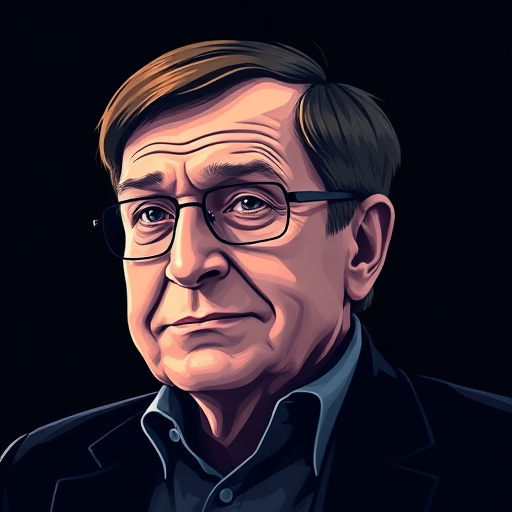
Stephen Hawking — "The ultimate goal of science is to provide a single theory that describes the wh…"
The ultimate goal of science is to provide a single theory that describes the whole universe.
The ultimate goal of science is to provide a single theory that describes the whole universe.
Click any product to generate a realistic preview. Up to 3 at a time.
* Initial load can take up to 90 seconds — revising the preview in another color is nearly instant.
"We are very, very small, but we are profoundly significant."
"In the proof stage, I nearly cut that last sentence of the book. Had I done so, the sales might have been halved."
"The universe is a great place to be, and I'm glad to be a part of it. But it's also a very dangerous place, and we need to be careful."
"The greatest achievement of the human race is not the invention of the wheel, but the ability to communicate."
"The universe is a vast and complex place, and we are only just beginning to understand it."
British theoretical physicist whose Hawking radiation work and A Brief History of Time (1988) brought black-hole physics to a mass audience while he lived with ALS for 55 years. Closely associated with Roger Penrose (his collaborator on singularity theorems) and Carl Sagan (fellow popularizer who wrote Brief History's foreword). For an intellectual contrast, see William Lane Craig, American philosopher of religion — Craig's Kalam cosmological argument depends on the Big Bang requiring a divine first cause; Hawking's no-boundary proposal was specifically designed to remove the moment that would require one — the cleanest cosmology-vs-natural-theology contrast in modern thought.
Found in 1 providers: grok
1 source checked
Science's highest ambition is a single unified framework explaining everything — from subatomic particles to the largest cosmic structures. Rather than maintaining separate theories for gravity, quantum mechanics, and electromagnetism, scientists seek one coherent set of laws governing all matter, energy, space, and time. Physicists call this a Theory of Everything: a complete, elegant description of reality that leaves no phenomenon unexplained and requires no external assumptions.
Hawking dedicated his career to this exact pursuit. He discovered that black holes emit thermal radiation — now called Hawking radiation — bridging general relativity and quantum mechanics, two otherwise incompatible frameworks. He co-authored the Hartle-Hawking no-boundary proposal for the universe's origin and later championed M-theory as unification's best candidate. Despite being almost completely paralyzed by ALS from his twenties onward, he pursued this quest until his death in March 2018.
Hawking worked through theoretical physics' most ambitious period. The Standard Model (1970s) unified three fundamental forces but stubbornly excluded gravity. String theory emerged in the 1980s as a promising candidate Theory of Everything. The 1990s brought M-theory, which Hawking publicly endorsed. The 2012 Higgs boson discovery validated quantum field theory. Simultaneously, cosmological observations confirmed dark energy and cosmic inflation, deepening physicists' conviction that one underlying theory must govern everything.
AI-generated insights based on extensive research and information for context. Factual errors? Email [email protected].
Your cart is empty