Stephen Hawking — "The universe is a great place to be, and I'm glad to be a part of it. But it's a…"
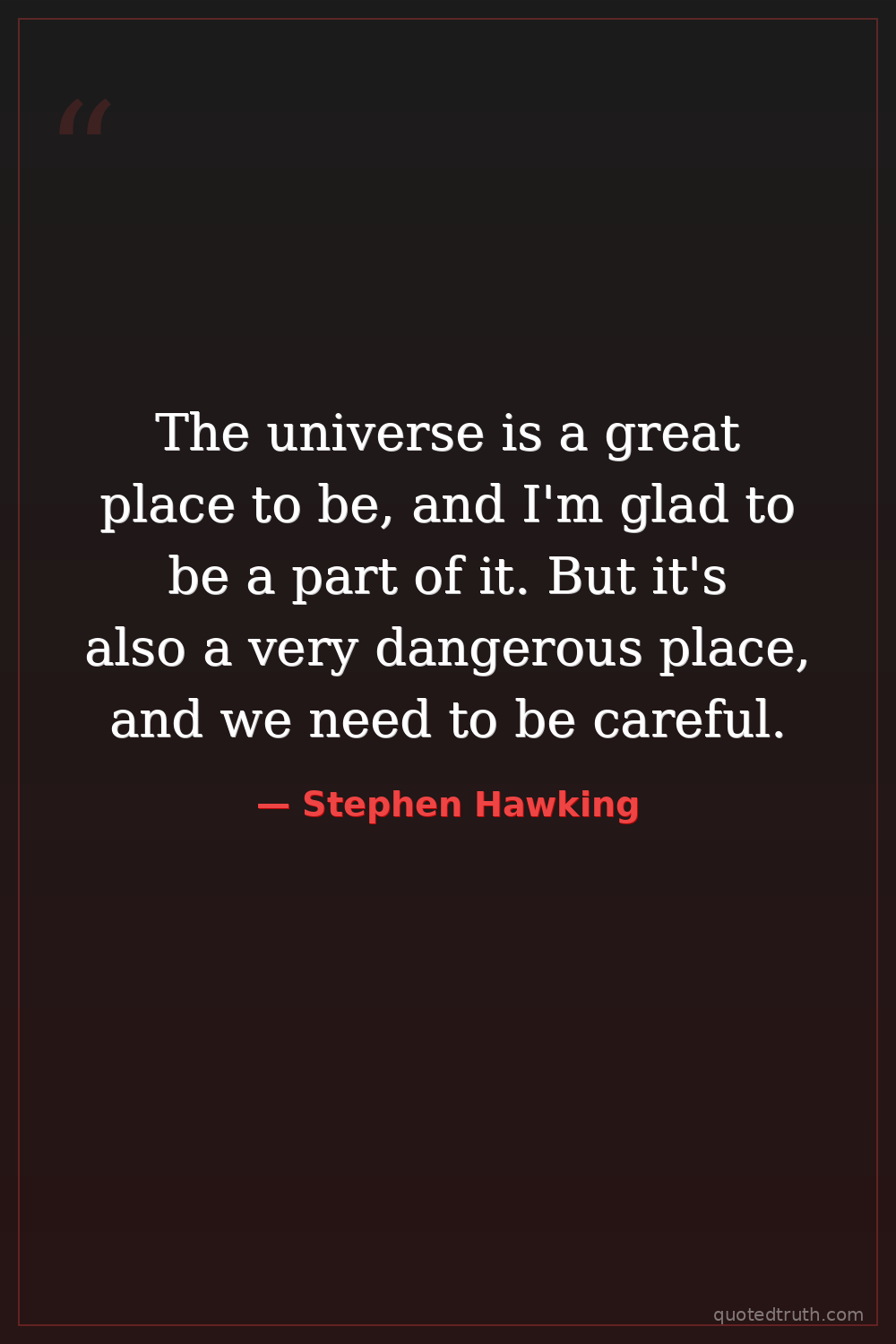
The universe is a great place to be, and I'm glad to be a part of it. But it's also a very dangerous place, and we need to be careful.
The universe is a great place to be, and I'm glad to be a part of it. But it's also a very dangerous place, and we need to be careful.
Click any product to generate a realistic preview. Up to 3 at a time.
* Initial load can take up to 90 seconds — revising the preview in another color is nearly instant.
"The laws of nature are the same everywhere in the universe."
"Mathematics is the language in which God has written the universe."
"Meeting an advanced civilization could be like Native Americans encountering Columbus. That didn't turn out so well."
"We are all driven by a desire to understand the universe."
"There is a fundamental difference between religion, which is based on authority, and science, which is based on observation and reason. Science will win because it works."
British theoretical physicist whose Hawking radiation work and A Brief History of Time (1988) brought black-hole physics to a mass audience while he lived with ALS for 55 years. Closely associated with Roger Penrose (his collaborator on singularity theorems) and Carl Sagan (fellow popularizer who wrote Brief History's foreword). For an intellectual contrast, see William Lane Craig, American philosopher of religion — Craig's Kalam cosmological argument depends on the Big Bang requiring a divine first cause; Hawking's no-boundary proposal was specifically designed to remove the moment that would require one — the cleanest cosmology-vs-natural-theology contrast in modern thought.
Found in 1 providers: grok
1 source checked
The universe is both magnificent and threatening. We should feel genuine wonder and gratitude for existing within something so vast and complex, but that same scale and indifference to human life demands that we treat our survival seriously. Awe and caution must coexist — celebrating existence doesn't mean ignoring the real risks that come with it.
Hawking spent his career revealing the universe's grandeur through black hole thermodynamics, the Big Bang, and quantum cosmology, yet he repeatedly warned humanity about existential threats: AI, climate change, asteroid strikes, and nuclear war. Confined to a wheelchair by ALS, he understood personally that fragility and wonder can inhabit the same existence.
Hawking worked through the Cold War, nuclear proliferation fears, and into the climate crisis era. By the 2000s–2010s, existential risk was becoming a serious academic field. His warnings about AI and planetary threats aligned with growing scientific consensus that technological civilization faces self-inflicted dangers unprecedented in human history.
AI-generated insights based on extensive research and information for context. Factual errors? Email [email protected].
Your cart is empty