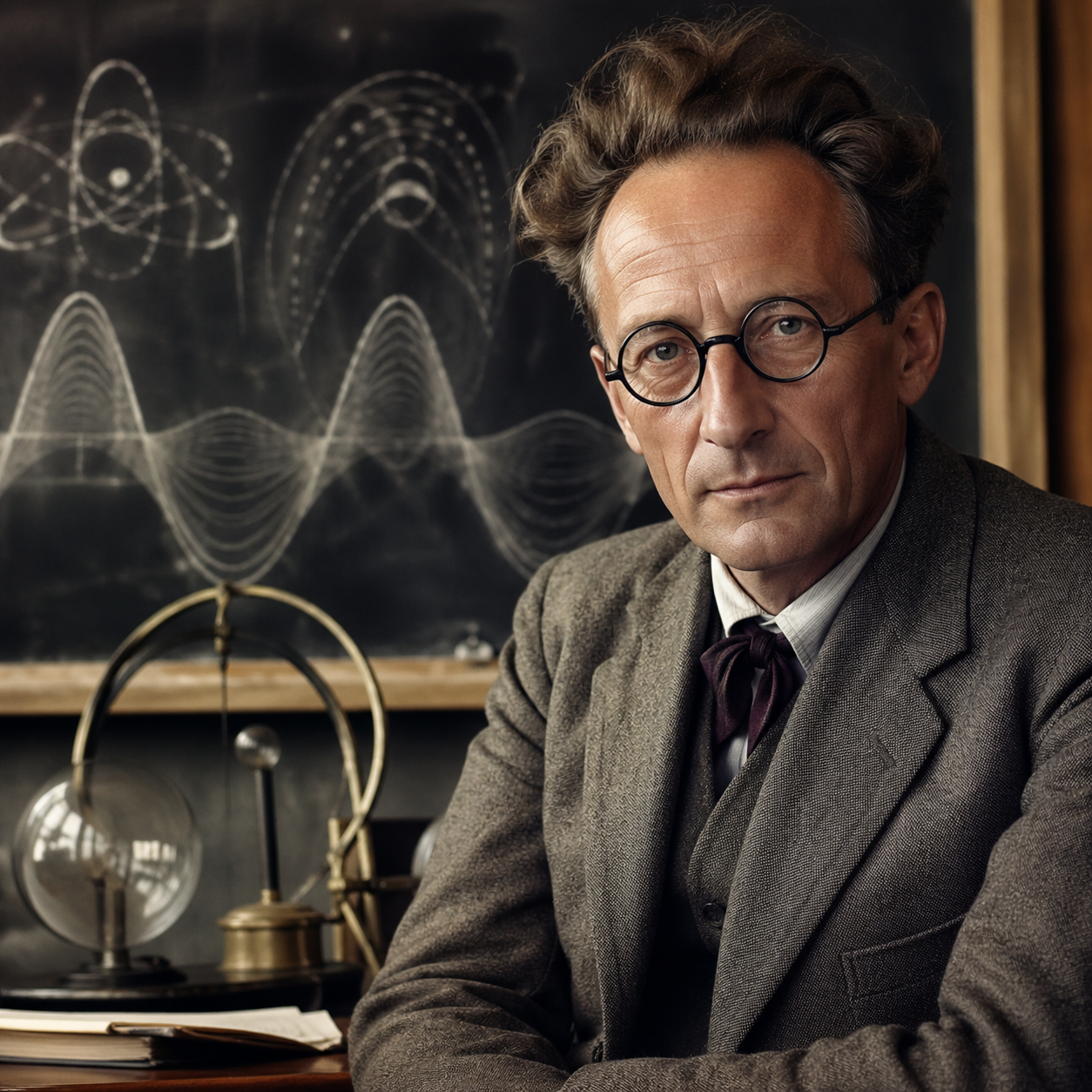
Erwin Schrodinger — "The ultimate goal of science is to understand the universe and our place in it."
The ultimate goal of science is to understand the universe and our place in it.
The ultimate goal of science is to understand the universe and our place in it.
Click any product to generate a realistic preview. Up to 3 at a time.
* Initial load can take up to 90 seconds — revising the preview in another color is nearly instant.
"I am a physicist, not a philosopher. But I cannot help but think about these things."
"The idea that there is a soul, which is a kind of independent entity in the body, is not something that I think a lot of people would agree with today. But the idea that consciousness is something tha…"
"The number of degrees of freedom of the cat is enormous. Is it possible that the cat is to be described by a wave function, which is a superposition of a live and a dead cat?"
"The greatest discovery of all time is the discovery that we can discover."
"The task is not so much to see what no one has yet seen; but to think what nobody has yet thought, about that which everybody sees."
Austrian physicist who shared the 1933 Nobel for the wave equation that bears his name and the famous cat thought-experiment. Closely associated with Werner Heisenberg (matrix-mechanics rival who reached the same physics by different math) and Albert Einstein (his pen-pal on quantum interpretation). For an intellectual contrast, see Niels Bohr, Danish physicist and architect of the Copenhagen interpretation — Schrödinger's cat thought-experiment was specifically designed to ridicule Bohr's 'observer-dependent reality' reading of quantum mechanics — Schrödinger thought the Copenhagen interpretation was absurd; the cat was meant as reductio ad absurdum.
Found in 1 providers: grok
1 source checked
Science exists not merely to collect facts or build technology, but to answer the deepest questions: how does the universe work, and where do humans fit within it? This is a call for science to pursue meaning alongside mechanism — to connect physical laws to human existence rather than treating knowledge as an end in itself divorced from philosophical purpose.
Schrödinger was unusual among physicists in refusing to separate science from philosophy and consciousness. His 1944 book 'What is Life?' bridged quantum physics and biology, and his late writings grappled with consciousness and Vedantic philosophy. He saw wave mechanics not as mere mathematical formalism but as a window into reality's deeper nature — making this pursuit of cosmic understanding central to his identity.
The early-to-mid 20th century saw quantum mechanics overturn classical certainties, leaving physicists confronting genuinely strange realities — superposition, uncertainty, wave-particle duality. Scientists like Schrödinger, Bohr, and Heisenberg debated what quantum theory meant philosophically. Simultaneously, Einstein's relativity reshaped cosmology. This era demanded scientists become philosophers, asking not just 'how' but 'what does this mean for humanity's understanding of existence.'
AI-generated insights based on extensive research and information for context. Factual errors? Email [email protected].
Your cart is empty