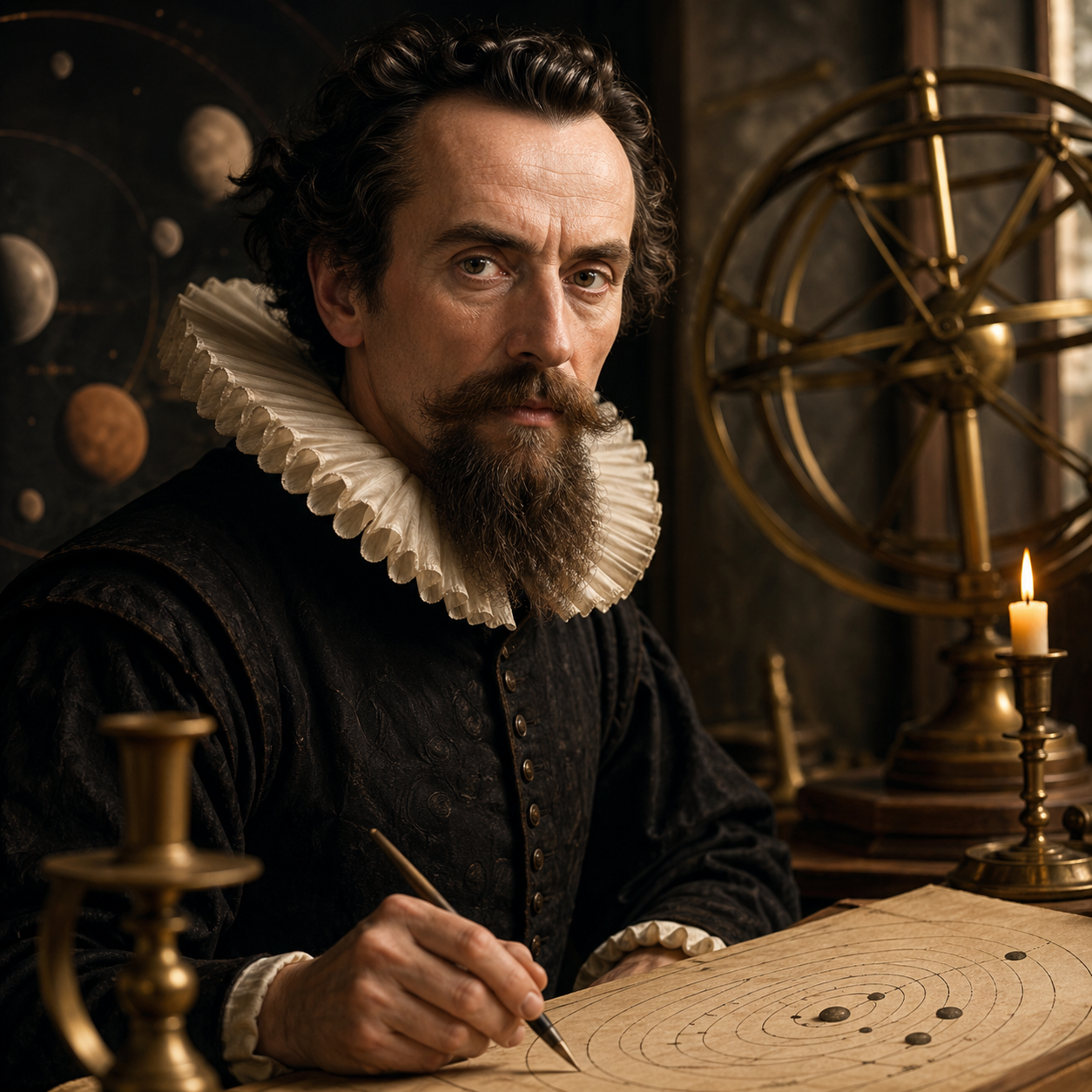
Johannes Kepler — "The universe is a machine, and God is its engineer."
The universe is a machine, and God is its engineer.
The universe is a machine, and God is its engineer.
Click any product to generate a realistic preview. Up to 3 at a time.
* Initial load can take up to 90 seconds — revising the preview in another color is nearly instant.
"I have been a teacher, and I have learned much from my students."
"I am a Lutheran astrologer, I throw away the nonsense and keep the hard kernel."
"Repudiating the sensible world, which he neither sees himself nor believes from those who have, the Peripatetic joins combat by childish quibbling in a world on paper, and denies the Sun shines becaus…"
"Mathematics is the alphabet with which God has written the universe."
"I am not ashamed to confess that I have often been mistaken."
Found in 1 providers: grok
1 source checked
Reality operates like a carefully built mechanism whose parts move according to fixed rules rather than whim or chance. The cosmos isn't a living creature or a stage for capricious gods but an engineered system, and whoever designed it worked like a skilled craftsman setting up gears and forces. Understanding nature therefore means uncovering its blueprint, not interpreting moods or omens.
Kepler spent decades hunting mathematical regularities in planetary orbits, ultimately proving they trace ellipses governed by precise laws relating distance, speed, and time. A devout Lutheran, he believed studying these patterns was worship, reading the Creator's design. Calling God an engineer fits a man who treated astronomy as geometry made visible and who insisted the heavens obeyed calculable rules rather than mystical harmonies alone.
In the early 1600s, Europe was shifting from an Aristotelian cosmos of nested crystalline spheres toward a mechanical worldview later crystallized by Newton. Galileo was turning telescopes skyward, Descartes would soon describe matter as extension in motion, and clockwork metaphors were spreading. Kepler wrote amid the Thirty Years' War and witch trials, including his own mother's, yet helped replace magical causation with lawful mechanism, bridging Renaissance mysticism and the Scientific Revolution.
AI-generated insights based on extensive research and information for context. Factual errors? Email [email protected].
Your cart is empty