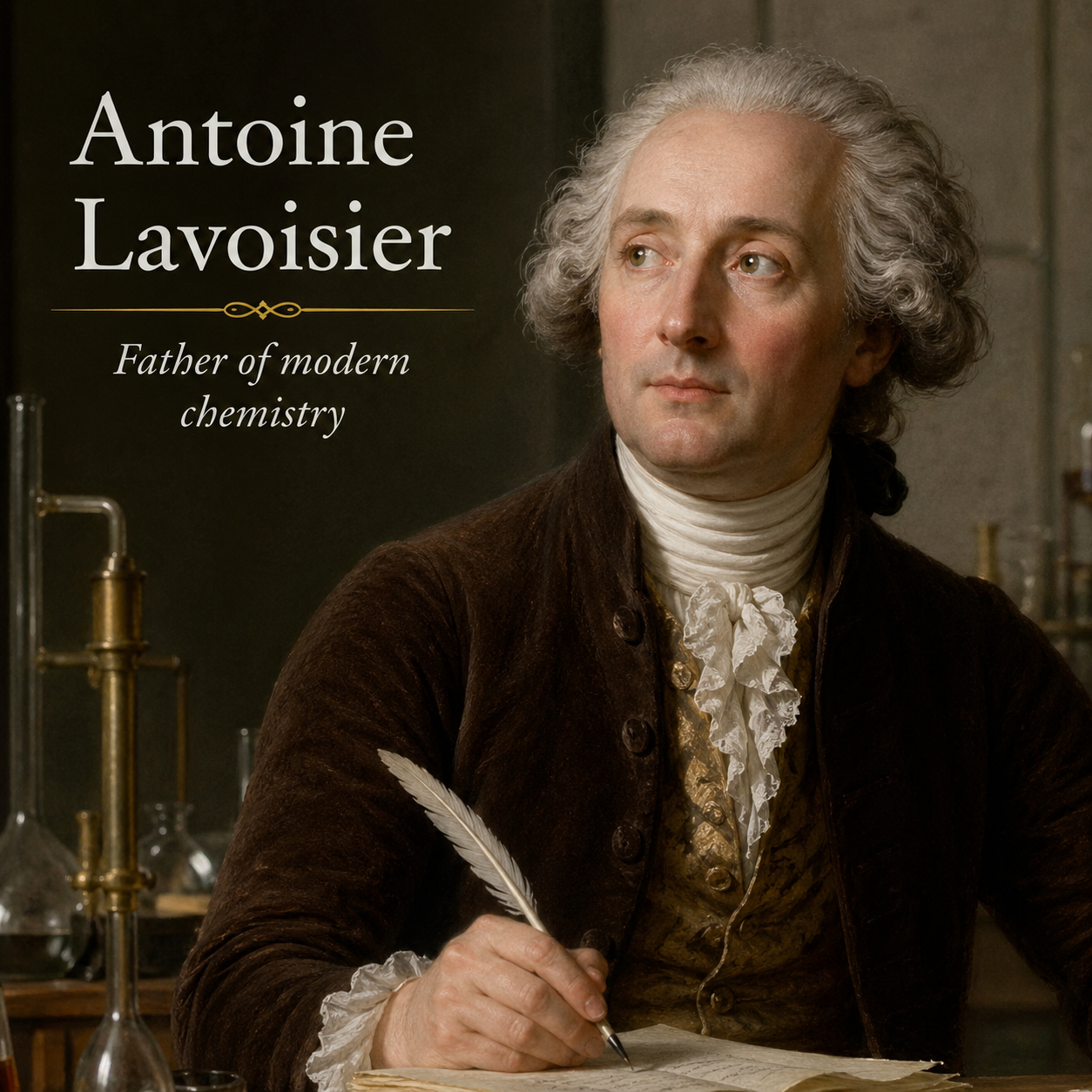
Antoine Lavoisier — "The universe is a machine, and we are its engineers."
The universe is a machine, and we are its engineers.
The universe is a machine, and we are its engineers.
Click any product to generate a realistic preview. Up to 3 at a time.
* Initial load can take up to 90 seconds — revising the preview in another color is nearly instant.
"The imagination is a dangerous guide in science, but it can be a useful servant."
"It is impossible for me to write anything without feeling myself inspired by a sort of scientific enthusiasm."
"The most important thing for a man of science is to have a clear head and a good heart."
"I have never been able to believe in anything that I could not demonstrate by experiment."
"Nothing is created, either in the operations of art, or in those of nature; and it may be considered as a general principle that in every operation there exists an equal quantity of matter before and …"
Found in 1 providers: grok
1 source checked
The universe operates by fixed, discoverable rules — like a machine with predictable parts. Humans aren't helpless spectators but active investigators who can decode nature's mechanisms through reason and experiment. Understanding those rules gives us power to intervene, redirect, and control outcomes. It elevates science from mere observation to a form of mastery, asserting that reality is fully comprehensible and that human intellect is the instrument for decoding it.
Lavoisier built modern chemistry on quantitative precision — weighing reactants and products to prove matter is neither created nor destroyed. He dismantled the centuries-old phlogiston theory by treating combustion as a measurable mechanical process involving oxygen. A trained lawyer and tax administrator, he applied rigorous system-building to science. His meticulous notebooks and balance-sheet approach to chemical reactions embodied the belief that chemistry, like engineering, rewards disciplined measurement over inherited myth.
Lavoisier worked during the High Enlightenment and French Revolution (1760s–1790s), when Newton's mechanical cosmos had already convinced Europe that nature follows mathematical law. French philosophes like Voltaire and Diderot championed reason over religious authority. The Industrial Revolution was transforming Britain through applied mechanics. Scientists of Lavoisier's generation believed human ingenuity could systematize all of nature — making the universe-as-machine metaphor not radical but the intellectual mainstream of his age.
AI-generated insights based on extensive research and information for context. Factual errors? Email [email protected].
Your cart is empty