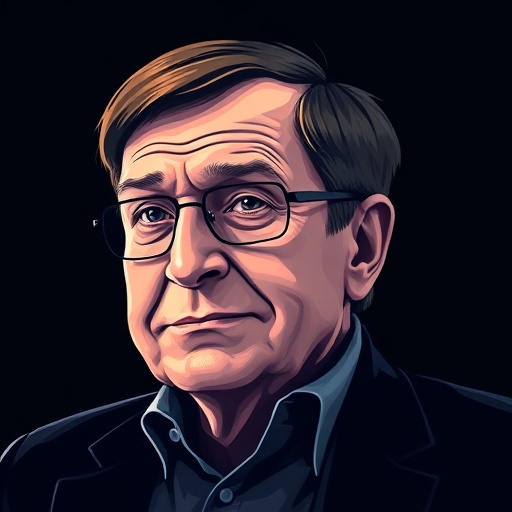
Stephen Hawking — "The universe is a place of wonder and mystery, and I'm glad to be a part of it."
The universe is a place of wonder and mystery, and I'm glad to be a part of it.
The universe is a place of wonder and mystery, and I'm glad to be a part of it.
Click any product to generate a realistic preview. Up to 3 at a time.
* Initial load can take up to 90 seconds — revising the preview in another color is nearly instant.
"One day, I hope to have a conversation with an alien."
"The universe is a big place, and we are a small part of it. But we are an important part of it."
"Women. They are a complete mystery."
"The greatest achievement of the human race would be to understand the universe."
"What makes human beings unique? Some say it's language or tools. Others say it's logical reasoning. They obviously haven't met many humans."
British theoretical physicist whose Hawking radiation work and A Brief History of Time (1988) brought black-hole physics to a mass audience while he lived with ALS for 55 years. Closely associated with Roger Penrose (his collaborator on singularity theorems) and Carl Sagan (fellow popularizer who wrote Brief History's foreword). For an intellectual contrast, see William Lane Craig, American philosopher of religion — Craig's Kalam cosmological argument depends on the Big Bang requiring a divine first cause; Hawking's no-boundary proposal was specifically designed to remove the moment that would require one — the cleanest cosmology-vs-natural-theology contrast in modern thought.
Found in 1 providers: grok
1 source checked
Life and existence, despite hardship, carry inherent worth. The universe's vast complexity and strangeness—its black holes, dark matter, quantum oddities—make simply being alive and conscious within it a privilege. Wonder is the appropriate response to reality, not anxiety or despair. Participating in existence, even briefly, is something to feel gratitude for rather than take for granted.
Hawking spent decades confined to a wheelchair by ALS, communicating through a speech synthesizer, yet he described the cosmos with infectious awe. He famously said disability never stopped his mind from roaming freely. His work on black hole radiation and the Big Bang emerged from someone who had every reason for bitterness but chose curiosity instead—making this sentiment deeply autobiographical.
Hawking's career spanned the Space Race through the Hubble telescope era and early internet age, a period when humanity first glimpsed distant galaxies and confirmed the Big Bang's afterglow. As existential anxieties around nuclear war and climate grew, his public voice consistently reframed humanity's smallness as wonder rather than insignificance, countering nihilism with cosmological perspective.
AI-generated insights based on extensive research and information for context. Factual errors? Email [email protected].
Your cart is empty