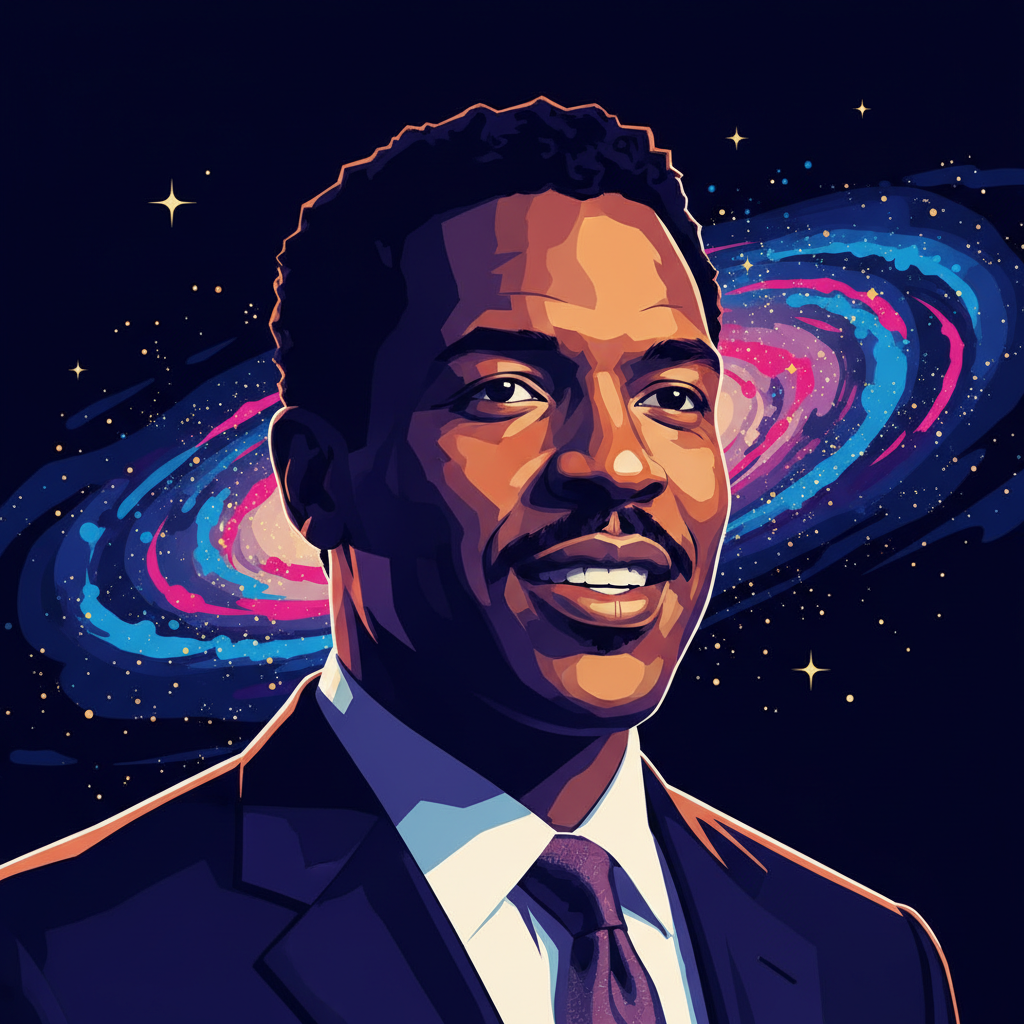
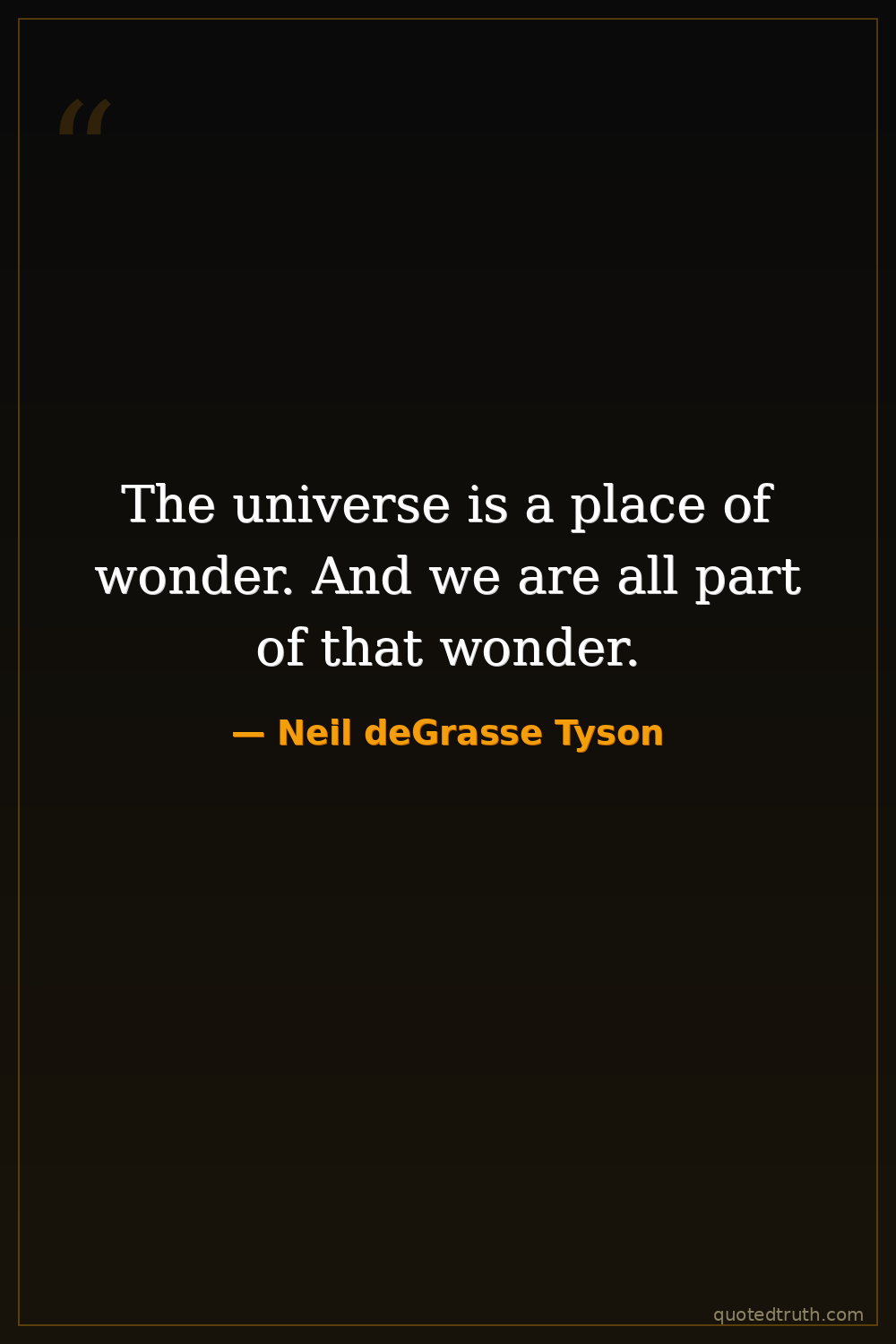
Neil deGrasse Tyson — "The universe is a place of wonder. And we are all part of that wonder."
The universe is a place of wonder. And we are all part of that wonder.
The universe is a place of wonder. And we are all part of that wonder.
Click any product to generate a realistic preview. Up to 3 at a time.
* Initial load can take up to 90 seconds — revising the preview in another color is nearly instant.
"I think the universe is trying to tell us something, and we're just not listening."
"I'm not saying I'm Batman. I'm just saying no one has ever seen me and Batman in the same room."
"I'm not saying there are no aliens. I'm just saying the evidence is insufficient for me to conclude it."
"If you are scientifically literate, the world looks very different to you, and that difference, I think, is a difference for the better."
"The good thing about science is that it's true whether or not you believe in it."
American astrophysicist, Hayden Planetarium director, and Cosmos: A Spacetime Odyssey host who carries the Carl Sagan public-science mantle. Closely associated with Bill Nye (fellow science communicator) and Brian Greene (theoretical physicist and string-theory popularizer). For an intellectual contrast, see Ken Ham, founder of Answers in Genesis and the Creation Museum — Ham's career has been organized around defending biblical 6-day creationism — exactly the science-education position Tyson's mainstream-science communication is structured to refute.
Book: 'Cosmic Queries: StarTalk's Guide to Who We Are, How We Got Here, and Where We're Going'
Date: 2021
ShockingFound in 1 providers: grok
1 source checked
The universe contains phenomena so vast and extraordinary that awe is the only rational response. Beyond passive admiration, we ourselves are constituents of that grandeur — made of stardust, governed by the same physical laws as galaxies. Wonder is not separate from us; it is something we participate in and embody simply by existing within the cosmos.
Tyson built his career dismantling the boundary between distant universe and everyday human. As director of the Hayden Planetarium and host of Cosmos: A Spacetime Odyssey, he repeatedly emphasized that stellar nucleosynthesis literally forged human atoms. This quote captures his signature move: converting abstract cosmology into personal identity, making science feel like self-knowledge rather than remote scholarship.
Tyson rose to public prominence during a period of renewed space enthusiasm — Mars rovers, exoplanet discoveries, gravitational wave detection — alongside growing science skepticism in public discourse. His framing of wonder as universal and inclusive directly countered cultural forces dismissing scientific inquiry. Positioning humans inside cosmic wonder, not outside observing it, was a deliberate rhetorical strategy for science engagement.
AI-generated insights based on extensive research and information for context. Factual errors? Email [email protected].
Your cart is empty