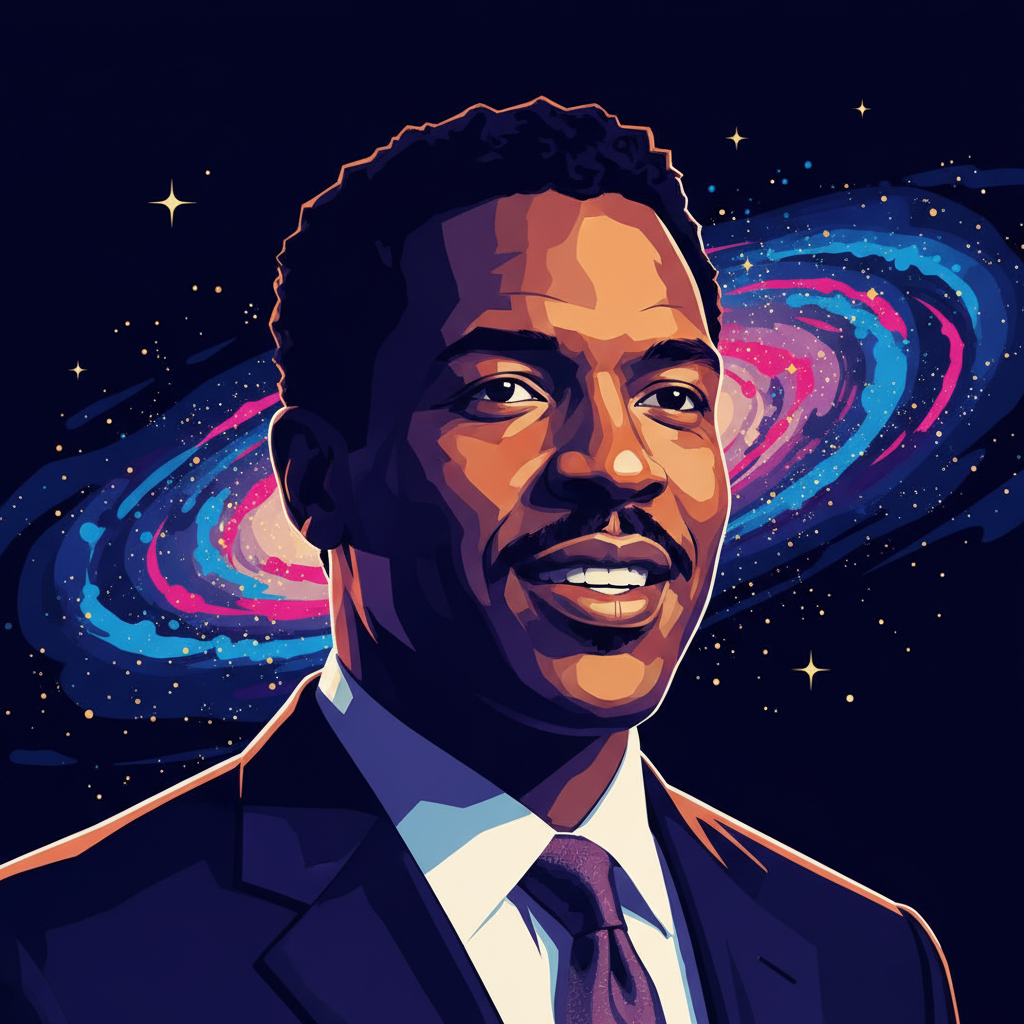
Neil deGrasse Tyson — "The universe is not just a puzzle to be solved. It's a poem to be read."
The universe is not just a puzzle to be solved. It's a poem to be read.
The universe is not just a puzzle to be solved. It's a poem to be read.
Click any product to generate a realistic preview. Up to 3 at a time.
* Initial load can take up to 90 seconds — revising the preview in another color is nearly instant.
"I often think about how small we are in the grand scheme of things, and it makes me feel both humbled and empowered."
"Knowing what's true is not the same as knowing what's right."
"I'm often asked whether I believe in God. I'm an agnostic."
"I'm often asked, 'What is the meaning of life?' I don't know, but I think that the search for meaning is a good meaning to have."
"My goal is to get people to think about the universe, not just about themselves."
American astrophysicist, Hayden Planetarium director, and Cosmos: A Spacetime Odyssey host who carries the Carl Sagan public-science mantle. Closely associated with Bill Nye (fellow science communicator) and Brian Greene (theoretical physicist and string-theory popularizer). For an intellectual contrast, see Ken Ham, founder of Answers in Genesis and the Creation Museum — Ham's career has been organized around defending biblical 6-day creationism — exactly the science-education position Tyson's mainstream-science communication is structured to refute.
Found in 1 providers: grok
1 source checked
Science is not merely about finding answers and checking boxes. The universe rewards sustained wonder and aesthetic appreciation, not just cold analysis. Understanding physics, cosmology, and nature should feel like encountering great literature — layered, beautiful, and perpetually revealing new meaning the more carefully you engage with it. Curiosity without reverence misses something essential about what makes discovery worthwhile.
Tyson built his career bridging rigorous astrophysics and public wonder — hosting Cosmos, writing accessible books, appearing on podcasts and late-night TV. He consistently argues that awe and scientific literacy are complementary, not competing. His Hayden Planetarium directorship reflects this philosophy: making the cosmos emotionally resonant, not just intellectually digestible, is central to his life's work.
In the early 21st century, science communication faces a crisis of engagement — climate denial, vaccine hesitancy, and declining STEM interest signal public disconnection from scientific thinking. Meanwhile, poetry and humanities enrollment also drop. Tyson's framing arrives when culture needs permission to treat science as a source of beauty, not just utility, countering the false split between analytical and artistic ways of knowing.
AI-generated insights based on extensive research and information for context. Factual errors? Email [email protected].
Your cart is empty