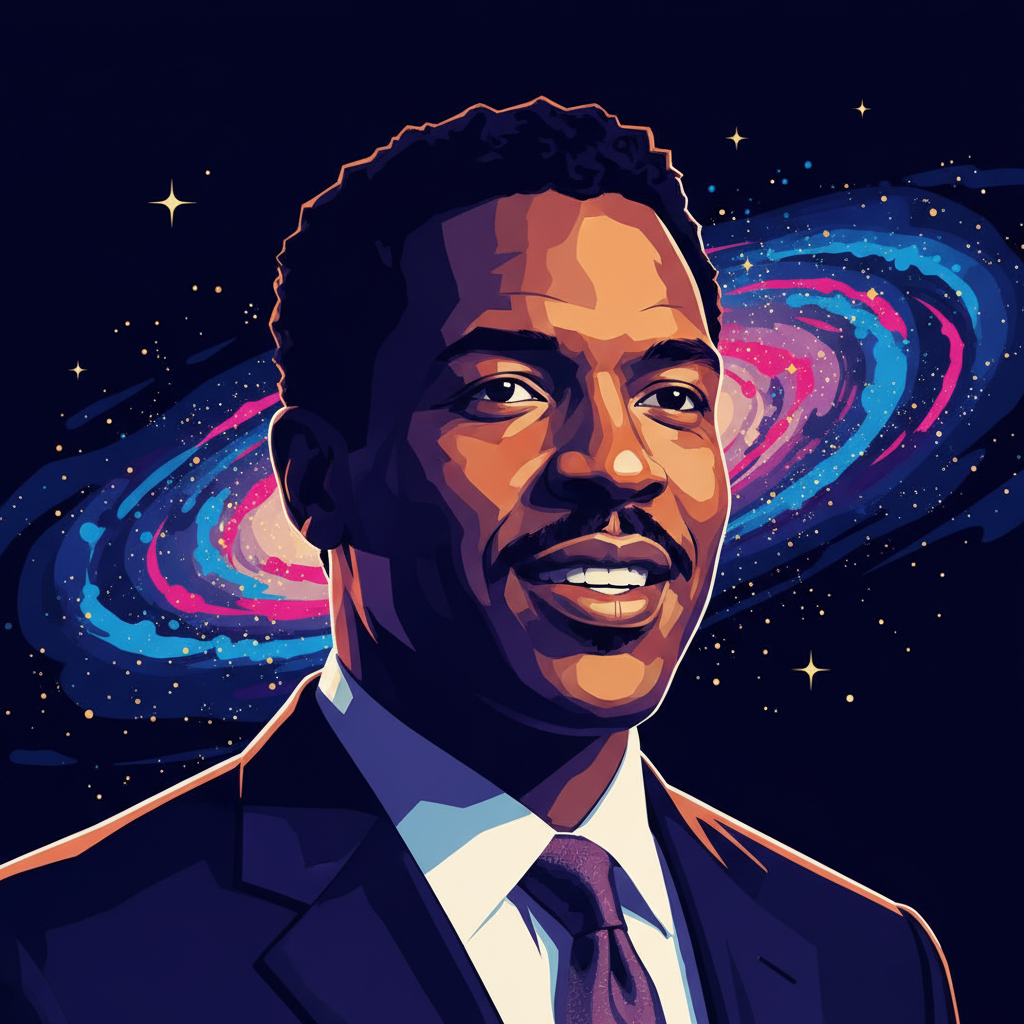
Neil deGrasse Tyson — "The universe is not just big. It's vast."
The universe is not just big. It's vast.
The universe is not just big. It's vast.
Click any product to generate a realistic preview. Up to 3 at a time.
* Initial load can take up to 90 seconds — revising the preview in another color is nearly instant.
"I don't want to live in a world where people don't understand science. That's a world of darkness."
"The universe is a hostile place. It will kill you if you're not careful."
"The problem with 'alternative medicine' is that once it's proven to work, it's just called medicine."
"We are all connected. To each other, biologically. To the Earth, chemically. To the rest of the universe, atomically."
"The greatest discovery is to find something you love to do and then figure out how to get paid for it."
American astrophysicist, Hayden Planetarium director, and Cosmos: A Spacetime Odyssey host who carries the Carl Sagan public-science mantle. Closely associated with Bill Nye (fellow science communicator) and Brian Greene (theoretical physicist and string-theory popularizer). For an intellectual contrast, see Ken Ham, founder of Answers in Genesis and the Creation Museum — Ham's career has been organized around defending biblical 6-day creationism — exactly the science-education position Tyson's mainstream-science communication is structured to refute.
Found in 1 providers: grok
1 source checked
Size descriptors like 'big' fall catastrophically short of cosmic reality. The universe spans 93 billion light-years of observable space alone, containing two trillion galaxies. 'Vast' gestures toward incomprehensibility itself — distances so extreme that human intuition, evolved for savanna-scale problems, simply breaks down. The point is not to impress but to recalibrate: our instincts about scale are wrong by dozens of orders of magnitude.
Tyson built his career on translating cosmic scale into emotional truth. As director of the Hayden Planetarium and host of Cosmos: A Spacetime Odyssey, he repeatedly returned to the theme that confronting the universe's true size produces humility, not despair. His books StarTalk and Astrophysics for People in a Hurry pursue exactly this project — stripping away comfortable approximations to reveal the genuine strangeness of existence.
Tyson speaks in an era of unprecedented cosmological discovery: the James Webb Space Telescope revealing galaxies from 300 million years post-Big Bang, gravitational wave detection opening new observational windows, and exoplanet catalogs numbering in the thousands. Simultaneously, science communication competes with misinformation at scale. Emphasizing vastness counters both cosmic parochialism and the cultural tendency to treat space as merely a backdrop for human ambition.
AI-generated insights based on extensive research and information for context. Factual errors? Email [email protected].
Your cart is empty