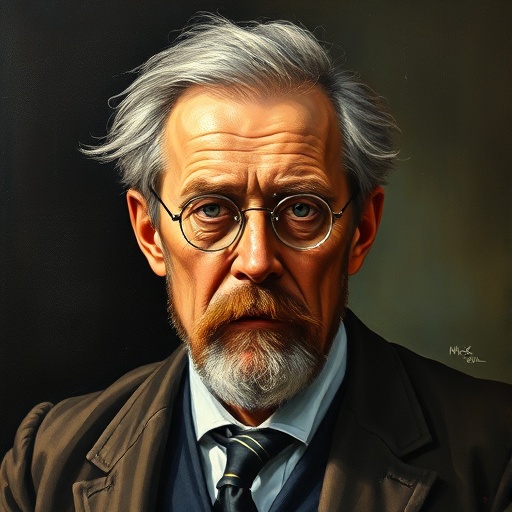
Max Planck — "The whole development of science is nothing but a continuous struggle to escape …"
The whole development of science is nothing but a continuous struggle to escape from the magic of the senses.
The whole development of science is nothing but a continuous struggle to escape from the magic of the senses.
Click any product to generate a realistic preview. Up to 3 at a time.
* Initial load can take up to 90 seconds — revising the preview in another color is nearly instant.
"My original decision to devote myself to science was a direct result of the discovery, which has never ceased to fill me with enthusiasm, that the laws of nature are accessible to human thought."
"An important scientific innovation rarely makes its way by gradually winning over and converting its opponents: it rarely happens that Saul becomes Paul."
"The true scientist is a man who is always asking questions, and never satisfied with the answers."
"Science advances one funeral at a time."
"The quantum hypothesis will never be understood until one realizes that it is only a provisional stopgap."
Found in 1 providers: grok
1 source checked
Science progresses by overcoming the limits of direct human perception. Our senses deliver a narrow, often misleading picture of reality, so real understanding requires instruments, mathematics, and abstractions that reveal what eyes and ears cannot detect. Planck is saying the history of discovery is essentially the steady effort to replace intuitive appearances with deeper, counterintuitive truths uncovered through reasoning, measurement, and theory rather than raw observation.
Planck personally lived this struggle. His 1900 discovery that energy comes in discrete quanta defied every classical intuition, including his own, and he resisted the implications for years before accepting them. A deeply philosophical physicist, he repeatedly wrote that the external world exists independently of observation and that real physics must push past sensory common sense. Quantum theory, which he founded, is the clearest case of science forcing humans to abandon perceptual assumptions about matter, energy, and causality.
Planck wrote amid the early twentieth-century revolution that shattered classical physics. Relativity, radioactivity, atomic structure, and quantum mechanics were overturning Newtonian certainties between 1900 and 1930. German science stood at the center of this upheaval, and Planck witnessed two world wars, the rise of Nazism, and the loss of his son. In that turbulent intellectual climate, sensory intuition repeatedly failed, and mathematical abstraction became the only reliable guide to understanding nature's hidden structure.
AI-generated insights based on extensive research and information for context. Factual errors? Email [email protected].
Your cart is empty