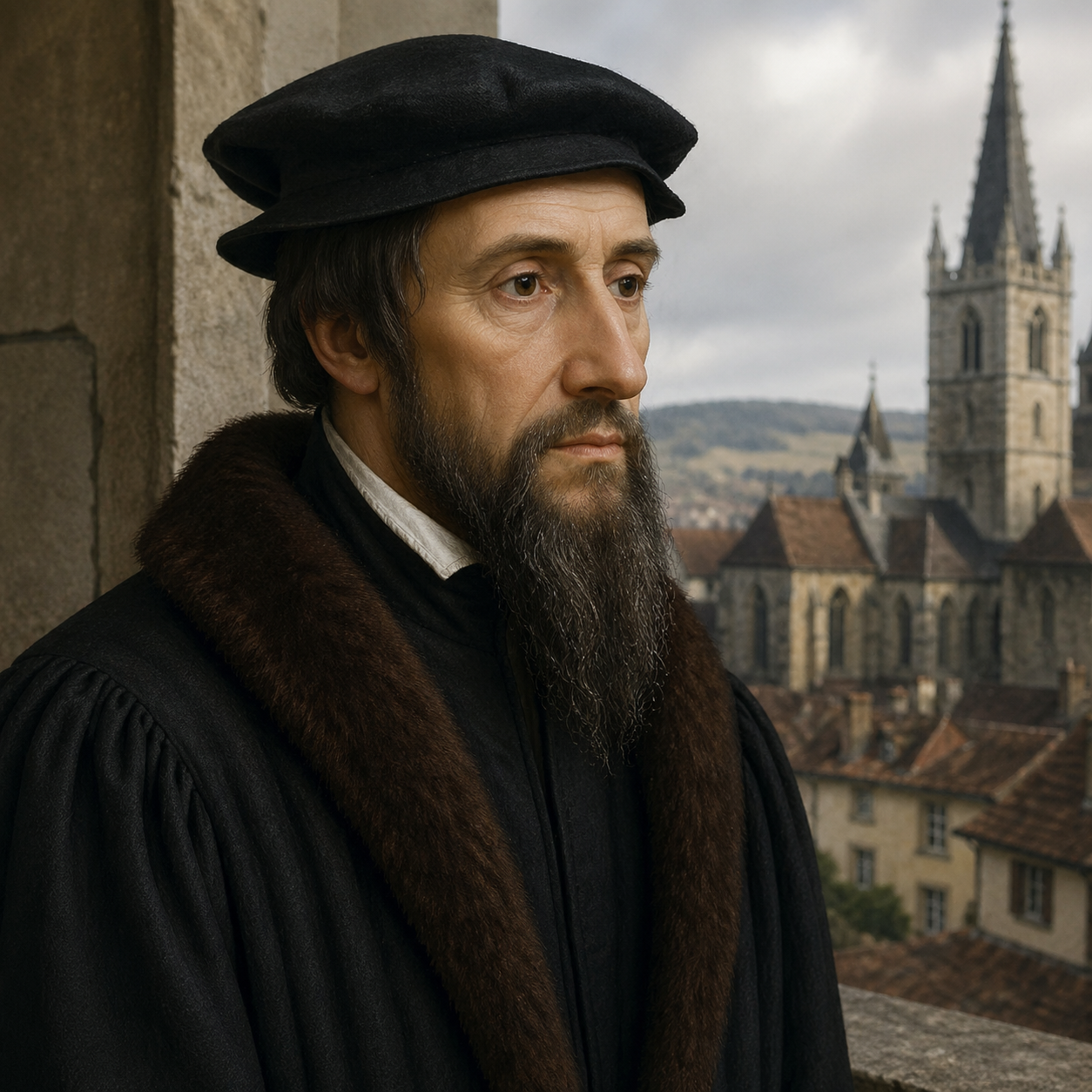
John Calvin — "The whole world is a theater of God's glory."
The whole world is a theater of God's glory.
The whole world is a theater of God's glory.
Click any product to generate a realistic preview. Up to 3 at a time.
* Initial load can take up to 90 seconds — revising the preview in another color is nearly instant.
"The reason why some are saved and others perish is not to be sought in their own will, but in the secret counsel of God."
"God blinds the minds of the reprobate, and hardens their hearts, that they may not believe."
"The reprobate are those whom God has determined to leave in their sins, and consequently to deliver to eternal perdition."
"This is not laid down on human authority; it is God who speaks and prescribes a perpetual rule for his Church."
"I hope that the verdict will call for the death penalty."
French theologian whose Institutes of the Christian Religion (1536) systematized Protestant Reformed doctrine, including predestination. Closely associated with Martin Luther (Reformation founder, Calvin's predecessor). For an intellectual contrast, see Jacobus Arminius, Dutch Reformed theologian (1560-1609) — Arminius's rejection of strict double-predestination founded Arminianism — the theological tradition modern Methodism, most evangelicalism, and Pentecostalism descend from. The Calvinist-Arminian debate has divided Protestantism for 400 years.
Institutes of the Christian Religion, Book I, Chapter 5, Section 8
Date: 1559
Art & CreativityFound in 1 providers: grok
1 source checked
All of creation—nature, history, human society—exists as a visible stage where God's power, wisdom, and beauty are continuously displayed. No part of life is spiritually neutral; everything from a sunrise to a political event reveals divine attributes. The world is not mere backdrop but active testimony. To truly see reality, one must learn to read creation as revelation of the God who made and governs it.
Calvin spent decades in Geneva building a theocracy where every domain—law, commerce, education, art—was accountable to God's sovereignty. His Institutes of the Christian Religion argued systematically that nature itself mirrors God's attributes. Exiled from France for his Protestant convictions, he understood God's authority transcended institutions. This quote captures his core belief: God's glory is the supreme purpose of all existence, not merely of formal church worship.
Calvin wrote in the 16th century as European explorers mapped unknown continents, Copernicus repositioned Earth in the cosmos, and the Reformation shattered the Church's monopoly on sacred knowledge. As Renaissance humanism celebrated human reason and discovery, Calvin's theatrical metaphor reoriented all inquiry toward divine glory. Creation was not a secular field for human mastery but a stage God designed, making science, politics, and art inherently theological acts.
AI-generated insights based on extensive research and information for context. Factual errors? Email [email protected].
Your cart is empty