Benjamin Franklin — "He that lies down with dogs shall rise up with fleas."
He that lies down with dogs shall rise up with fleas.
He that lies down with dogs shall rise up with fleas.
Click any product to generate a realistic preview. Up to 3 at a time.
* Initial load can take up to 90 seconds — revising the preview in another color is nearly instant.
"Industry need not wish, and he that lives upon hopes will die fasting."
"Anger is never without a Reason, but seldom with a good One."
"The greatest invention of the world is the invention of good bread."
"He who dines on human meat, shall never want for things to eat."
"If a man empties his purse into his head, no man can take it away from him. An investment in knowledge always pays the best interest."
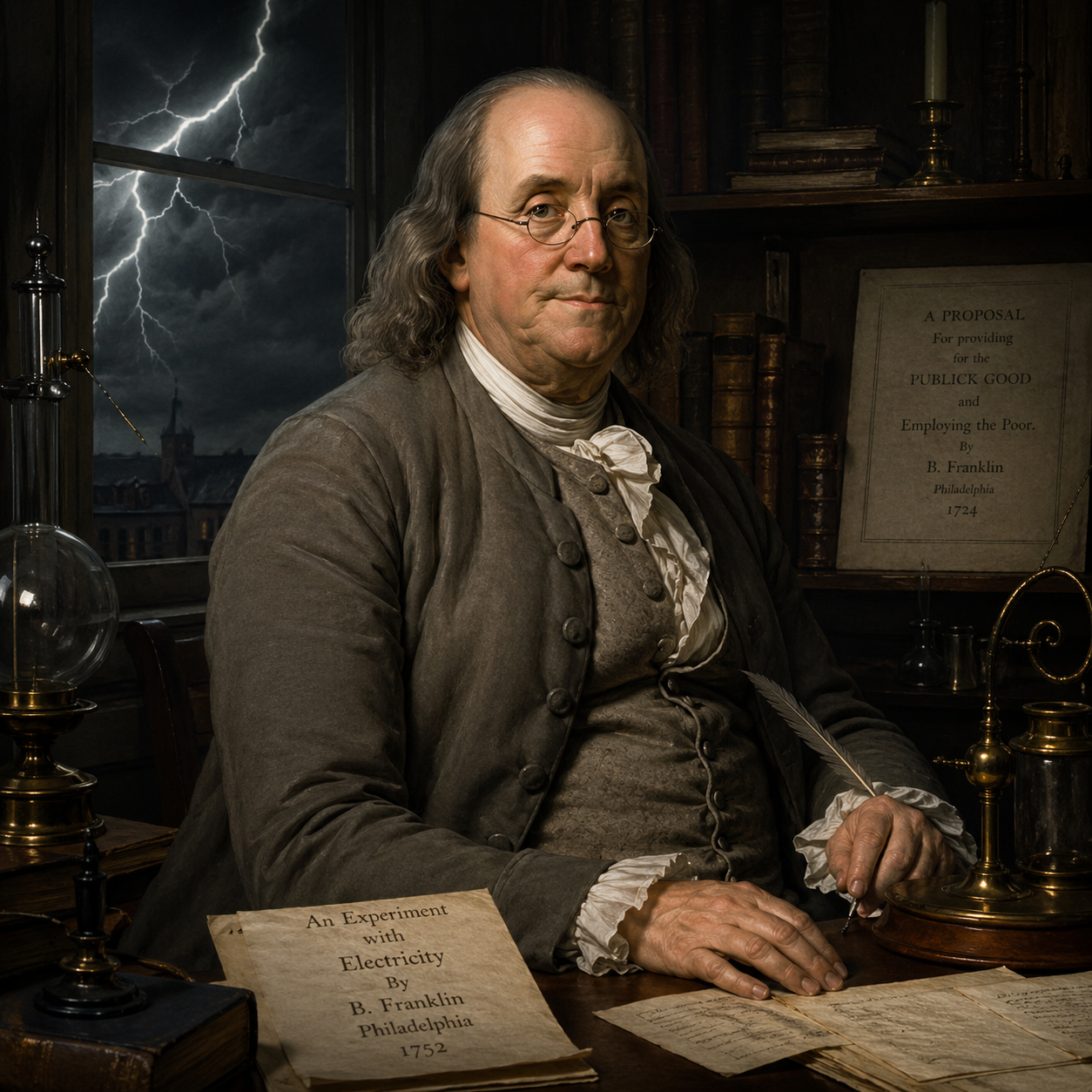
Polymath Founding Father, diplomat, and Poor Richard's Almanack author who helped draft the Declaration of Independence and the Constitution. Closely associated with John Adams (fellow Founder, Massachusetts statesman) and Thomas Jefferson (fellow Declaration drafter). For an intellectual contrast, see Thomas Hutchinson, last royal governor of colonial Massachusetts — Franklin leaked Hutchinson's loyalist correspondence to Boston in 1772 to inflame revolutionary sentiment — Hutchinson represented the colonial-aristocrat crown-loyalty that Franklin's revolution was organized to dismantle.
Found in 2 providers: deepseek,grok
2 sources checked
The company you keep shapes who you become. Spending time with people of poor character, bad habits, or low standards means you'll absorb their flaws and suffer their consequences—whether through corrupted behavior, damaged reputation, or practical misfortune. It's a plain warning: your associates are not neutral. Choose carefully who you spend time with, because proximity to trouble makes you vulnerable to it.
Franklin published this proverb in Poor Richard's Almanack, his annual publication running 1732–1758, where he compiled practical wisdom for ordinary colonists. A self-made tradesman who rose to diplomat and statesman through deliberate cultivation of useful relationships, Franklin lived this maxim. He meticulously chose his social circles—scientific societies, civic clubs, Parisian salons—and documented his self-improvement program across 13 virtues. He understood that reputation built through association determined a man's success.
Colonial America ran on reputation. In the 18th century, tight merchant communities, church congregations, and political clubs made a man's standing inseparable from his associates. The Enlightenment promoted rational self-cultivation, but class mobility remained fragile—a business scandal or criminal association could ruin decades of work. Franklin's Philadelphia, a fast-growing commercial hub, saw fortunes made and lost through networks of trust. Choosing companions carefully was not just moral advice but economic survival.
AI-generated insights based on extensive research and information for context. Factual errors? Email [email protected].
Your cart is empty