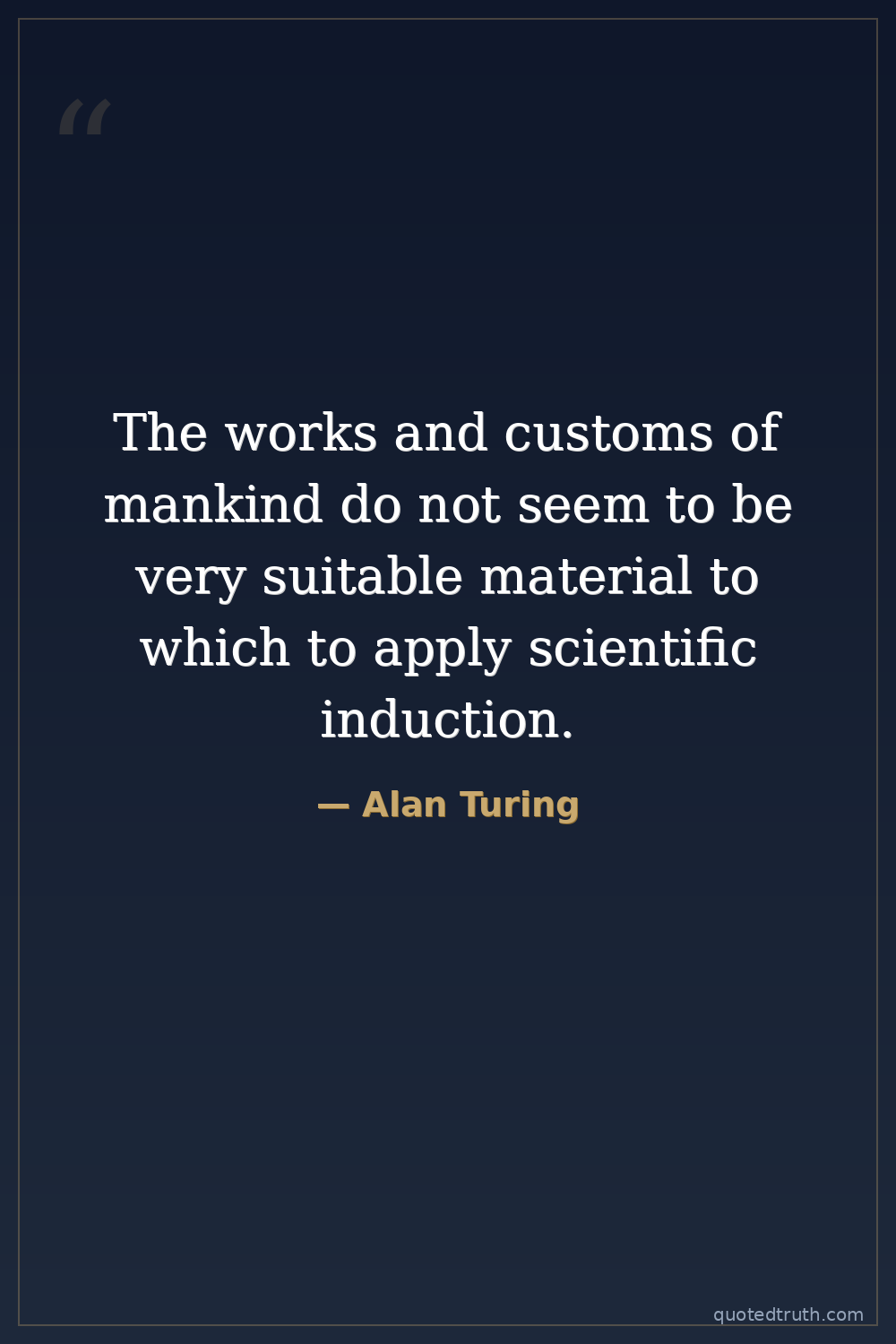
Alan Turing — "The works and customs of mankind do not seem to be very suitable material to whi…"
The works and customs of mankind do not seem to be very suitable material to which to apply scientific induction.
The works and customs of mankind do not seem to be very suitable material to which to apply scientific induction.
Click any product to generate a realistic preview. Up to 3 at a time.
* Initial load can take up to 90 seconds — revising the preview in another color is nearly instant.
"The power of machines will one day be so great that they will be able to do anything we can do, and more."
"It is not easy to devise a game which is fair in this respect between the machine and the man."
"I see no reason why a machine should not be able to have emotions."
"It is not possible to produce a machine which will be intelligent in the same way that a human being is intelligent."
"Logic will get you from A to B. Imagination will take you everywhere."
Found in 1 providers: gemini
1 source checked
Human behavior and social customs resist scientific analysis because they are too variable, context-dependent, and shaped by individual will. Unlike physical phenomena that follow consistent laws, what people do and how societies operate cannot be reliably predicted or systematized through empirical observation and pattern-matching alone. Human affairs defy the neat generalizations that science depends on.
Turing built machines that processed logic with absolute precision, yet this observation reveals his awareness of science's limits. As someone who cracked Enigma by exploiting systematic patterns in German military communications, he understood deeply when patterns existed and when they didn't. His own persecution for homosexuality—an irrational social custom—personally demonstrated how human behavior defies rational induction.
Written in the early 1950s, amid post-war optimism about applying scientific rationalism to human problems—behaviorism, cybernetics, social engineering. Governments believed computation and systems thinking could optimize society. Turing, working at the dawn of computing, pushed back against naive scientism, recognizing that the messy, culturally embedded nature of human customs resists the clean formalism his machines demanded.
AI-generated insights based on extensive research and information for context. Factual errors? Email [email protected].
Your cart is empty