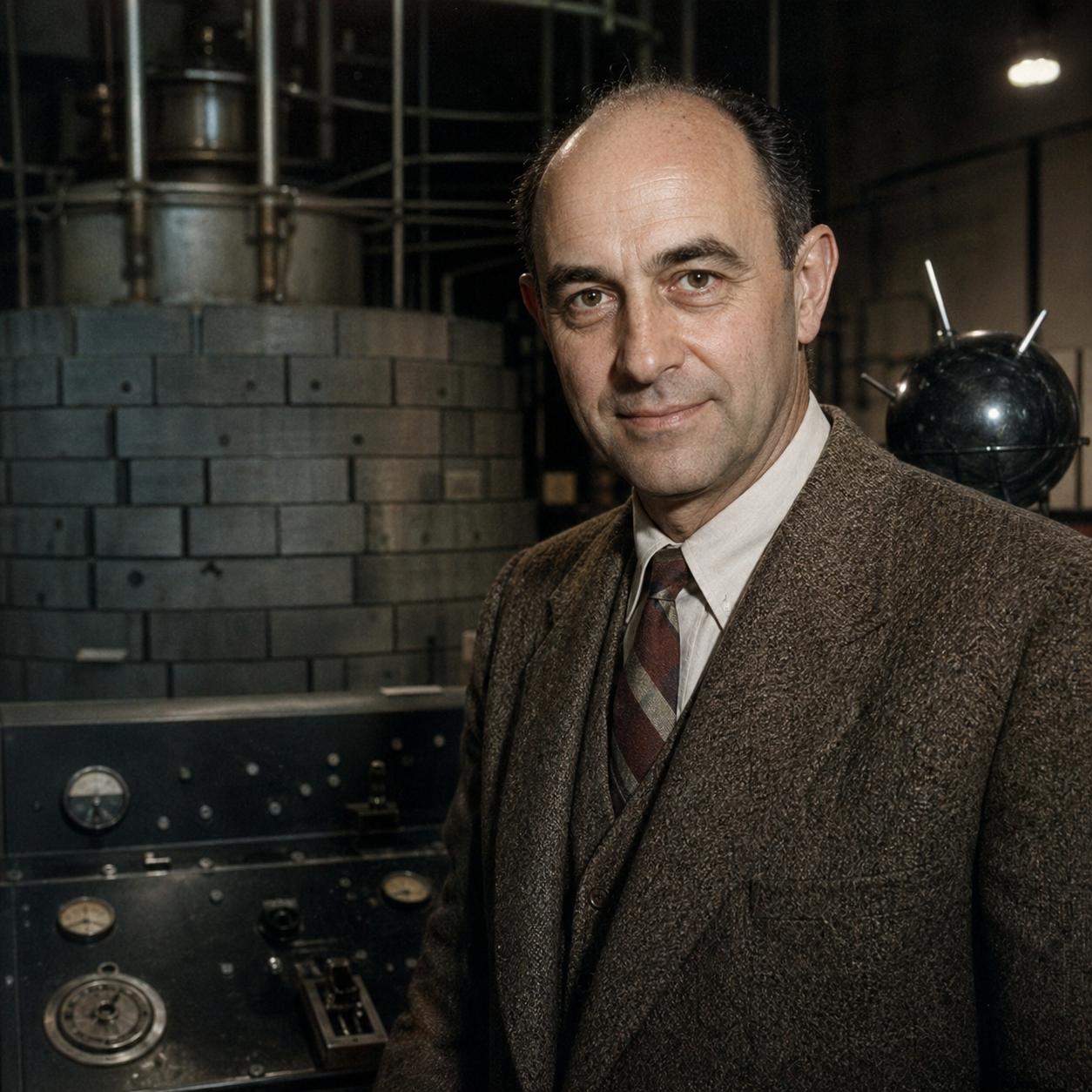
Enrico Fermi — "The world has been changed, for good or ill."
The world has been changed, for good or ill.
The world has been changed, for good or ill.
Click any product to generate a realistic preview. Up to 3 at a time.
* Initial load can take up to 90 seconds — revising the preview in another color is nearly instant.
"The only trouble is that the damn stuff is radioactive."
"There is no such thing as a trivial experiment."
"I hope it won't take long."
"Never make anything more accurate than it needs to be."
"I am an optimist, because I believe that man is capable of solving his problems."
Found in 1 providers: grok
1 source checked
Some actions permanently alter the course of history, and no one can fully control whether the outcome proves beneficial or catastrophic. This is an acknowledgment that transformative change — especially scientific — carries irreversible consequences that outlast the intentions of those who set it in motion. Rather than celebrating or lamenting, it simply states a fact: things are fundamentally different now, and humanity must live with that reality, for better or worse.
Fermi built the world's first self-sustaining nuclear reactor (Chicago Pile-1, December 1942) and was a central Manhattan Project contributor, personally demonstrating that sustained fission was achievable. He watched the nuclear age he helped create lead directly to Hiroshima and Nagasaki. Known for detached, precise thinking rather than emotional expression, this phrase reflects his honest reckoning — neither pride nor guilt, just a scientist acknowledging that he and his colleagues had permanently altered civilization's trajectory.
Fermi worked during the 1940s–1950s, when nuclear physics transformed from theoretical curiosity to world-altering force. The Manhattan Project, the atomic bombings of Japan, and the subsequent Cold War arms race defined the era. Scientists grappled publicly with their role — Oppenheimer spoke of sin; others joined weapons labs without apology. Society simultaneously feared atomic annihilation and dreamed of nuclear energy powering the future, making moral ambiguity about scientific progress the defining tension of the age.
AI-generated insights based on extensive research and information for context. Factual errors? Email [email protected].
Your cart is empty