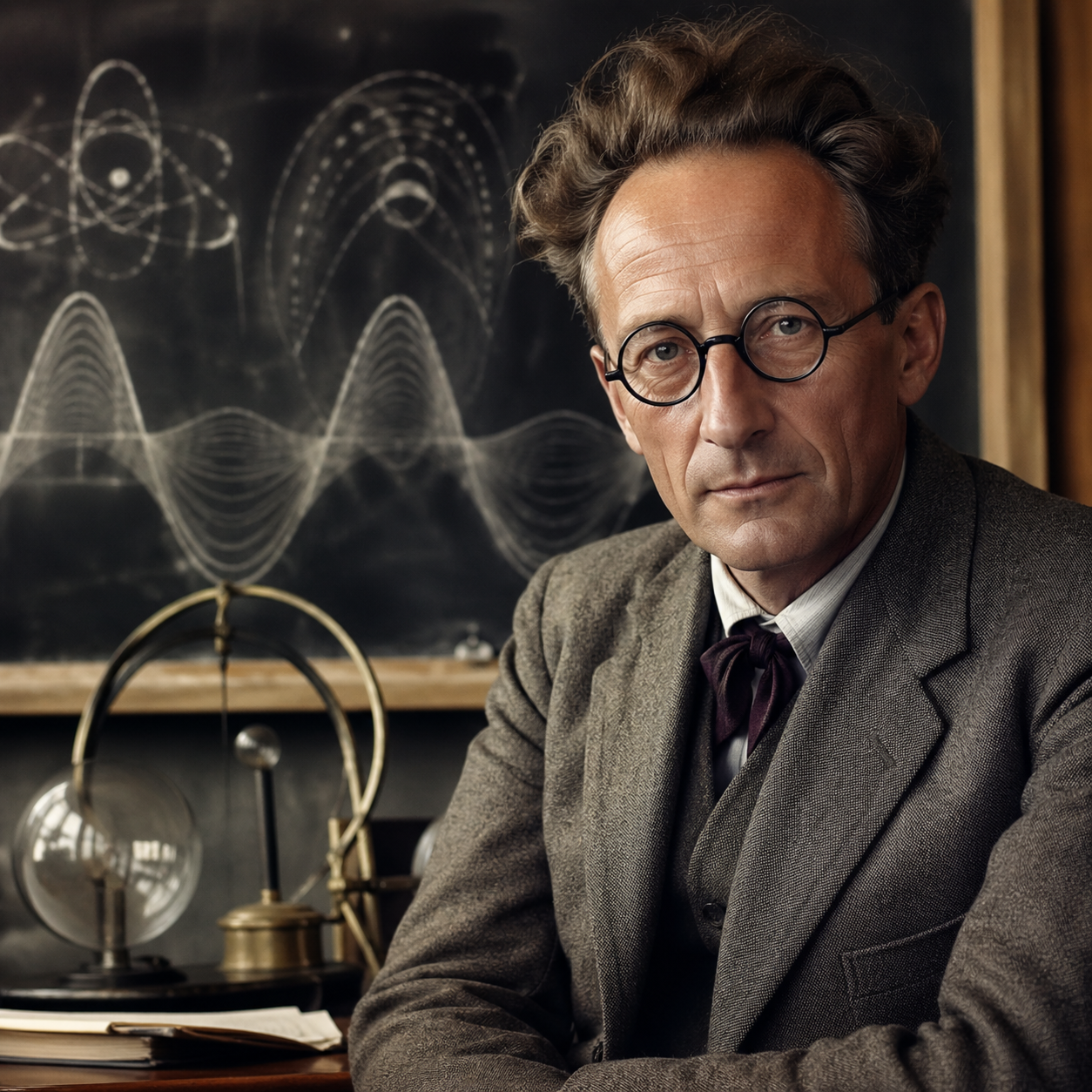
Erwin Schrodinger — "The world is a book, and those who do not travel read only one page."
The world is a book, and those who do not travel read only one page.
The world is a book, and those who do not travel read only one page.
Click any product to generate a realistic preview. Up to 3 at a time.
* Initial load can take up to 90 seconds — revising the preview in another color is nearly instant.
"This life of yours which you are living is not merely a piece of the entire existence, but is in a certain sense the whole; only this whole is not so constituted that it can be surveyed in a single gl…"
"My solution was not motivated by the desire to reduce the number of independent constants in nature, but rather by the desire to avoid the infinite self-energy of the electron."
"The path to knowledge is paved with doubt."
"The most important thing is not to stop questioning. Curiosity has its own reason for existence."
"The problem of consciousness is the most difficult problem in science."
Austrian physicist who shared the 1933 Nobel for the wave equation that bears his name and the famous cat thought-experiment. Closely associated with Werner Heisenberg (matrix-mechanics rival who reached the same physics by different math) and Albert Einstein (his pen-pal on quantum interpretation). For an intellectual contrast, see Niels Bohr, Danish physicist and architect of the Copenhagen interpretation — Schrödinger's cat thought-experiment was specifically designed to ridicule Bohr's 'observer-dependent reality' reading of quantum mechanics — Schrödinger thought the Copenhagen interpretation was absurd; the cat was meant as reductio ad absurdum.
Found in 1 providers: grok
1 source checked
The quote urges direct experience over secondhand knowledge. One place, one culture, one perspective represents a single page in an infinitely rich text. Genuine understanding demands encountering different peoples, landscapes, and ways of life. Travel dismantles assumptions, broadens empathy, and reveals existence's complexity. Remaining stationary—geographically or intellectually—leaves most of that book unread, permanently limiting your comprehension of what the world actually contains and how its parts connect.
Schrödinger embodied this through necessity and curiosity alike. Fleeing Nazi-annexed Austria in 1933, he moved through Berlin, Oxford, Graz, and spent seventeen formative years in Dublin. Each relocation reshaped his thinking. He also crossed disciplines—his book What is Life? brought quantum concepts into biology, influencing the DNA double-helix discovery. His deep engagement with Indian Vedanta philosophy, absorbed through wide reading, directly informed his unconventional views on consciousness and physical reality.
The early twentieth century was simultaneously a golden age of physics and an era of catastrophic upheaval. The quantum revolution unfolded across international borders—Copenhagen, Göttingen, Vienna, Cambridge—as scientists physically traveled to collaborate and debate. Simultaneously, rising nationalism forced Jewish and dissident intellectuals into exile. This era proved that intellectual progress required cross-border exchange, while demonstrating that insularity bred tribalism and catastrophe, making the call to broaden one's world urgently, literally life-or-death relevant.
AI-generated insights based on extensive research and information for context. Factual errors? Email [email protected].
Your cart is empty