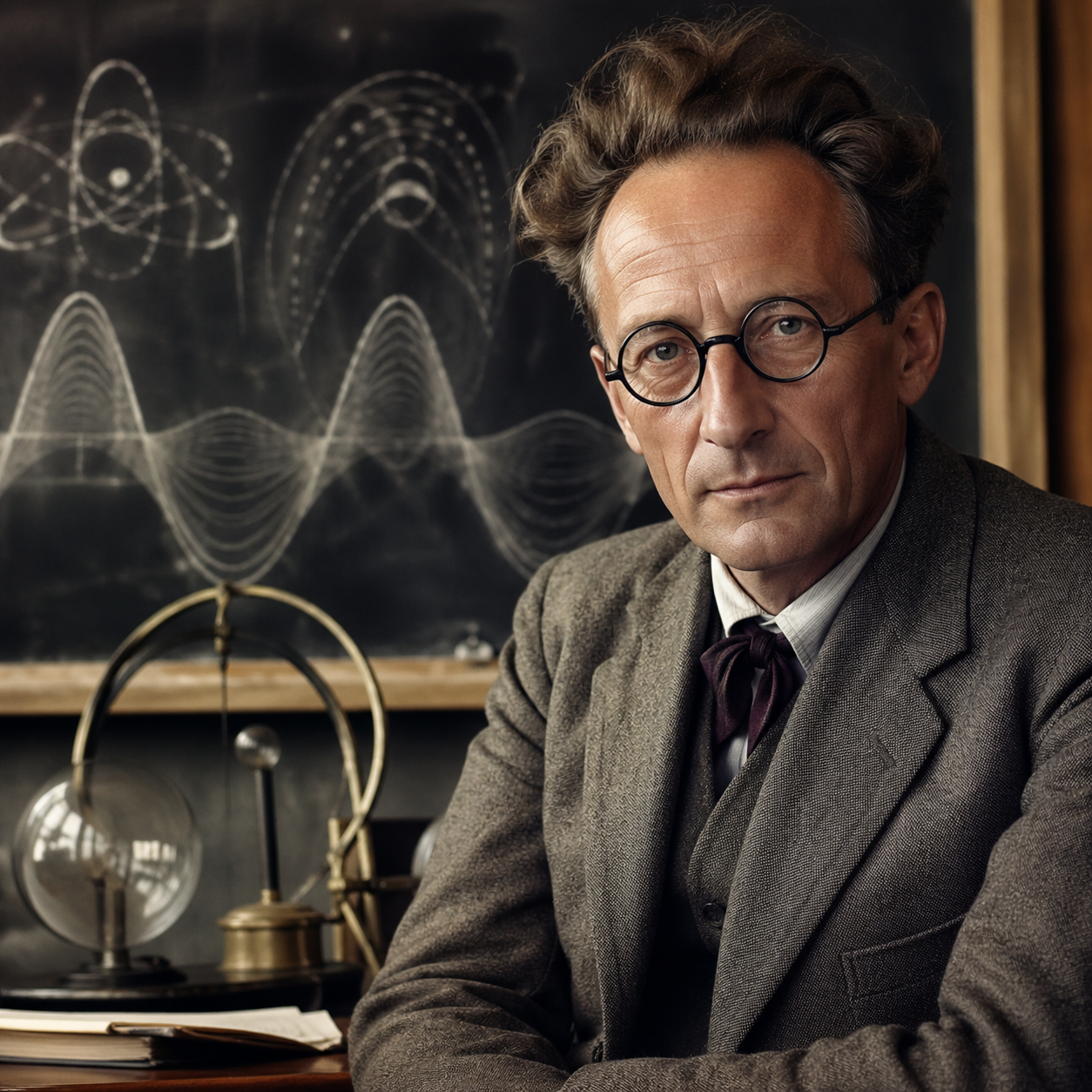
Erwin Schrodinger — "The path to knowledge is paved with doubt."
The path to knowledge is paved with doubt.
The path to knowledge is paved with doubt.
Click any product to generate a realistic preview. Up to 3 at a time.
* Initial load can take up to 90 seconds — revising the preview in another color is nearly instant.
"I consider the idea of a personal God as being very childish. We must give up this idea."
"The true meaning and purpose of human life lies in our striving for understanding and knowledge."
"Consciousness cannot be accounted for in physical terms. For consciousness is absolutely fundamental. It cannot be accounted for in terms of anything else."
"I am very astonished that the scientific picture of the real world around me is very deficient. It gives a lot of factual information, puts all our experience in a magnificently consistent order, but …"
"The only real valuable thing is intuition."
Austrian physicist who shared the 1933 Nobel for the wave equation that bears his name and the famous cat thought-experiment. Closely associated with Werner Heisenberg (matrix-mechanics rival who reached the same physics by different math) and Albert Einstein (his pen-pal on quantum interpretation). For an intellectual contrast, see Niels Bohr, Danish physicist and architect of the Copenhagen interpretation — Schrödinger's cat thought-experiment was specifically designed to ridicule Bohr's 'observer-dependent reality' reading of quantum mechanics — Schrödinger thought the Copenhagen interpretation was absurd; the cat was meant as reductio ad absurdum.
Found in 1 providers: grok
1 source checked
Genuine understanding requires questioning assumptions rather than accepting information passively. Doubt is not weakness or ignorance—it is the engine of inquiry. To truly learn something, you must first challenge it, probe its edges, and resist premature certainty. Knowledge earned through skeptical examination is far more durable and trustworthy than belief accepted without scrutiny.
Schrödinger embodied productive doubt throughout his career. His famous thought experiment—Schrödinger's Cat—was itself an act of radical doubt, designed to expose contradictions in Copenhagen quantum interpretation. He questioned Bohr's orthodoxy when most physicists deferred. His wave equation emerged from dissatisfaction with existing atomic models, proving that skepticism toward established frameworks could yield transformative discovery.
The early twentieth century shattered classical physics certainties. Relativity and quantum mechanics demolished Newtonian absolutes that had stood for centuries. Scientists like Schrödinger operated amid profound institutional and philosophical upheaval—competing interpretations of reality, the rise of positivism, and Einstein's revolution. In this environment, doubt was not destabilizing but generative, as foundational assumptions collapsed and demanded replacement through rigorous questioning.
AI-generated insights based on extensive research and information for context. Factual errors? Email [email protected].
Your cart is empty