Erwin Schrodinger — "The world is a dream, but it is a dream that we can shape."
The world is a dream, but it is a dream that we can shape.
The world is a dream, but it is a dream that we can shape.
Click any product to generate a realistic preview. Up to 3 at a time.
* Initial load can take up to 90 seconds — revising the preview in another color is nearly instant.
"The fundamental laws of physics are statistical. They do not determine precisely what will happen, but only the probability of what will happen."
"I don't like it, and I'm sorry I ever had anything to do with it."
"Even if I should be right in this, I do not know whether my way of approach is really the best and simplest. But, in short, it was mine."
"The problem of the 'thing in itself' is not a problem that can be solved by science. It is a philosophical problem."
"This life of yours which you are living is not merely a piece of the entire existence, but is in a certain sense the whole; only this whole is not so constituted that it can be surveyed in a single gl…"
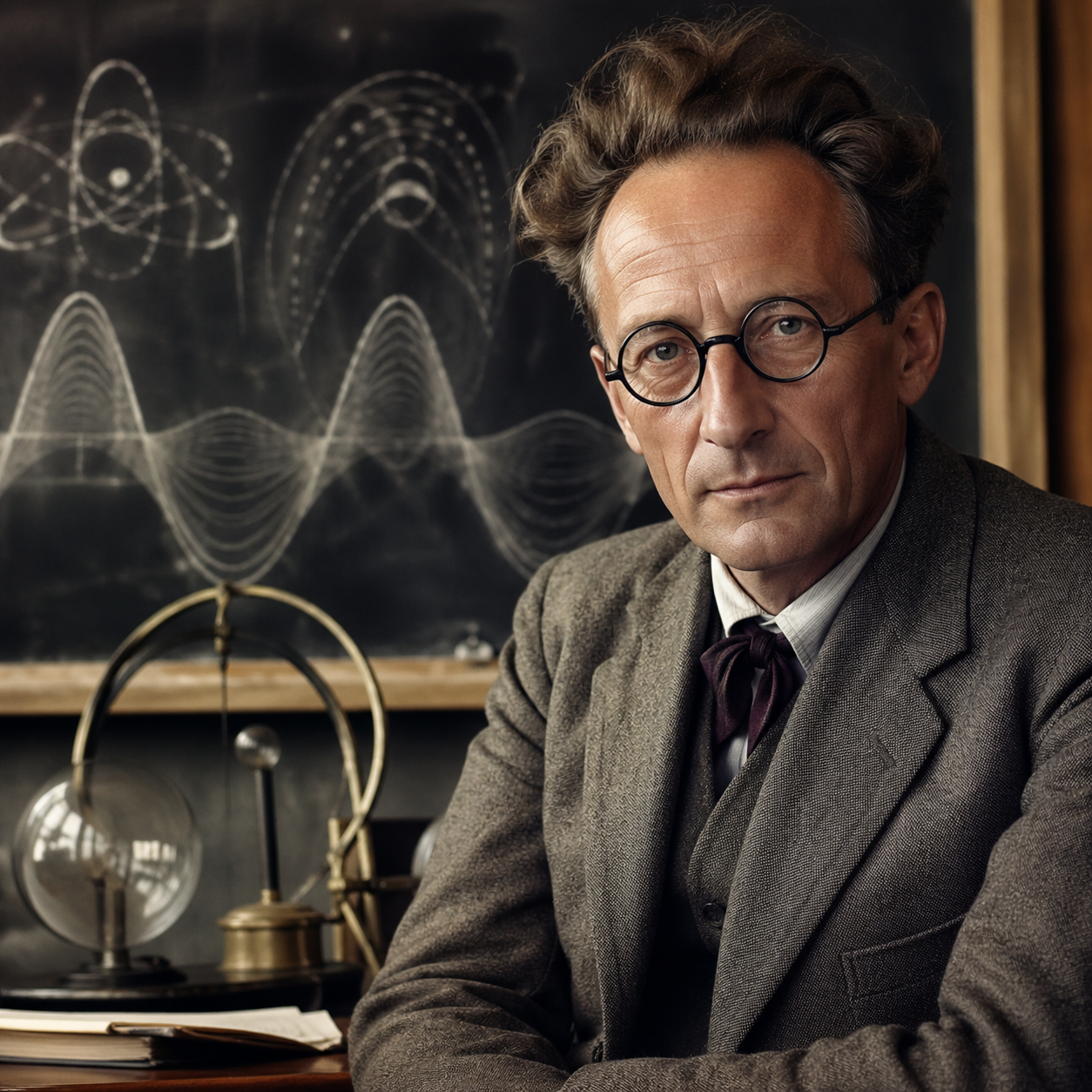
Austrian physicist who shared the 1933 Nobel for the wave equation that bears his name and the famous cat thought-experiment. Closely associated with Werner Heisenberg (matrix-mechanics rival who reached the same physics by different math) and Albert Einstein (his pen-pal on quantum interpretation). For an intellectual contrast, see Niels Bohr, Danish physicist and architect of the Copenhagen interpretation — Schrödinger's cat thought-experiment was specifically designed to ridicule Bohr's 'observer-dependent reality' reading of quantum mechanics — Schrödinger thought the Copenhagen interpretation was absurd; the cat was meant as reductio ad absurdum.
Found in 1 providers: grok
1 source checked
Reality isn't fixed or objectively solid — it's fluid, shaped by perception and active participation. The quote rejects both rigid materialism, which treats the world as immovably concrete, and passive fatalism, which treats it as beyond our influence. Instead, it positions humans as co-creators of experience. The 'dream' isn't dismissive of reality but describes its malleable, constructed nature — something we encounter, interpret, and genuinely transform through thought and deliberate action.
Schrödinger was steeped in Vedanta philosophy, which frames reality as maya — a layered illusion shaped by consciousness. His wave equation described particles not as fixed objects but as probability distributions, making reality indeterminate until observed. His cat paradox dramatized this directly: a system exists in superposition until measurement collapses it. His book 'My View of the World' explicitly argued that mind and matter aren't separate, and that consciousness participates in constructing what we call reality.
Schrödinger worked during the quantum revolution of the 1920s–1940s, when classical physics' clockwork certainty collapsed entirely. The Copenhagen interpretation suggested particles hold no definite state until measured — reality itself was contested. Meanwhile, two World Wars demonstrated catastrophically that human choices reshape civilization. The tension between determinism and agency was live and urgent. Science was rewriting what 'real' meant, while history proved that collective human will could remake — or unmake — the world.
AI-generated insights based on extensive research and information for context. Factual errors? Email [email protected].
Your cart is empty