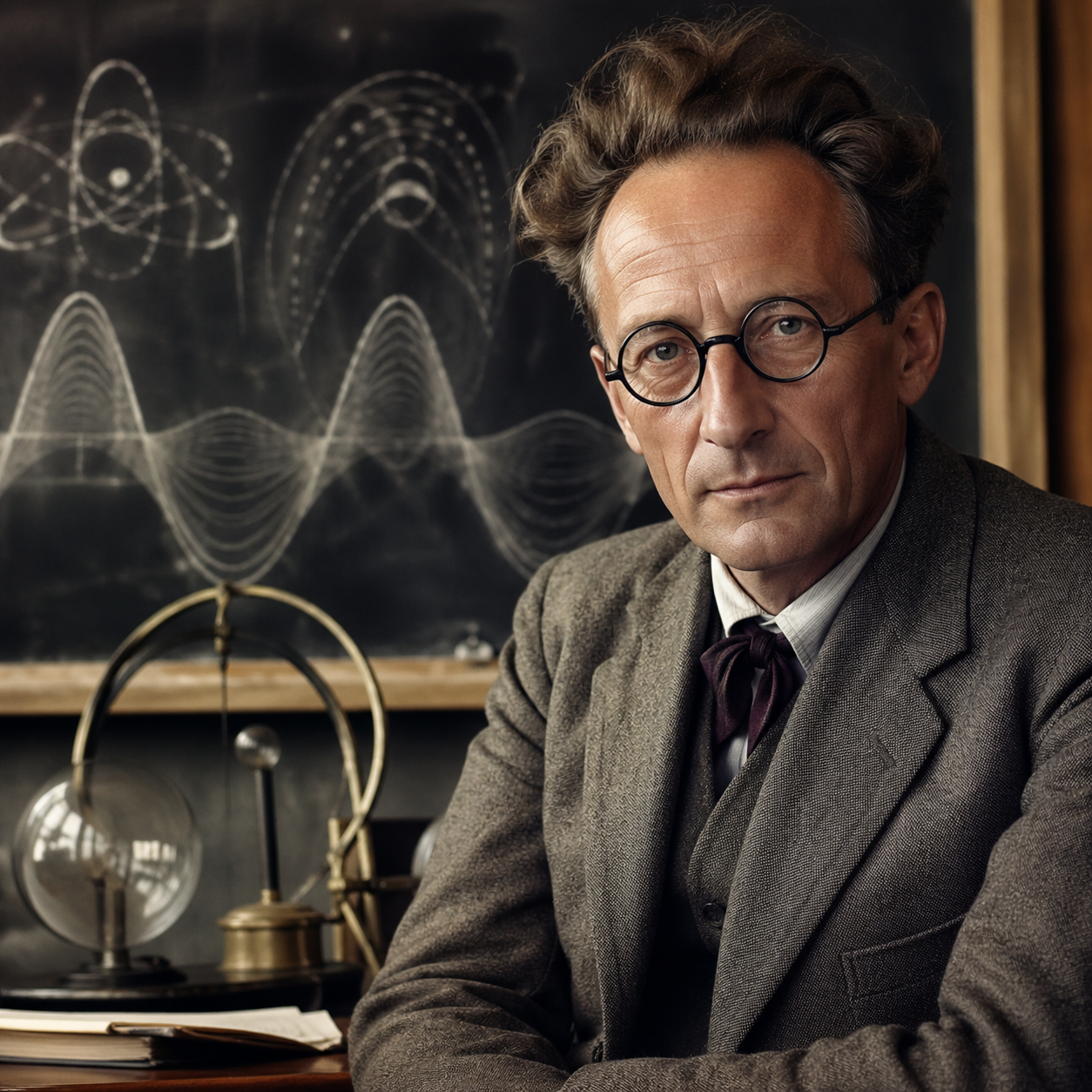
Erwin Schrodinger — "What we observe as material bodies and forces are nothing but shapes and variati…"
What we observe as material bodies and forces are nothing but shapes and variations in the structure of space.
What we observe as material bodies and forces are nothing but shapes and variations in the structure of space.
Click any product to generate a realistic preview. Up to 3 at a time.
* Initial load can take up to 90 seconds — revising the preview in another color is nearly instant.
"We do not belong to this material world that science constructs for us. We are not in it; we are outside. We are only spectators. The reason why we believe that we are in it, that we belong to the pic…"
"The scientist only imposes the laws of nature on nature."
"The unity and continuity of Vedanta are reflected in the unity and continuity of wave mechanics. This is a brilliant insight."
"The world is not a machine. It is a living being."
"The universe is a grand illusion. But it is a very persistent one."
Austrian physicist who shared the 1933 Nobel for the wave equation that bears his name and the famous cat thought-experiment. Closely associated with Werner Heisenberg (matrix-mechanics rival who reached the same physics by different math) and Albert Einstein (his pen-pal on quantum interpretation). For an intellectual contrast, see Niels Bohr, Danish physicist and architect of the Copenhagen interpretation — Schrödinger's cat thought-experiment was specifically designed to ridicule Bohr's 'observer-dependent reality' reading of quantum mechanics — Schrödinger thought the Copenhagen interpretation was absurd; the cat was meant as reductio ad absurdum.
From 'Nature and the Greeks', a philosophical statement on the fundamental nature of reality.
Date: 1954
ShockingFound in 1 providers: gemini
1 source checked
Everything we perceive as solid matter and physical forces is not actually made of tiny independent things. Instead, what looks like objects and pushes and pulls are really patterns, ripples, and geometric distortions within space itself. The universe is not a collection of separate particles bouncing around in empty void; it is one continuous fabric, and what we call stuff is just how that fabric bends, vibrates, and arranges itself locally.
Schrodinger built wave mechanics in 1926, replacing the picture of electrons as tiny billiard balls with continuous wavefunctions spread through space. His famous equation describes matter as standing waves, not points. Philosophically inclined and steeped in Vedantic monism, he resisted the particle interpretation and believed reality was fundamentally unified. This quote captures his lifelong conviction that matter is a manifestation of underlying continuous structure, not discrete substance.
In the 1920s and 1930s, physics was being rewritten. Einstein's general relativity (1915) had already recast gravity as curvature of spacetime, and quantum mechanics was dissolving the classical atom. Schrodinger worked amid Bohr, Heisenberg, and Born, debating whether reality was waves, particles, or probability. Europe between the wars was also a hotbed of philosophical reexamination, and physicists openly speculated about the metaphysical implications of their equations.
AI-generated insights based on extensive research and information for context. Factual errors? Email [email protected].
Your cart is empty