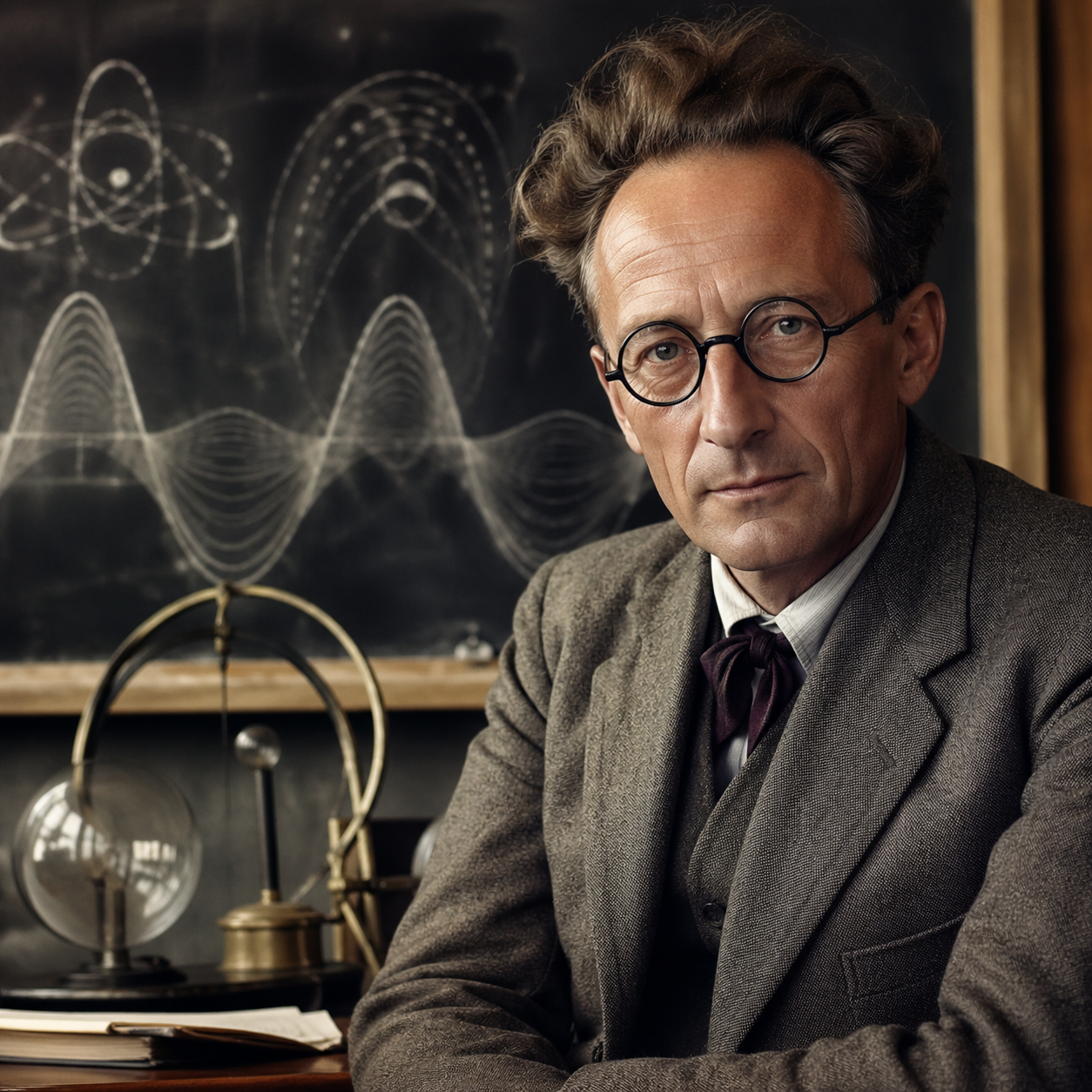
Erwin Schrodinger — "The world is a mystery, and we are here to unravel it."
The world is a mystery, and we are here to unravel it.
The world is a mystery, and we are here to unravel it.
Click any product to generate a realistic preview. Up to 3 at a time.
* Initial load can take up to 90 seconds — revising the preview in another color is nearly instant.
"I am born into an environment — I know not whence I came nor whither I go nor who I am."
"Our [Western] science has cut itself off from an adequate understanding of the Subject of Cognizance, of the mind."
"It is not possible that this unity of knowledge, feeling and choice which you call your own should have sprung into being from nothingness at a given moment not so long ago; rather this knowledge, fee…"
"The scientist only imposes the laws of nature on nature."
"The ultimate goal of science is to understand the universe and our place in it."
Austrian physicist who shared the 1933 Nobel for the wave equation that bears his name and the famous cat thought-experiment. Closely associated with Werner Heisenberg (matrix-mechanics rival who reached the same physics by different math) and Albert Einstein (his pen-pal on quantum interpretation). For an intellectual contrast, see Niels Bohr, Danish physicist and architect of the Copenhagen interpretation — Schrödinger's cat thought-experiment was specifically designed to ridicule Bohr's 'observer-dependent reality' reading of quantum mechanics — Schrödinger thought the Copenhagen interpretation was absurd; the cat was meant as reductio ad absurdum.
Found in 1 providers: grok
1 source checked
Reality is not self-evident or fully transparent — it conceals deep structure that demands active investigation. We exist not merely to observe the world passively but to interrogate it, strip away appearances, and expose underlying patterns. Understanding is a duty, not a luxury. The universe withholds its logic until pressed by rigorous curiosity and disciplined thought.
Schrödinger spent his career dismantling apparent certainties — his wave equation revealed particles as probability clouds rather than definite objects, and his famous cat paradox exposed quantum measurement as irreducibly mysterious. He wrote 'What is Life?' crossing into biology, refusing disciplinary boundaries. Mystery was not an obstacle to him but the engine of his entire intellectual life.
Schrödinger worked through the 1920s–1950s, when classical physics was collapsing under quantum and relativistic discoveries. Einstein, Bohr, and Heisenberg were rewriting reality itself. Old deterministic certainties evaporated; the atom proved stranger than imagination. This was an era when 'mystery' was not poetic license but a precise scientific condition — nature genuinely resisted complete classical description.
AI-generated insights based on extensive research and information for context. Factual errors? Email [email protected].
Your cart is empty