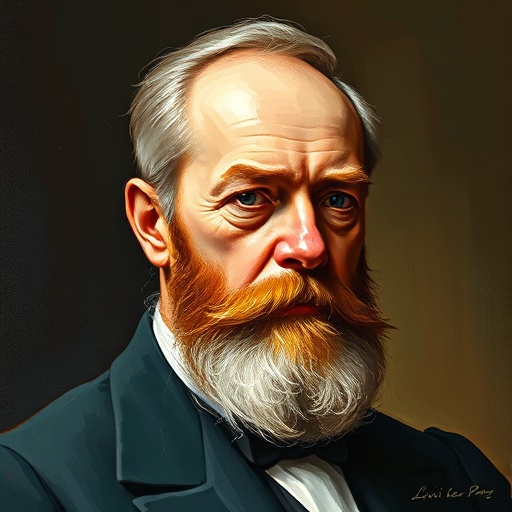
Louis Pasteur — "The world is full of wonders, but they are only visible to the eyes that know ho…"
The world is full of wonders, but they are only visible to the eyes that know how to see them.
The world is full of wonders, but they are only visible to the eyes that know how to see them.
Click any product to generate a realistic preview. Up to 3 at a time.
* Initial load can take up to 90 seconds — revising the preview in another color is nearly instant.
"Little science takes you away from God but more of it takes you to Him."
"I am convinced that I have found the cause of fermentation."
"I have great hopes that the vaccine against rabies will be a success."
"Posterity will one day laugh at the sublime foolishness of the modern materialistic philosophy."
"The more I learn, the more I realize how much I don't know."
Attributed, suggesting a deeper appreciation for observation.
Date: Late 19th Century (approx.)
WisdomFound in 1 providers: grok
1 source checked
Reality is packed with remarkable phenomena, but noticing them requires trained attention. Most people walk past extraordinary things because they lack the curiosity, knowledge, or discipline to recognize what is in front of them. Seeing well is a skill, not a default. The quote argues that wonder is less about the world being interesting and more about the observer learning to look carefully, ask questions, and interpret what ordinary eyes overlook.
Pasteur built his career on seeing what others missed. Peering through microscopes, he recognized that invisible microorganisms caused fermentation, spoilage, and disease, overturning spontaneous generation. His work on pasteurization, anthrax, and rabies vaccines came from patient observation of phenomena dismissed as trivial. As a chemist trained in crystallography, he first distinguished molecular handedness by noticing tiny asymmetries. The line captures his conviction that disciplined, prepared minds transform mundane samples into revolutionary discoveries.
Pasteur worked during the nineteenth-century scientific revolution, when improved microscopes, germ theory, and laboratory methods were reshaping medicine, agriculture, and industry. Europe faced cholera outbreaks, silkworm epidemics, and wine spoilage crises that demanded empirical answers. Rival theories like spontaneous generation still dominated, and many physicians rejected invisible microbes. Against this backdrop, careful observation and experiment were radical tools. Pasteur's France was also industrializing rapidly, making scientific 'seeing' economically vital for brewers, farmers, and public health officials.
AI-generated insights based on extensive research and information for context. Factual errors? Email [email protected].
Your cart is empty