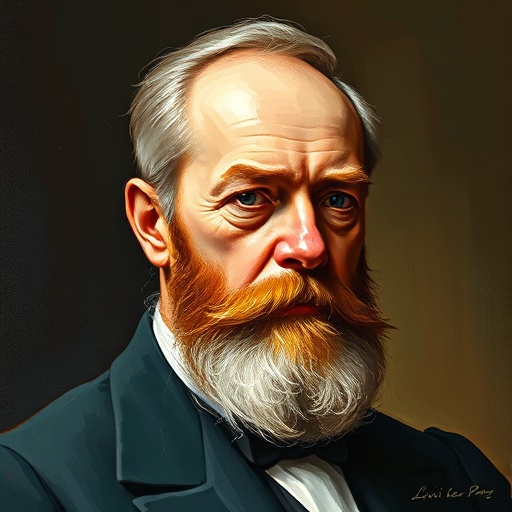
Louis Pasteur — "One must have a certain amount of daring to embark on a scientific career."
One must have a certain amount of daring to embark on a scientific career.
One must have a certain amount of daring to embark on a scientific career.
Click any product to generate a realistic preview. Up to 3 at a time.
* Initial load can take up to 90 seconds — revising the preview in another color is nearly instant.
"Science knows no country, because knowledge belongs to humanity, and is the torch which illuminates the world. Science is the highest embodiment of the patriotism of nations."
"The greatest error is to believe that one knows everything."
"Wine is the most healthful and hygienic of beverages."
"The true scientist is a man of faith, for he believes in the order and harmony of the universe."
"The greatest victory is that over oneself."
Attributed, acknowledging the challenges inherent in scientific research.
Date: Late 19th Century (approx.)
WisdomFound in 1 providers: grok
1 source checked
Pursuing science requires real courage. You commit years to uncertain results, risk being wrong in public, challenge established authorities, and often work without guaranteed pay or recognition. The quote says you cannot play it safe and do serious research; you have to accept the possibility of failure, ridicule, and dead ends as part of the job.
Pasteur lived this. He staked his reputation on germ theory when most doctors still believed in spontaneous generation, publicly tested an unproven anthrax vaccine on livestock in 1881, and injected a rabies vaccine into nine-year-old Joseph Meister in 1885 without prior human trials. Each move risked career ruin if wrong, embodying the daring he prescribed.
Nineteenth-century France treated science as a gentleman's pursuit with thin funding and fierce academic rivalries. Miasma theory dominated medicine, surgeons rarely washed hands, and challenging doctrine could end a career. Pasteur worked as industrial chemistry modernized brewing, silk, and wine, but germ theory, vaccination, and microbiology were contested frontiers where bold public experiments, not cautious lab work, decided which ideas survived.
AI-generated insights based on extensive research and information for context. Factual errors? Email [email protected].
Your cart is empty