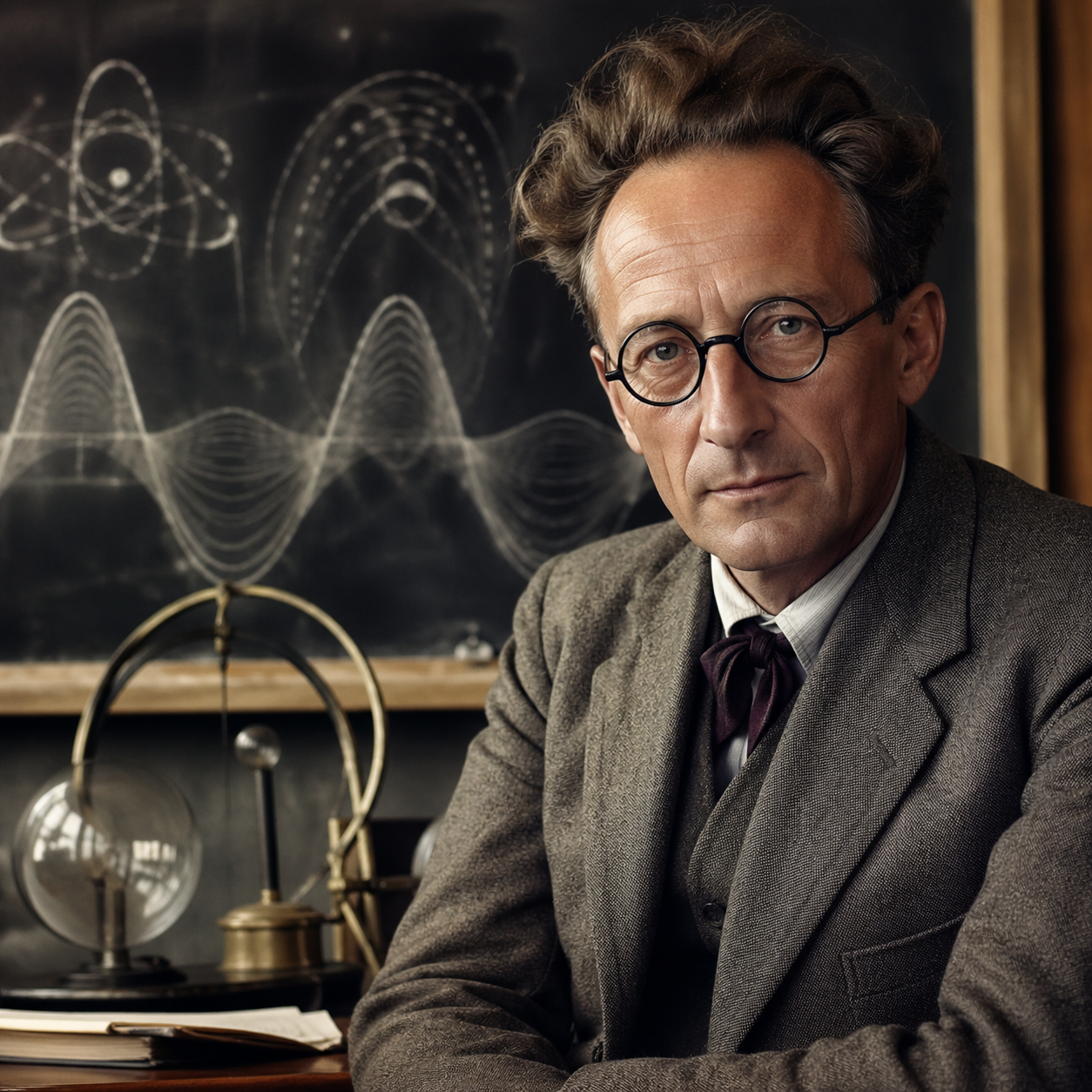
Erwin Schrodinger — "The world is full of wonders, and it is our task to explore them."
The world is full of wonders, and it is our task to explore them.
The world is full of wonders, and it is our task to explore them.
Click any product to generate a realistic preview. Up to 3 at a time.
* Initial load can take up to 90 seconds — revising the preview in another color is nearly instant.
"The human mind is a mirror, reflecting the universe."
"Consciousness is a singular of which the plural is unknown."
"The important thing is not to stop questioning."
"We are all connected. There is no real separation between us."
"The origin of life is still one of the greatest mysteries of science."
Austrian physicist who shared the 1933 Nobel for the wave equation that bears his name and the famous cat thought-experiment. Closely associated with Werner Heisenberg (matrix-mechanics rival who reached the same physics by different math) and Albert Einstein (his pen-pal on quantum interpretation). For an intellectual contrast, see Niels Bohr, Danish physicist and architect of the Copenhagen interpretation — Schrödinger's cat thought-experiment was specifically designed to ridicule Bohr's 'observer-dependent reality' reading of quantum mechanics — Schrödinger thought the Copenhagen interpretation was absurd; the cat was meant as reductio ad absurdum.
Found in 1 providers: grok
1 source checked
Reality overflows with mysteries waiting to be understood, and human beings carry an active responsibility to investigate rather than passively accept. Wonder is not merely aesthetic appreciation but a call to action — to probe, question, and seek understanding of how things actually work beneath surface appearances.
Schrödinger spent his career dismantling comfortable assumptions about physical reality. His wave equation revealed particles as probabilistic waves, not definite objects. His famous cat paradox was itself an act of exploration — using absurdity to expose quantum measurement's unresolved strangeness. He wrote 'What is Life?' crossing into biology, embodying cross-disciplinary intellectual restlessness.
Schrödinger worked through quantum mechanics' revolutionary 1920s–1930s emergence, when physics shattered classical certainties. Einstein's relativity had already upended space and time. Heisenberg's uncertainty principle challenged determinism itself. Scientists were confronting a universe fundamentally stranger than Newton imagined, making the imperative to keep exploring — rather than retreat to dogma — urgently relevant.
AI-generated insights based on extensive research and information for context. Factual errors? Email [email protected].
Your cart is empty