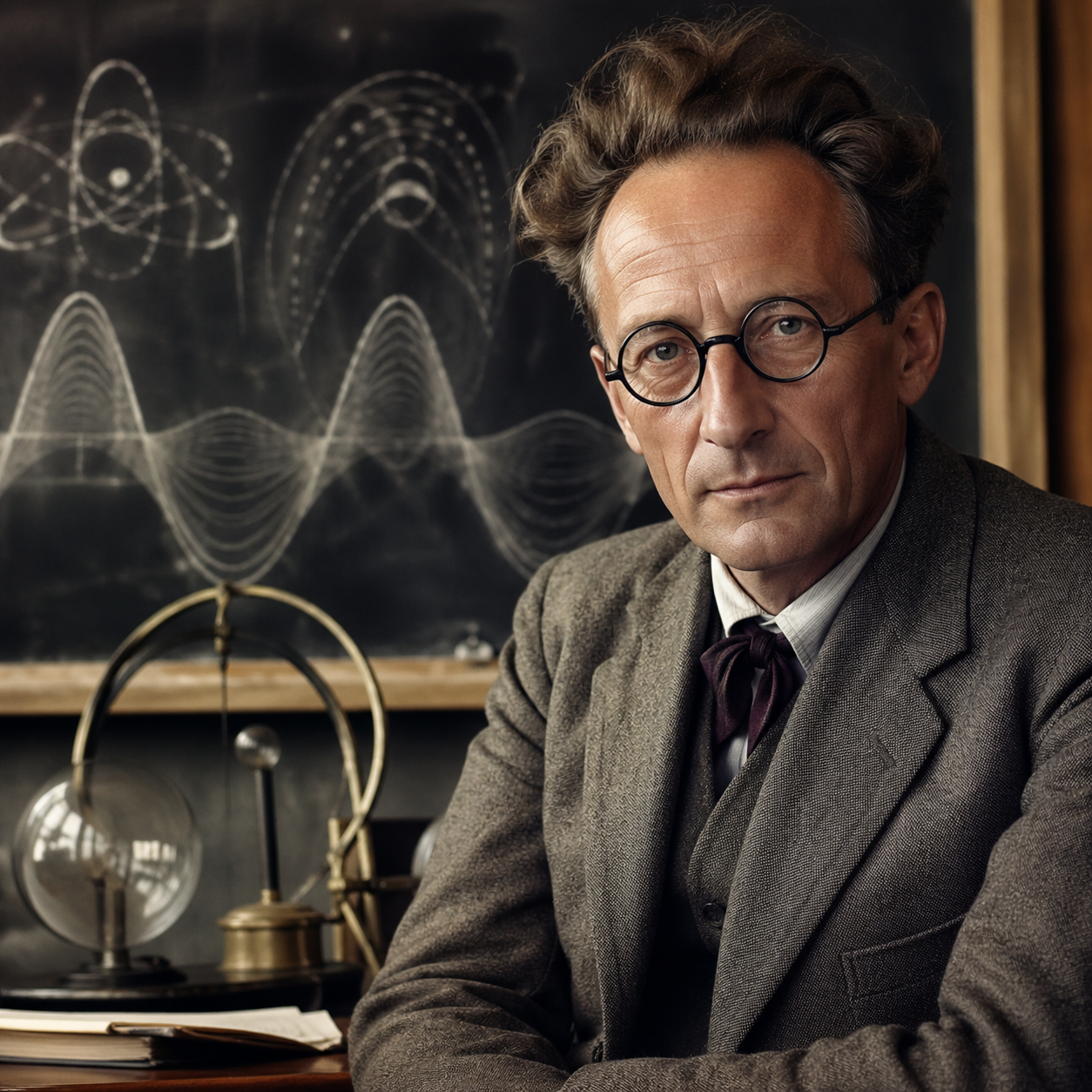
Erwin Schrodinger — "The great task of science is to unify all knowledge."
The great task of science is to unify all knowledge.
The great task of science is to unify all knowledge.
Click any product to generate a realistic preview. Up to 3 at a time.
* Initial load can take up to 90 seconds — revising the preview in another color is nearly instant.
"The human organism is a highly ordered and organized system, which maintains its order by continually drawing order from its environment."
"This life of yours which you are living is not merely a piece of the entire existence, but is in a certain sense the whole; only this whole is not so constituted that it can be surveyed in a single gl…"
"The true meaning and purpose of human life lies in our striving for understanding and knowledge."
"We are all connected. There is no real separation between us."
"I don't like it, and I'm sorry I ever had anything to do with it."
Austrian physicist who shared the 1933 Nobel for the wave equation that bears his name and the famous cat thought-experiment. Closely associated with Werner Heisenberg (matrix-mechanics rival who reached the same physics by different math) and Albert Einstein (his pen-pal on quantum interpretation). For an intellectual contrast, see Niels Bohr, Danish physicist and architect of the Copenhagen interpretation — Schrödinger's cat thought-experiment was specifically designed to ridicule Bohr's 'observer-dependent reality' reading of quantum mechanics — Schrödinger thought the Copenhagen interpretation was absurd; the cat was meant as reductio ad absurdum.
Found in 1 providers: grok
1 source checked
Science's highest purpose is not merely to collect isolated facts but to weave them into a single coherent framework. All disciplines — physics, biology, chemistry, philosophy — ultimately describe one reality, and the deepest scientific achievement is finding the underlying principles that connect them all into unified understanding.
Schrödinger embodied this drive personally: his 1944 book 'What is Life?' applied quantum physics to biology, pioneering molecular genetics decades before DNA's structure was known. He studied Eastern philosophy alongside physics, seeking unity between mind and matter. His wave equation itself unified particle and wave descriptions of matter.
Schrödinger worked through the early-to-mid 20th century, when quantum mechanics, relativity, and nuclear physics were fragmenting science into incomprehensible specialties. Einstein's unified field theory quest dominated physics culture. Post-WWII, scientists confronted the moral consequences of fragmented knowledge applied to weapons, making the call for unified, humanistic science urgent.
AI-generated insights based on extensive research and information for context. Factual errors? Email [email protected].
Your cart is empty