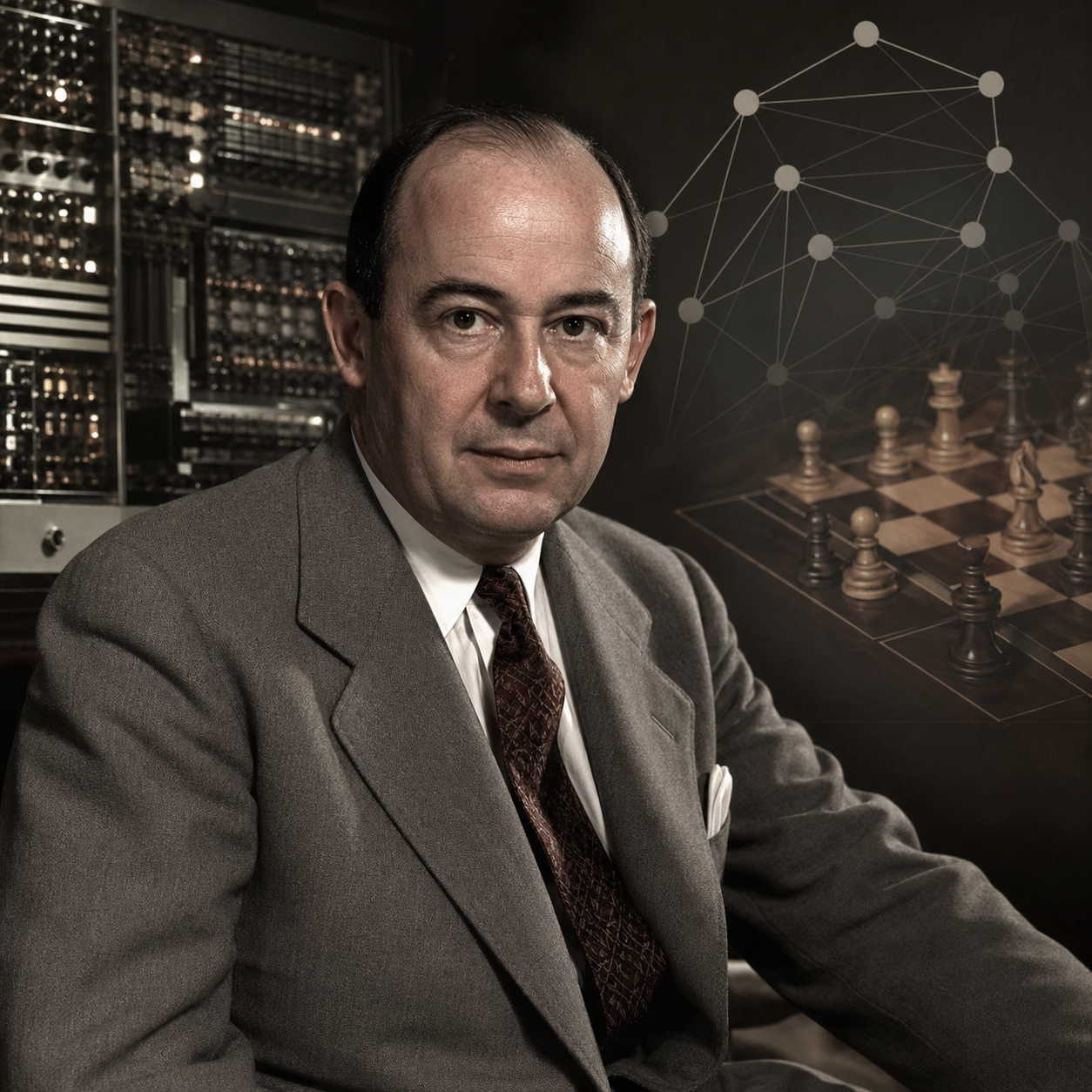
John von Neumann — "The world is governed by statistics, not by laws."
The world is governed by statistics, not by laws.
The world is governed by statistics, not by laws.
Click any product to generate a realistic preview. Up to 3 at a time.
* Initial load can take up to 90 seconds — revising the preview in another color is nearly instant.
"Young man, in mathematics you don't understand things. You just get used to them."
"Technological possibilities are irresistible to man. If man can go to the moon, he will. If he can control the climate, he will."
"The world is not a game, but it has rules."
"My own feeling is that the most important advances in the future will come from the interaction of mathematics with other sciences."
"The game of life is a game of perfect information."
A probabilistic view of reality, reflecting his work on uncertainty.
Date: 1940s-1950s
GeneralFound in 1 providers: grok
1 source checked
Reality doesn't run on absolute rules that hold everywhere, every time. It runs on probabilities — statistical patterns that describe what tends to happen across many cases, not guarantees about any single one. Complex systems, from economics to physics to human behavior, don't yield to rigid laws; they reveal themselves through distributions and frequencies. To truly understand the world, you need statistical thinking, not the false comfort of deterministic certainty.
Von Neumann spent his career proving this. He mathematically formalized quantum mechanics — a theory built on irreducible probability — and showed determinism fails at nature's foundation. He invented game theory, where optimal strategies are often probabilistic mixes, not fixed choices. He co-developed the Monte Carlo method, using randomness to solve otherwise intractable problems. Statistics wasn't a workaround for him; it was the deeper truth that all his work kept confirming.
Von Neumann's working decades (1930s–50s) saw Newtonian determinism crumble. Quantum mechanics proved nature itself is probabilistic — Heisenberg's uncertainty principle set hard limits on predictability. Meanwhile, World War II made statistics indispensable: operations research, radar optimization, nuclear weapon design, and population-level logistics all ran on probabilistic models. Einstein famously refused to accept it, insisting 'God does not play dice.' Von Neumann, who had mathematically sealed quantum theory's probabilistic foundation, disagreed — and history sided with him.
AI-generated insights based on extensive research and information for context. Factual errors? Email [email protected].
Your cart is empty