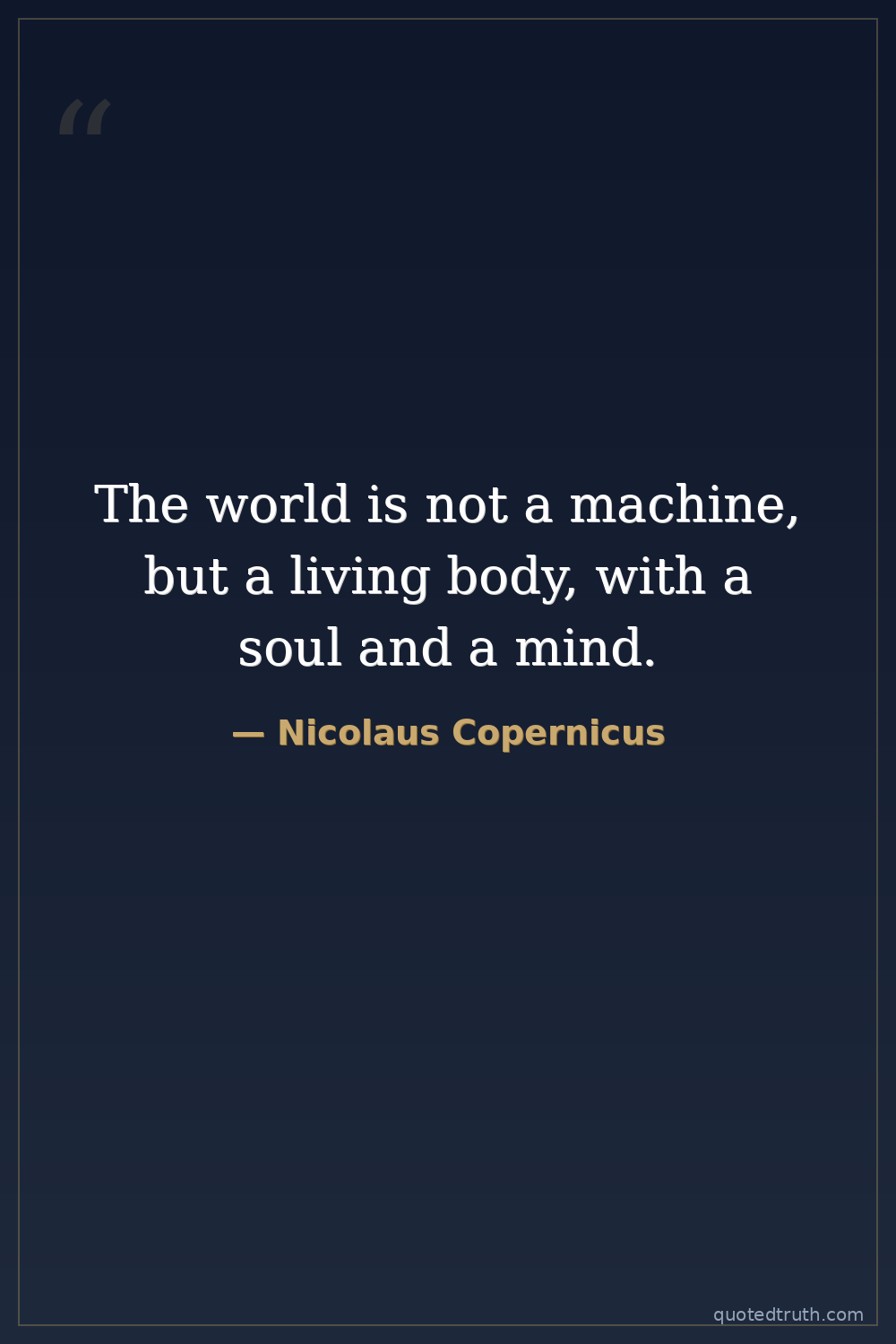
Nicolaus Copernicus — "The world is not a machine, but a living body, with a soul and a mind."
The world is not a machine, but a living body, with a soul and a mind.
The world is not a machine, but a living body, with a soul and a mind.
Click any product to generate a realistic preview. Up to 3 at a time.
* Initial load can take up to 90 seconds — revising the preview in another color is nearly instant.
"For the motion of the earth is not a simple motion, but a composite of many motions."
"For it is the duty of an astronomer to compose the history of the celestial motions from a careful and skillful study of the observations."
"For, when a ship is floating calmly on a smooth sea, and the mariners are thinking of nothing but the voyage, if a sudden storm should strike it, and the ship should be driven by the wind, it is not t…"
"The earth has a spherical shape, for it is bounded on all sides by the circumference of a circle."
"Thus, the sun, although it is the center of the world, is not the center of the universe."
This is a philosophical idea, but not a direct quote from 'De Revolutionibus'. His work was about the mechanics of the cosmos.
Date: Unknown
ReligiousFound in 1 providers: grok
1 source checked
The universe isn't a cold, mechanical system of gears and forces — it's an organic whole, alive with purpose and intelligence. This rejects a purely physical, reductionist view of reality and insists the cosmos has inner life: a soul that animates it and a mind that directs it. It's a call to see the world not as something to be disassembled and explained, but as something to be understood and respected as a living presence.
Copernicus placed the Sun at the center of the cosmos not just mathematically but almost spiritually, calling it the 'lamp,' 'mind,' and 'ruler' of the universe in De Revolutionibus. Trained in medicine and Neoplatonic philosophy, he inhabited a world where animate nature and divine order were inseparable. His heliocentrism wasn't cold mechanism — it was an act of reverence for cosmic harmony, rooted in the Renaissance belief that the universe is a living, ensouled whole.
In early 16th-century Europe, the mechanical worldview hadn't yet arrived — Descartes and Newton were over a century away. Renaissance thinkers revived Plato's concept of the anima mundi, the world-soul, through figures like Marsilio Ficino. Nature was seen as alive and divinely ordered. Copernicus published his heliocentric theory in 1543 within this vitalist intellectual climate, where astronomy, theology, and natural philosophy were deeply intertwined and the cosmos was regarded as sacred and animate.
AI-generated insights based on extensive research and information for context. Factual errors? Email [email protected].
Your cart is empty