Werner Heisenberg — "The path to the nucleus is easy to find, but the nucleus itself is hard to reach…"
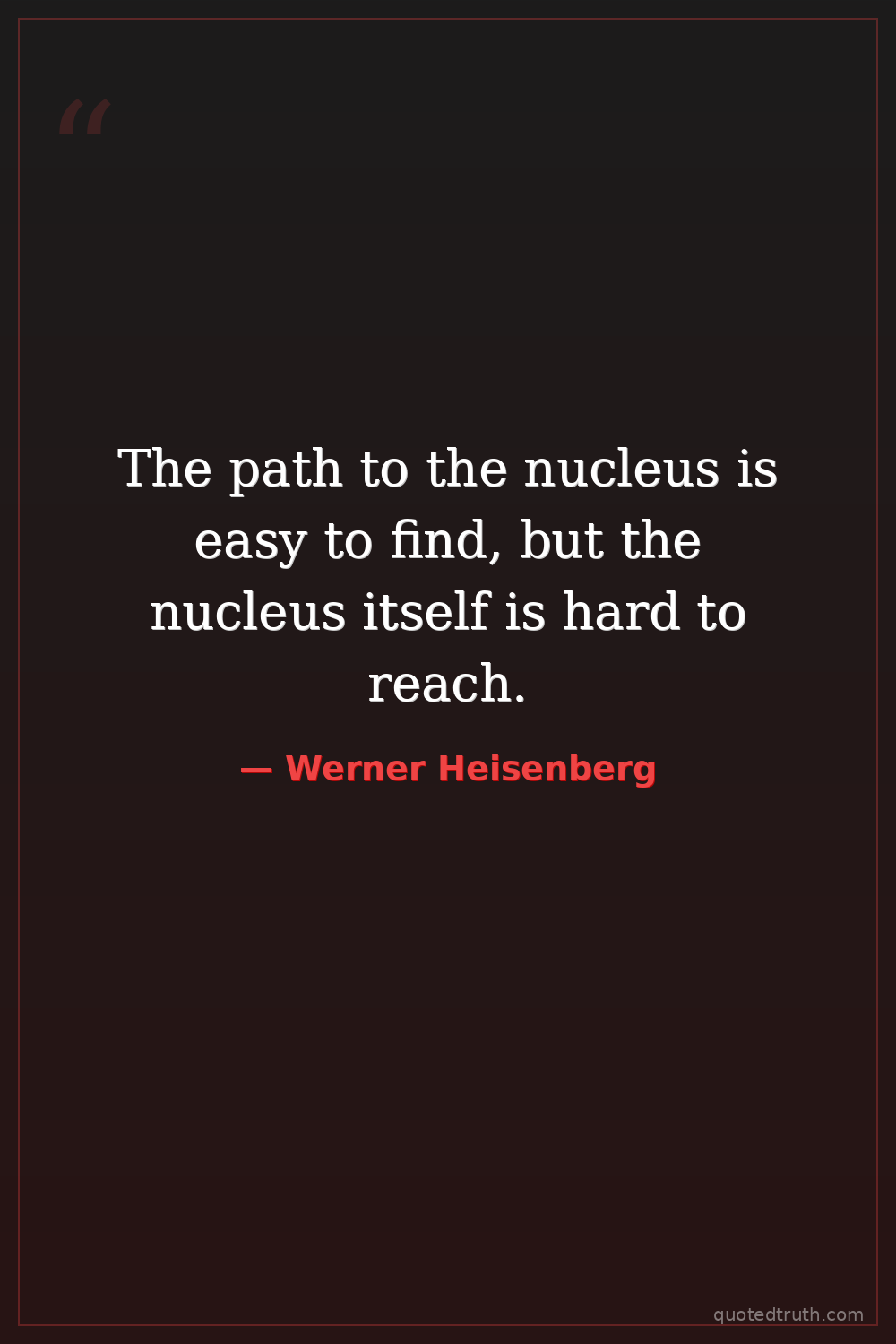
The path to the nucleus is easy to find, but the nucleus itself is hard to reach.
The path to the nucleus is easy to find, but the nucleus itself is hard to reach.
Click any product to generate a realistic preview. Up to 3 at a time.
* Initial load can take up to 90 seconds — revising the preview in another color is nearly instant.
"Only a few know, how much one must know to know how little one knows."
"Every word or concept, clear as it may seem to be, has only a limited range of applicability."
"The decision to break with the tradition of classical physics was a very difficult one."
"An expert is someone who knows some of the worst mistakes that can be made in his subject and how to avoid them."
"Science is rooted in conversations."
Found in 1 providers: deepseek
1 source checked
Getting close to a goal often proves simpler than actually achieving it. You can see the target clearly, understand the direction, and make rapid progress toward it, yet the final step—true mastery, deep understanding, or complete resolution—resists easy capture. The closer you get to something fundamental, the more it seems to slip away, demanding far more effort, precision, and insight than the initial approach ever suggested.
Heisenberg spent his career probing the atom's core and formulated the uncertainty principle, which states that the more precisely you pin down a particle's position, the less you can know its momentum. He literally lived this quote: physicists could approach the nucleus experimentally, but its quantum behavior fundamentally resisted complete measurement. His work revealed that nature itself places limits on how fully we can grasp its smallest components.
Heisenberg worked during the 1920s-1970s, when physics was shattering classical certainty. Rutherford had discovered the nucleus in 1911, and scientists raced to understand atomic structure amid revolutionary discoveries in quantum theory. World War II weaponized this knowledge through the Manhattan Project, while Heisenberg led Germany's contested nuclear program. The era combined breathtaking theoretical progress with the sobering realization that deeper reality was probabilistic, observer-dependent, and permanently beyond complete human description.
AI-generated insights based on extensive research and information for context. Factual errors? Email [email protected].
Your cart is empty