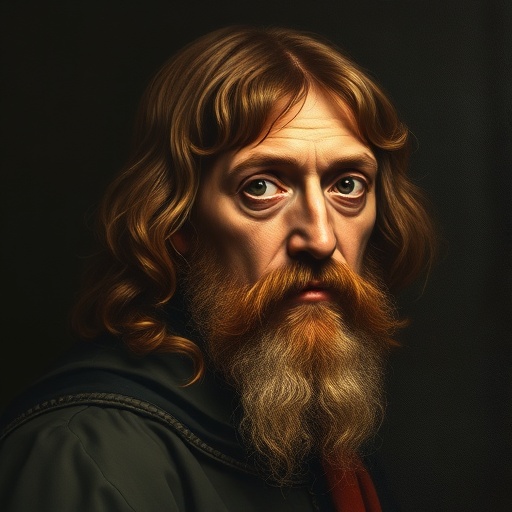
Nicolaus Copernicus — "There are three kinds of motion of the earth, as I shall demonstrate below."
There are three kinds of motion of the earth, as I shall demonstrate below.
There are three kinds of motion of the earth, as I shall demonstrate below.
Click any product to generate a realistic preview. Up to 3 at a time.
* Initial load can take up to 90 seconds — revising the preview in another color is nearly instant.
"For it is the duty of an astronomer to compose the history of the celestial motions through careful and expert study."
"For the mind, which is created in the image of God, is capable of understanding the divine order of the universe."
"For it is manifest that the movements of the planets are not uniform, but sometimes faster, sometimes slower, sometimes direct, sometimes retrograde."
"The earth has a spherical shape, for it is bounded on all sides by the circumference of a circle."
"It is the duty of a good astronomer to seek for truth in all things, and to follow it wherever it may lead."
Found in 1 providers: grok
1 source checked
Earth undergoes three distinct movements: its yearly orbit around the Sun, its daily spin on its axis, and a slow wobble called axial precession. Copernicus states this as a provable claim, promising rigorous mathematical demonstration. The phrase 'as I shall demonstrate' signals scientific confidence — not faith or philosophy, but evidence-based argument. This frames Earth as a moving, dynamic body rather than the fixed, immovable center ancient Greek-derived cosmology assumed.
Copernicus spent over 30 years developing his heliocentric model while working as a Catholic Church canon, doing astronomy on the side. His meticulous nature — reflected in 'as I shall demonstrate' — shaped his life's work, De Revolutionibus Orbium Coelestium (1543). He delayed publication until he was dying, fearing ridicule. The three motions of Earth were the mathematical heart of his system, replacing Ptolemy's stationary Earth with a precise, calculable model.
In the early 16th century, Ptolemy's geocentric model — Earth fixed at the universe's center — had dominated European thought for 1,400 years, backed by Church authority. Copernicus wrote during the Renaissance, when ancient texts were being critically reexamined. The Reformation was fracturing Church power. His claim that Earth moves in three ways challenged the cosmological underpinning of medieval Christianity, making the careful phrasing 'I shall demonstrate' essential — proof, not heresy.
AI-generated insights based on extensive research and information for context. Factual errors? Email [email protected].
Your cart is empty