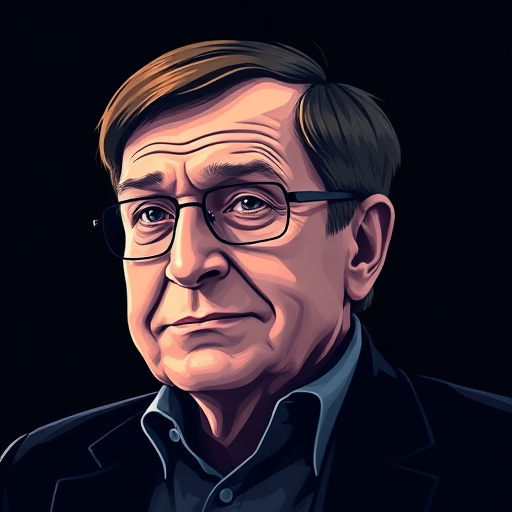
Stephen Hawking — "There is no God. No one created the universe and no one directs our destiny."
There is no God. No one created the universe and no one directs our destiny.
There is no God. No one created the universe and no one directs our destiny.
Click any product to generate a realistic preview. Up to 3 at a time.
* Initial load can take up to 90 seconds — revising the preview in another color is nearly instant.
"I would like to know the mind of God, but I'm not sure God has a mind. He may just be a set of laws."
"My goal is simple. It is a complete understanding of the universe, why it is as it is and why it exists at all."
"I have always been fascinated by the big questions: Where did we come from? How did the universe begin? What is the nature of reality?"
"We are all connected to the universe, and the universe is connected to us."
"We are in danger of destroying ourselves by our greed and stupidity. We cannot remain looking inwards at ourselves on a small and increasingly polluted and overcrowded planet."
British theoretical physicist whose Hawking radiation work and A Brief History of Time (1988) brought black-hole physics to a mass audience while he lived with ALS for 55 years. Closely associated with Roger Penrose (his collaborator on singularity theorems) and Carl Sagan (fellow popularizer who wrote Brief History's foreword). For an intellectual contrast, see William Lane Craig, American philosopher of religion — Craig's Kalam cosmological argument depends on the Big Bang requiring a divine first cause; Hawking's no-boundary proposal was specifically designed to remove the moment that would require one — the cleanest cosmology-vs-natural-theology contrast in modern thought.
Found in 1 providers: grok
1 source checked
The universe arose from natural physical laws, not divine creation, and no supernatural force guides human fate. It's a blunt declaration of scientific naturalism: physics alone explains existence. Meaning and destiny emerge from the laws of nature, not from any god's plan. Humanity is on its own — shaped by cause and effect, not by divine will — which is both humbling and, to Hawking, liberating.
Hawking spent his career mathematically probing the universe's origins — black hole radiation, the Big Bang's boundary conditions, imaginary time. His 2010 book 'The Grand Design' argued gravity alone makes spontaneous creation inevitable, eliminating any need for a creator. Living with ALS for over 50 years, he found purpose in scientific truth rather than faith, embodying the conviction that reason, not religion, is humanity's most honest response to existence.
Hawking spoke into a charged cultural moment shaped by Richard Dawkins' 'The God Delusion' (2006) and the New Atheism wave. Cosmological breakthroughs — WMAP satellite mapping the early universe, then the Higgs boson confirmation in 2012 — gave naturalism unprecedented empirical grounding. Simultaneously, creationism battles in U.S. schools, faith-based policy debates, and post-9/11 religious tensions made his stark declaration scientifically resonant and culturally provocative.
AI-generated insights based on extensive research and information for context. Factual errors? Email [email protected].
Your cart is empty