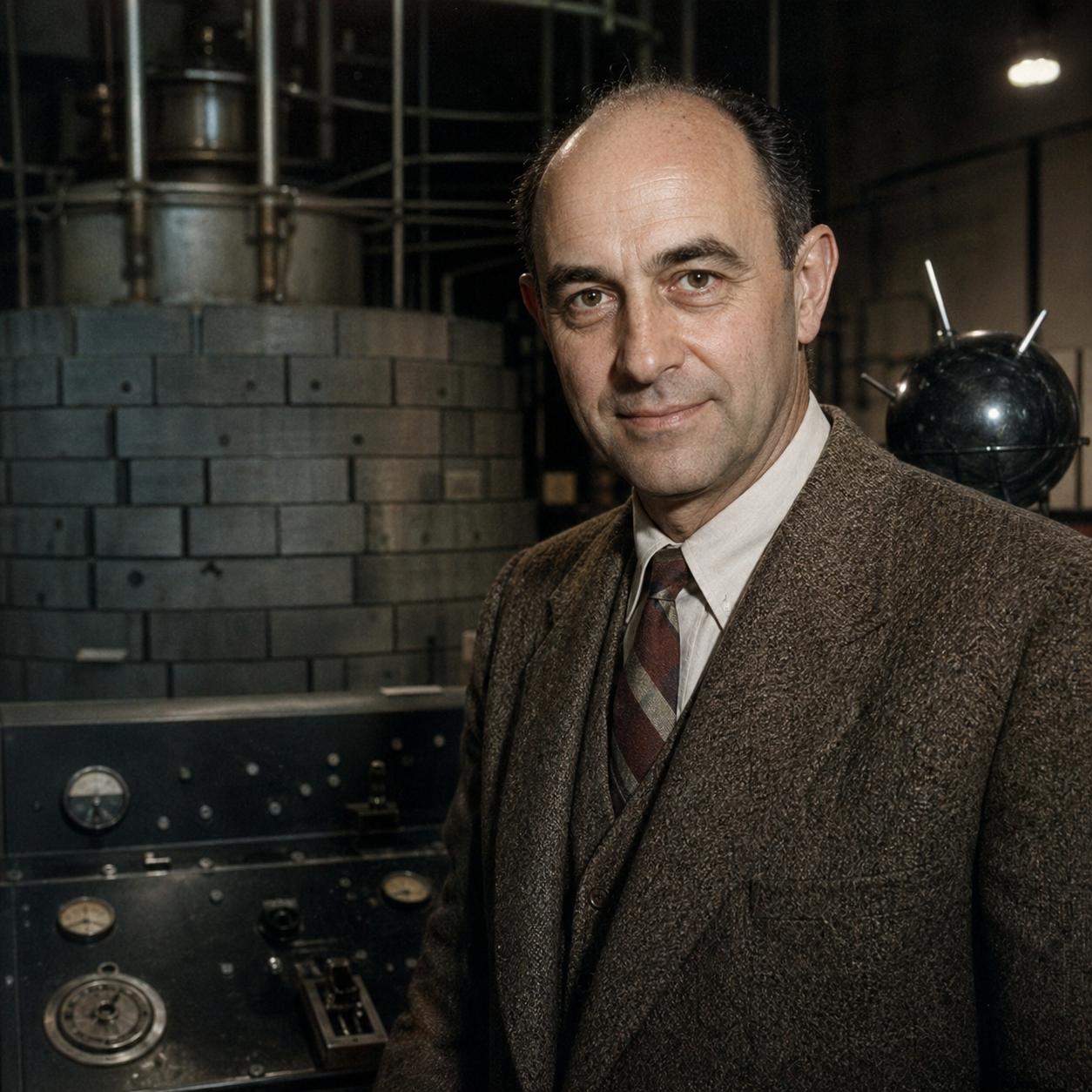
Enrico Fermi — "There is no such thing as a trivial experiment."
There is no such thing as a trivial experiment.
There is no such thing as a trivial experiment.
Click any product to generate a realistic preview. Up to 3 at a time.
* Initial load can take up to 90 seconds — revising the preview in another color is nearly instant.
"I have been very lucky in my life, because I have always been able to do what I love."
"Where is everybody? Humans could theoretically colonize the galaxy in a million years or so, and if they could, astronauts from older civilizations could do the same. So why haven't They come to Earth…"
"It was a beautiful phenomenon, a terrifying spectacle, and a profound experience."
"It is not enough to know how to build a bomb. One must also know how to control it."
"The mind is not a vessel to be filled, but a fire to be kindled."
Found in 1 providers: grok
1 source checked
Every experiment, no matter how small or routine, carries real value. Even seemingly insignificant tests can reveal hidden assumptions, expose measurement errors, or accidentally uncover phenomena that reshape entire fields. Dismissing an experiment as trivial means risking the loss of information you didn't know you needed. Scientific progress depends on treating every data point as potentially crucial rather than assuming outcomes before the results arrive.
Fermi built the world's first artificial nuclear reactor, Chicago Pile-1, through exhaustive step-by-step experimental verification rather than relying on theory alone. His famous Fermi estimates—precise answers extracted from rough calculations—showed he found value where others saw mere approximation. His neutron bombardment work, considered routine by contemporaries, helped unlock nuclear fission. Fermi personally verified every measurement throughout his career, treating each small test as a necessary brick in larger understanding.
Fermi worked during the 1930s–1950s, when nuclear physics was transforming from theoretical curiosity to civilization-altering force. The Manhattan Project operated under wartime urgency where a single experimental miscalculation could doom the program or cause catastrophe. Meanwhile, quantum mechanics tempted physicists to trust elegant theory over messy empirical work. In this climate, insisting no experiment was trivial was both scientific discipline and a practical safeguard against errors with potentially catastrophic consequences.
AI-generated insights based on extensive research and information for context. Factual errors? Email [email protected].
Your cart is empty