Rachel Carson — "There is something infinitely healing in the repeated refrains of nature—the ass…"
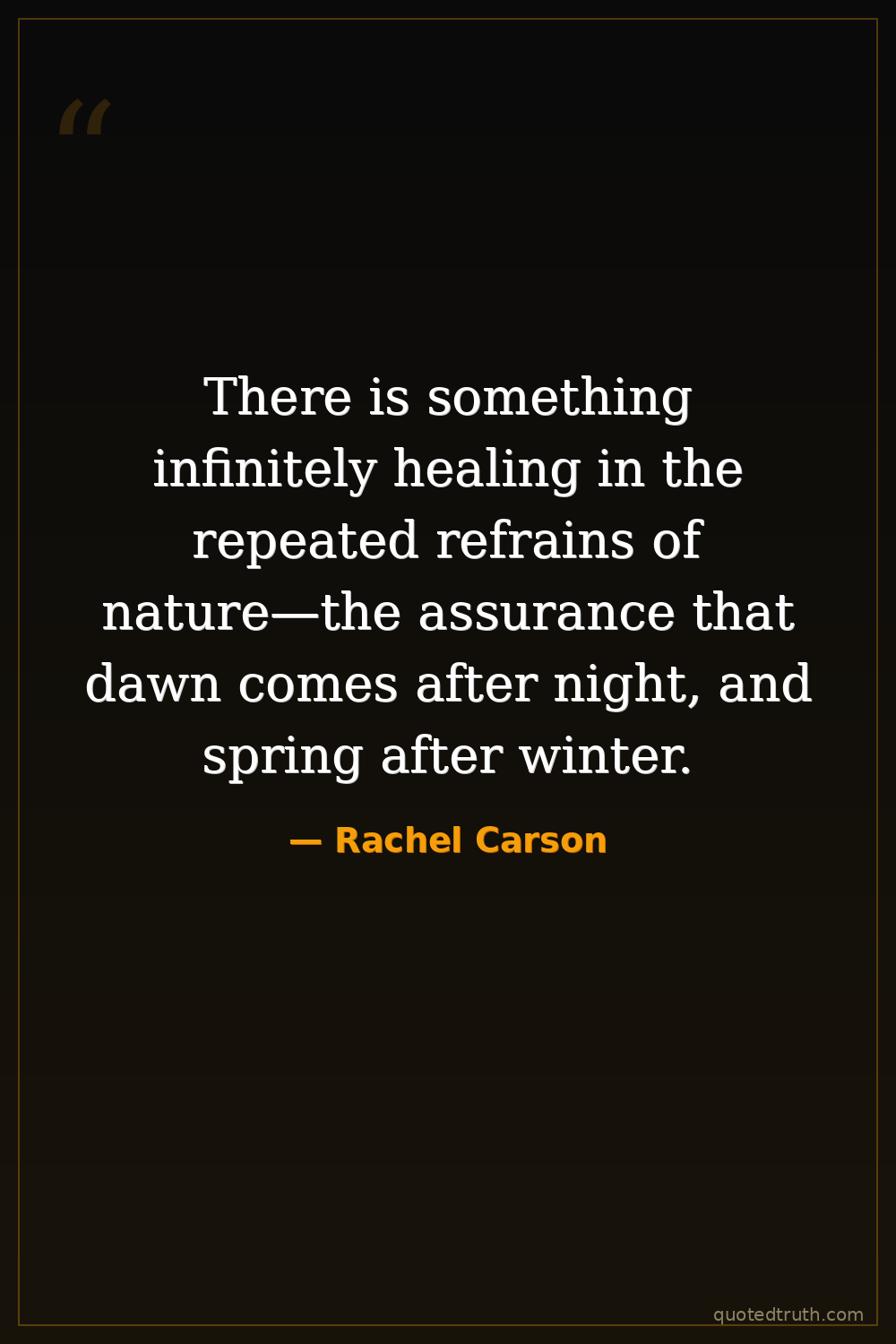
There is something infinitely healing in the repeated refrains of nature—the assurance that dawn comes after night, and spring after winter.
There is something infinitely healing in the repeated refrains of nature—the assurance that dawn comes after night, and spring after winter.
Click any product to generate a realistic preview. Up to 3 at a time.
* Initial load can take up to 90 seconds — revising the preview in another color is nearly instant.
"The most alarming aspect of the story is that the effects of these poisons are cumulative and largely irreversible."
"It is a silent spring that I fear, a spring without birdsong."
"The balance of nature is not a static thing; it is a dynamic, complex, and constantly changing relation among living things and their nonliving environment."
"The most alarming of all man's assaults upon the environment is the contamination of air, earth, rivers, and sea with dangerous and even lethal materials."
"I am not a scientist in a white coat. I am a writer who happens to write about science."
Found in 1 providers: grok
1 source checked
Nature's cycles — night giving way to dawn, winter yielding to spring — carry a steady, dependable comfort. The quote argues that these recurring rhythms hold restorative power: they remind us hardship is temporary and renewal is inevitable. There is psychological healing in nature's consistency, a reassurance built not from words but from the observable, repeating patterns of the living world that persist regardless of human trouble.
Carson spent decades studying coastal ecosystems, finding in them both scientific truth and personal solace. She wrote The Sense of Wonder celebrating nature's restorative qualities. Battling breast cancer while completing Silent Spring, she drew on this exact belief — that nature's cycles persist beyond individual suffering. Her lifelong conviction that humans needed reconnection with natural rhythms shaped her entire career as America's most influential environmental voice.
Carson wrote in the 1950s and early 1960s, when Cold War anxiety, nuclear testing fallout, and aggressive industrial pesticide use were dismantling Americans' sense of security. DDT and chemical companies were poisoning landscapes while postwar suburban expansion severed people from natural environments. Her work arrived as audiences desperately needed reassurance that nature's ancient rhythms still existed beneath the industrial damage — and that protecting them was urgent.
AI-generated insights based on extensive research and information for context. Factual errors? Email [email protected].
Your cart is empty